Burmese history during the Mediaeval Period: Bagan

By Beau Sansoni

All images credited to the author.


Burmese history is long and storied, but is generally quite overshadowed by its modern politics. The people of these lands find themselves in one of the world’s most oppressive dictatorships, or under one of the many rebel militaries, with each fighting one another for dominance of either their region or the whole country. The war, however, should not discourage learning and intrigue into the past of Burma. Prior to the modern wars , military juntas, and British colonisation, there were a myriad of kingdoms and peoples that inhabited these valleys. This article will be a history of the Burmese Kingdom of Bagan from my own knowledge, and using photographs I took during my recent trip to the country. Should you wish to know more about broader Burmese history, I highly recommend Thant Myint-U’s books on the subject, particularly The River of Lost Footsteps. Another option is the Youtube channel Fall of Civilizations, and their episode on Bagan, which is more digestible at 2 hours in length.
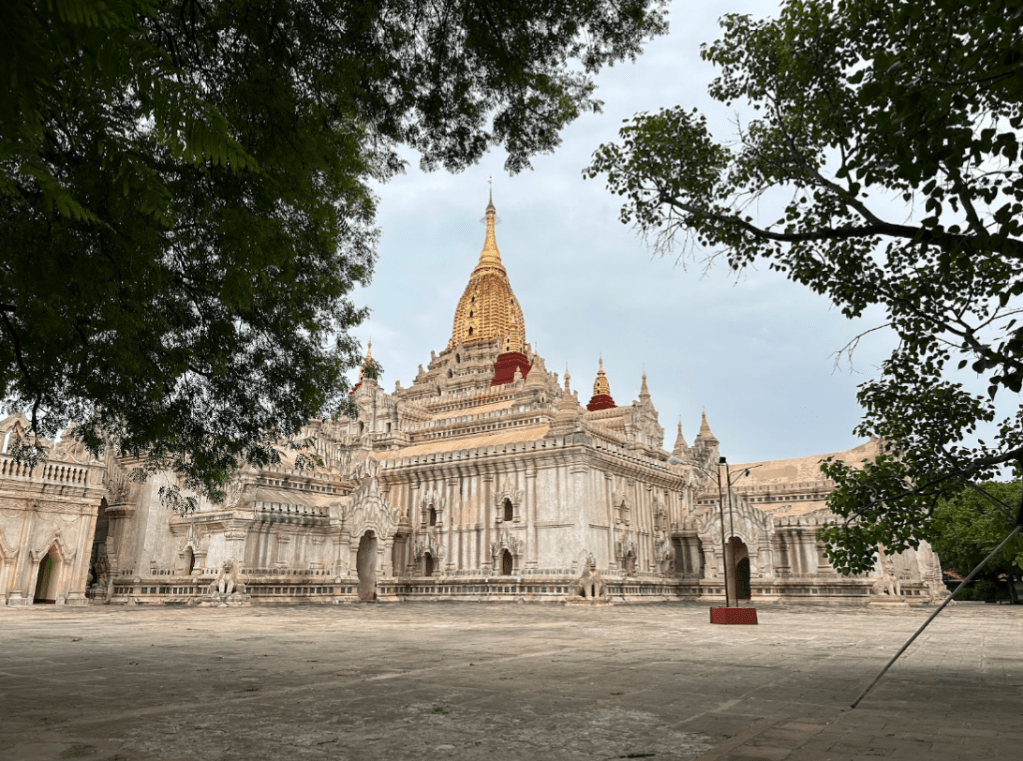
↑ Above: The Ananda Temple, photographed from the South-East.

To begin, the Irrawaddy river valley, the core of Burmese society as we perceive it today, was initially inhabited by a range of culturally similar, brick walled city states. Taking root during the period of Late Antiquity, they were dominated by the Pyu peoples, who adapted their Sino-Tibetan language to a Brahmic script, and adopted various forms of Buddhism and Hinduism. 

However, at the beginning of the Western Mediaeval period, the Pyu City States had found themselves in decline.  War with the Kingdom of Nanzhao brought alongside them the first Burmese, who migrated into the Irrawaddy river valley. Here, a short ways downstream from the confluence of the Chindwin and upper Irrawaddy, perhaps on the ruins of an old Pyu city, they founded the city of Bagan. 

The city would, for a time, be among the many Pyu cities of the region, with its focus on Buddhist architecture in a style reminiscent of the Pyu (For examples, see: Bupaya, and Ngakywenadaung Pagoda). As Bagan began rapidly expanding, and enveloping its neighbouring states, the styles in architecture, along with the society of Bagan as a whole, would change dramatically in the 11th century. The most important of these annexations was the semi-legendary war with the Mon Kingdom of Thaton, a kingdom to the south which relied heavily on trade. Burmese legends attesting to the conquest of Thaton are of various sources, many of which are more modern, such as the Glass Palace Chronicles of the 18th century. The traditional story goes that King Anawrahta of Bagan demanded that Thaton hand over their Buddhist texts in order for King Anawrahta to convert Bagan from Ari Buddhism, to Theravada Buddhism. Thaton refused, and Anawrahta mustered an army and conquered the southern emporium. What remains certain is that Bagan expanded far into the south, with Bagan-style inscriptions found farther south than Thaton.

Starting with King Anawrahta, the royal lineage would spawn a series of Temple Building kings, which would span from the 11th to 13th centuries. Anawrahta’s successor; Kyansittha, would build the first, and most popular of the great temples of Bagan: the Ananda Temple (See top image above). This temple would continue its position as one of the most revered temples in Burma, and would receive continual upkeep by future Burmese dynasties. Its style, along with the Burmese court of the era, was inspired by Mon styles which were imported along with the artisans who initially created it. It was only until King Alaungsithu, Kyansittha’s grandson, that a Burmese style would emerge, and its language supersede Pyu and Mon in usage. 

As history unfolded, the empire continued its growth, attracting more merchants and workers to continue in the construction of further temples. The average resident, in their effort at piety, would commission workers and artisans, who would build a temple (or multiple) of brick and cover it with a layer of render, possibly with objects of religious significance, like votive tablets. They would also purchase slaves for the upkeep of the property, ensuring that they would have their religious efforts remain even as they departed for the next life. It would be these numerous temples, numbering into their thousands, if not tens of thousands at the empire’s height, which would be its slow demise. Many have analysed that the land usage of the core around Bagan left little for farmlands, housing, or workplaces, instead replaced by lands which produced no tangible value (in their lifetime, prior to death, at least) and were not taxable as it was managed by the Buddhist clergy. This lack of taxable lands meant that the royal administration found it difficult to raise money, and led to the empire slowly impoverishing itself. The temples which originally led to the growth of the empire through attracting artisans and traders, were also slowly killing it.
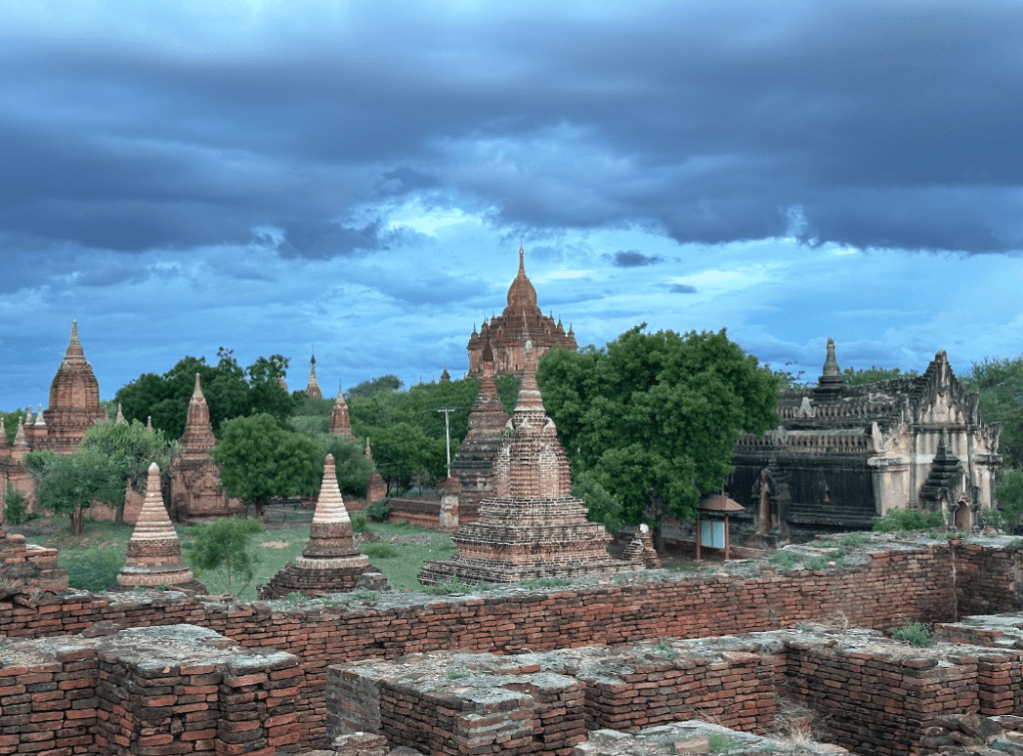
↑ Above: The Htilominlo Temple, the Upali Thein and various stupa; both ancient and modern. Photographed from the North-West of the Htilominlo Temple.

This effect came to effect firstly under King Htilominlo, in the early 13th century, who would be the last of the great temple builder kings. His work, the Htilominlo Temple (pictured  above), would continue its legacy for many years to come, as it has legendary significance as it was raised to commemorate where Htilominlo would be chosen to succeed his father. The way he was chosen (via a tilting umbrella, which would point to the successor) would reflect to the temple its name, which can be interpreted as ‘the umbrella (hti) chooses the king (min)’. It would also be the site that General Min Aung Hlaing would raise a new Hti (the decorative top on many Burmese temples) prior to the coup he led in 2021, a potential gesture of piety in his efforts to become the ruler of the country. 

The empire of Bagan would receive the final nail to its coffin in the 1270s-80s, being invaded by the Mongols under the Yuan dynasty. As attested by Marco Polo, the Mongols would rout the Burmese military, led by the King Narathihapate and reinforced by elephants. The Great Khan would annex the entirety of Burmese territory (although in effect only controlled the north), and would establish the son of the King of Bagan to act as a puppet ruler within Bagan. Atypically, Marco Polo attests that the Great Khan did not sack the city of Bagan (called by Polo as “Mien”) due to the sheer number of temples which were raised for kings of old, as the Mongols found it a sin to (the) “removal of any article appertaining to the dead”. A state under the previous senior generals of Bagan’s army would eventually remove the Mongols from Burma, but by then the damage had been done, and Bagan would not rise as the capital of a new Burmese kingdom. Instead the lineage of the Kings of Bagan and the generals would go on to found multiple small states in the wake of the fallen empire, reentering the south-east Asian political theatre with their newly independent neighbours, from the borderlands to the core.

80 Years On: Reflections on the Liberation of Le Havre

by Fyodor Dmitrenko

All photos credited to the author.

On the 12th of September, I attended a ceremony at the Place du Monument aux Morts, the largest of a series of celebrations, film screenings and exhibitions hosted by the local administration over the course of the previous weeks to commemorate the 80-year anniversary of Le Havre’s liberation from the Nazi occupation. It was not really what I expected. Certainly there was the usual fanfare with marching bands on rue de Paris, speeches by Le Havre’s mayor Edouard Philippe and President Macron, and little French flags waving in the wind – however the usual jubilations felt strangely subdued. 

But this is not surprising upon consideration of the city’s history . 

The city of Le Havre did not fare well at all in WWII. After France’s shameful surrender in May 1940, the city was forced under the Nazi jackboot and turned into a festung – a fortress city  – due to its strategic importance as the largest port on the Channel coast. 

This led to the construction of numerous blockhouses, casemates, and other fortifications to combat potential allied landings including the Dollemard battery at Sainte-Adresse, and the incorporation of a German garrison that at its greatest extent reached 21,000 soldiers. 

Life for civilians under the occupation was also transformed drastically with the introduction of rationing and virulently antisemitic policies. This transformation began with the removal of Jews from public office, including the town’s then mayor Léon Meyer, and culminated in the arrests of an estimated 900 Jews and deportation of 740 to their deaths. The Nazis also perpetrated violent reprisals against Le Havre’s civilian population in reaction to resistance activities. For example, after the assassination of 2 German sailors on Place d’Arsenal, 1 100 PCF (Parti Communiste Français) and CGT (Confédération Générale du Travail) members were rounded up and deported. 

Nor did the arrival of the Allies in June 1944 bring respite. The importance of the port made seizing it a top priority for allied commanders in order to supply the allied armies driving to Paris and beyond. 

According to historians Corinne Bouillot and John Barzman, while an attempt was made to compel the German garrison to surrender peacefully after the D-Day landings, garrison commander Hermann Eberhard Wildermuth rejected the offer citing the order given to him by Adolf Hitler to fight to the last man. As an alternative resolution, Wildermuth reportedly countered the Allies with an offer to evacuate the remaining civilians. The offer was not taken up, with Lieutenant-General John Crocker who led the assault arguing that it would take too long, thereby allowing the Germans time to prepare and execute a counterattack which would halt the allied offensive in its tracks. 

Under the purview of ‘Operation Astonia’ the city and its defences were bombarded from the sea by battleships HMS Erebus and HMS Warspite with more than 4,100 t of shells over the course of several days starting on September 5th to 12th with a further 10,000 tons of bombs being dropped on the city by the RAF. 

The bombardment was considered a success as it silenced German batteries and allowed the Allies to advance into the city relatively unimpeded due to the German garrison being too shell-shocked to fight back, however its gains came at a horrible cost. 

Of the city’s 41,000 buildings, 13,500 were completely destroyed, including key buildings like the Hotel de Ville and the Natural History Museum. Only charred, smoking husks remained. Around half of Le Havre’s population (approximately 80,000 people) was left homeless. Nor was the destruction limited to the residential quarters, with bombings targeting the submarine and torpedo boat pens in the port which gave Le Havre its name, destroying about 85% of its 1939 facilities. 

80 years on, the memories of victory are still tainted for many of the citizens of Le Havre. Many are able to celebrate the city’s momentous regaining of its freedom, however some will always wonder whether the price it had to pay was too high. 

L’opium, arme de guerre.

Par Pr. Sophie Rochefort-Guillouet

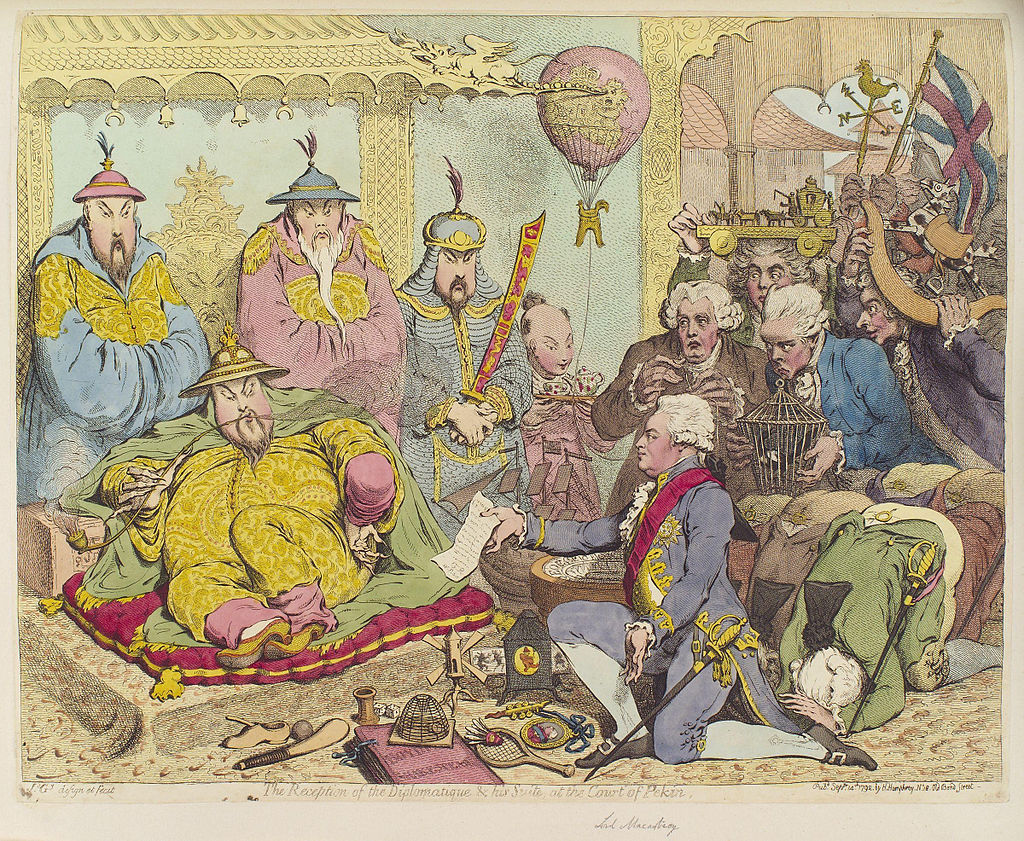
On connaît mieux les résultats militaires et diplomatiques des guerres de l’Opium, qui opposèrent la Chine à la Grande Bretagne, que les raisons profondes de leur déclenchement.


Continue reading “L’opium, arme de guerre.”

A Step Backwards

By Joaquín Gosálvez Castillo

Joaquín Gosálvez Castillo writes about the political climate in his country.

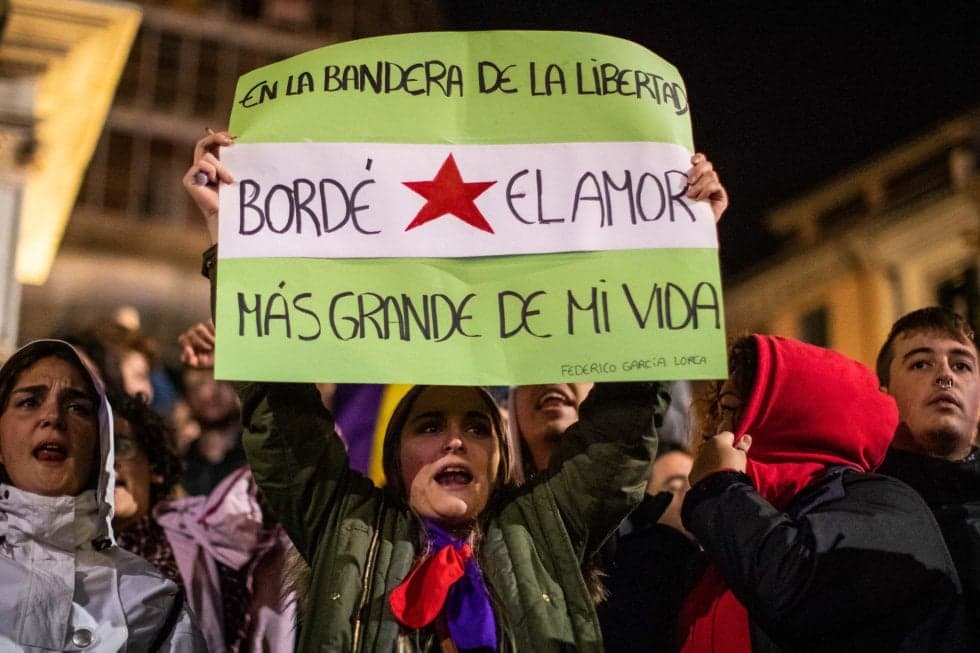
José Saramago, a Portuguese writer awarded in 1998 with the Nobel Prize of Literature, said: “We must recover, preserve and transmit historical memory, because when we start with oblivion, we end up with indifference”. I have been thinking about the way in which events in the political arena in my country, Spain, have been taking place in 2019 and that this political legislature may be the most polarized and angry in our recent democracy. Today, more than ever, we need to defend historical memory.

Sometimes we would like to believe that things are not as they are, to forget the harshness of an incredibly unbearable reality: we are taking steps backwards. I am writing now because I feel overcome by the harshness of this reality, because I see that we have wanted to take away the freedom to be brave and to be lucid, and therefore we want to be unable to move forward. I need to talk about the collapse of truth, the collapse of historical memory and, what is worse, the collapse of human rights that we are witnessing. It would be obvious and no less important to talk about how badly things work in the world, about the enormous inequalities that exist, about the abuses committed against women simply because they are women, about an immense poverty that we cannot or do not want to eradicate, about an enormous climate crisis that is no more than a secondary issue in our daily lives. However it is more useful to reflect by going back to the basics. That is why I will talk about how our societies have decided to turn their backs on the truth and what that entails, and in particular I will talk about a situation that I think I know well: the situation in Spain.

Between the two legislative elections held in Spain in 2019, the extreme right-wing party Vox progressed by 47% to win the vote of 15.1% of the electorate, that is, just over 3,600,000 voters. But what does Vox propose? To sum up, they want to dismantle the system of autonomies in Spain and return to a political centralism, expel immigrants en masse, repeal the Gender Violence Law, lower taxes for the richest classes, abolish the Historical Memory Law, greatly limit abortion, abolish the Climate Change Law…and more. How did we even get to this point?

In 1948 everything was clear ; humanity had gone through two bloody and atrocious World Wars, we had learned from our mistakes with pain and suffering, and hatred could not be a way to move our societies forward. In 1948, the Universal Declaration of Human Rights was written, and soon after, a large majority of countries ratified it. Humanity’s greatest historical milestone was achieved: to agree on a consensual and common basis of ethical and just values that we had an obligation to defend; it was the victory of a common human conscience freed from the burden of a history of violence and blood, from which lessons had been learned for the future.

Today, however, it seems that all that has been called into question in the minds of many people. What seemed to be evidence, today is no longer evident. What we had decided would be our common basis for building a decent and better world for all, is today called into question by more and more societies that vote with conviction for the extreme right.

It breaks my heart, when people vote for a party that wants to repeal a law that has allowed to protect women victims of gender violence in Spain and which has had a very positive effect on thousands and thousands of people. It breaks my heart when, in Andalusia, a party asks in an intimidating way for the names of the professionals who attend to the victims of gender violence. It breaks my heart, when people vote for a revisionist party that opposes the Historical Memory that, in Spain, must serve us to learn lessons from the past and to be able to avoid repeating the dark times of Franco’s repressive dictatorship and to help those families whose relatives, victims of repression, are today buried in ditches and have disappeared. It breaks my heart, when people vote for a party that shows no humanity by proposing to abandon Spain’s participation in the Convention on the Rights of the Child, the most consensual convention that has ever existed at an international level, with the aim of expelling unaccompanied immigrant minors from national territory. It breaks my heart, when people vote for a party that says that the biggest challenge of our era, climate change, does not exist and that it is a lie, and they mess with Greta Thunberg instead of tackling the real environmental problems.

But perhaps that is not the worst thing, because at the end of the day we are all free to vote for whomever we want and to think what we want. Yet, that freedom also demands a great deal of responsibility. The freedom to vote requires responsibility for the opinions, approaches and, above all, actions of the parties we vote for. Not exercising this responsibility means not being free in the practice of voting. If Vox is clearly a party that has approaches that are opposed to human rights, which can be verified objectively, how is it possible that there are people – and they are often people I know personally – who say that Vox is not opposed to human rights? If there are people who vote for Vox, they have to assume that this party has certain approaches that are opposed to human rights. You cannot vote for Vox and be a fervent defender of human rights at the same time if you want to be consistent. The problem that arises is therefore the following: either there are people who vote for Vox and lie, or there are people who vote for Vox who are blinded by excessive irrationality. The first case is reprehensible and unworthy for those of us who defend the truth, especially if we consider the philosopher William James’ theory of the usefulness and practical effectiveness of truth. The second case is worrying, because it teaches us that there are people who have not wanted to reason enough to arrive at an objective truth, and that these people are slaves of a blind faith that they profess towards the politicians of Vox. It is even more so when you demonstrate to Vox voters, and I suppose something similar will happen with many extreme right-wing voters in other countries, that the party they support has proposals that are incompatible with human rights – this is an objective truth – they are not capable of assuming it and with hesitation and resentment they say that this is not true but they are not able of demonstrating it rationally.

The problem we have with far-right parties is a problem of telling the truth. Of course, there are extreme right-wing voters who know very well what their parties are about, but I think there is a large majority who is persuaded by fallacies, lies and fake news, therefore believing such a party represents their ideals whereas actually not. And we are faced with a wall of inconsistency: we know that without the immigrant workers, the pensioners could not have had such high pensions in Spain during the Great Recession (according to data from the National Institute of Statistics, INE). Yet Vox says that we are facing an invasion and that immigrants cost Spaniards a lot. Then some of us are afraid and want to believe that Vox is right, even if we know that Vox has approaches that are contrary to Human Rights. However a high percentage of Vox voters may have have a high regard for Human Rights, then they say that Vox respects Human Rights because they could not bear emotionally that this was not the case. In the same vein, we know that climate change is real and a huge threat to life, since according to the European Environment Agency, in Europe alone, there are already 400000 deaths a year from pollution, but then Vox says that climate change does not exist and so its voters think that there are other issues that Vox defends that are more important than climate change. The problem of Vox and its voters is one of truth and consistency.

I appeal to anyone who reads this to consider who they are voting for and whether they really represent their ideals. To those who are Vox voters I say: if you vote for Vox, it is because you think there are other things more important than human rights; if you vote for Vox, you have to assume that there are things more important to you than climate change; if you vote for Vox, it is because there are things more important to you than saving lives, particularly the lives of migrants and refugees who die every year at sea trying to cross the Mediterranean. If you are prepared to face up to the reality of what Vox and the extreme right are, then you will be truly free to vote. But if, on the contrary, you defend the truth above all, if you defend above all that action must be taken to resolve climate change as shown by science, if you defend Human Rights above all, if you defend life unconditionally, and if you want to be coherent with what you defend ; then you cannot vote for Vox because, in that case, you would not be assuming your values coherently and you would be acting against your own ideals and yourself, slaves to an excessive feeling of hate, illusion or nostalgia that would not let you see what reality is like. Each of us also has that responsibility to argue to show the truth, because the truth should be the basis of any reasoning we do, especially knowing what politics is like in these times. How can we expect politics to be useful to everyone, if we are not able to understand reality?

To appeal to reflection, I would like to conclude with two famous quotes. The first one was written by a great thinker and a lucid mind whose 60th anniversary of death corresponds to this year, Albert Camus: “Il n’est pas une vérité qui ne porte avec elle son amertume”. The second one is from Gloria Steinem, mother of the second wave of feminism in the United States who had the courage to say “The truth will set you free, but first it will piss you off!”.