L’appel de l’océan | Starry Waters

Un poème de Clémence des Déserts et sa traduction par Paramveer Gupta | A poem by Clémence des Déserts and its twin poem by Paramveer Gupta

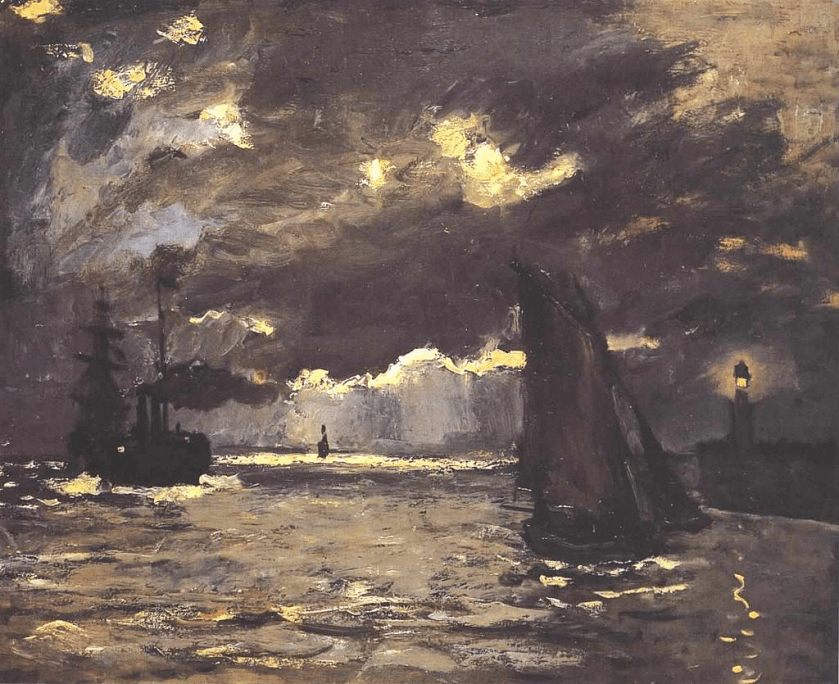
“Marine, navigation au clair de lune”, Claude Monet, 1864

L’appel de l’océan

La plage endormie luit

D’une douce noirceur


Rayonnant dans la nuit


De splendides couleurs.

Assise sur un rocher

De granit et de fer


Je contemple à mes pieds


L’assourdissante mer.

Et ni l’onde bleutée,

Ni le ciel orageux,


Ni le phare agressé


Par les flots tumultueux,

Ni même ce frais vent

Qui chante de très longs


Et séduisants chants


Ne me retiendront.

Mes ailes vont s’ouvrir.

Je vois le soleil poindre,

Au loin comme pour dire:

«Vole, viens me rejoindre.»

Starry Waters

The beach reflects the darkness

Off the soft sand


Basking in the starry night


The colours of the delight

Sititing on the beach

I hear at my feet


The roaring sea


Calling something


Deep inside of me

The starry night

The sleepy cries

The hollow plights

The darkening lights

Nor the windy hollows

And the ricketing wallows

Shall keep my dreams shallow

I see the sun rise

And look into the sky

To see with my eyes

A prophecy for me to fly

A Call for Transparency

An open letter concerning Sciences Po’s administration and recent reforms, by Zhenlin Ouyang.

Zhenlin Ouyang is a second-year student at Sciences Po, Campus du Havre. He majors in Politics and Government. He is orginally from China, but lived in Canada before coming to Le Havre.

I have confidence Sciences Po, as an institution firmly rooted in and representative of democratic principles, will be receptive to criticism from its student body. Therefore, I write this letter to bring forth two major issues:

1. The lack of transparency about administrative regulations and the reform;

2. The treatment of students who are currently repeating either year of their studies;

I – The lack of transparency

Throughout our time at Sciences Po, the information we have been given has been incredibly inconsistent. In some cases, we have been given no information at all. A key example of this is the contradictory information we were given about the reform.

During the designated information session we had regarding our choice of major, we were told that:

  • our major during the third year abroad would not have to correspond to our major at Sciences Po;
  • that we would be free to pursue an intensive language program regardless of our second year major

However, during this semester, we were told the exact opposite, and the following announcements were made:

  • Our current major has to be pursued during 3A
  • Our current major also determines what universities we can apply to; as some universities do not offer certain majors
  • The intensive language program is not open to anyone anymore.

There are many questions that spring to mind:

  • Where do these inconsistencies come from?
  • Why was this reform not more thoroughly organized before being presented to the student body?
  • Why was there no procedure of consultation with the students regarding this reform?
  • And most importantly: Why were all applicants who would be subject to the reform not informed about it before applying?

Moreover, we were registered for Digital Workshop seminars (on September 14 – 15) without prior notice. However, in my opinion, we should have the ability to choose the seminars we want to sign up for.

II – The Treatment of redoublants

It is hard for students to study at such a demanding university. Enrolling for an extra year is, thereby, doubly difficult. Especially without the proper assistance.

Last summer, when I discovered I had to do an extra year, the administration and I scheduled a Skype conference to discuss my situation. In addition to a half-an-hour delay, I was only allocated five minutes of time to pose my questions. During that brief meeting, I expressed my concerns and asked two questions:

  • Would I have to re-do the group project? (Before the reform, students were required to implement a group project during the first year)
  • Would I be able to validate the internship I did during the summer of 2017?

I was told that I didn’t have to do another team project and that I would be able to validate my internship if all the relevant documents were provided.

Then, to my surprise, when I went to the administration to validate my internship during the last semester, I was given an entirely different response. They first told me that they had to check with their colleagues in Paris and, finally, that I wouldn’t be able to validate it. I was confused by their reasoning: I wrote my engagement letter about the promotion of gender equality and my internship was correspondingly conducted at an NGO promoting rights for gender minorities.

I was fed the same story when I asked them about the independent engagement. As the administration has completely ignored my repeated attempts to give my perspective, and as one of my fellow student is in the exact same situation, I would like to ask the following questions on our behalf:

  • If the reform had been set forth with clear instructions, why do we still rely on Paris for clarifications?
  • Why do I have to re-do my internship and the Independent Project? Our administration misled me by giving me contradictory instructions for half of the year (thus giving me less time than other students to find an internship). Why was I obligated to re-do this when the internship I did the year before could have been counted?
  • For students who passed conditionally: why do we still have no information on how to retake classes despite the fact that the first semester is coming to a close?

III: Our Demands

The aforementioned examples are just the tip of the iceberg, but they reflect the lack of transparency within our institution. Beyond these examples, there are several contradictory regulations (such as the absence policy) and our plans are often disturbed by the fluctuating rules passed down from the administration. We were left in the dark as to why the reform was put forth so quickly, and why the regulations were made to be so ambiguous.

When even the administration does not know what they are doing, imagine how we students feel; without sufficient and transparent information, it is difficult for students to incorporate the reform into our personal academic program.

Hence, I present this set of demands on the behalf of students of Sciences Po, who I hope will join me in this call. We hereby demand that:

  • A general assembly be held to explain why regulations about 3A have been reversed without consulting students
  • A responsive mechanism be implemented by the school to collect the students’ opinions and recommendations on the reform, and that these be taken into account
  • A unifying standard should be established to prevent any future rapid change of rules and regulations;
  • An ad hoc procedure should be negotiated for les redoublants.

We want a full account of why the school thinks it is acceptable to change rules without going through transparent and inclusive procedures, and we want to see commitments to end such practices.

Revised for clarity by the editorial team of LDD.

The opinions expressed by the author do not necessarily represent the editorial position of Le Dragon Déchaîné.

« Andromaque, je pense à vous… »

Pierre-Narcisse Guérin, 1813, Andromaque et Pyrrhus

« Andromaque, je pense à vous » c’est ainsi que Baudelaire commence à entonner sa déploration d’un Paris qui n’est plus (Le Cygne, Les Fleurs du mal, 1857). « Ce petit fleuve, Pauvre et triste miroir où jadis resplendit / L’immense majesté de vos douleurs de veuve, / Ce Simoïs menteur qui par vos pleurs grandit, / A fécondé soudain ma mémoire fertile. » Le rythme est funèbre, le ton nostalgique, le poète se place sous l’invocation de la Troyenne qui vit en une nuit disparaitre sa famille et sa cité. La veuve d’Hector, symbole séculaire de constance et de fidélité m’apparait aujourd’hui surtout comme l’archétype de la femme en exil, de celle qu’on a forcé à quitter le sol natal et qui ne trouve que dangers et périls dans un séjour étranger. Dans les textes grecs, on exalte souvent la figure de l’exilée, de celle qu’on enlève, de la captive qui suit le vainqueur sous d’autres cieux, de celle qu’un péril pousse à chercher le salut dans la fuite. Sans compagnons à leur côté, elles définissent en creux par le manque, l’absence et le chagrin.

L’idée de cette analyse m’a été soufflée lors d’une représentation récente d’Andromaquede Racine à laquelle j’ai assisté. Jamais auparavant l’acuité de la situation de cette femme éponyme ne m’avait semblé aussi flagrante. On ne parlera pas de modernité, on ne fera pas d’anachronisme, on dira simplement que rien ne change vraiment sous le soleil et que les tragiques grecs rendaient déjà compte du malheur millénaire que vivent encore aujourd’hui tant de femmes, par fait de guerre, de violence, de préjugés sociaux, étatiques ou religieux. Chacun et chacune saura entendre le lieu, le pays, où ces destins mythiques s’accomplissent encore de nos jours même si les protagonistes actuelles restent souvent sans visage et anonyme. Andromaque est avant tout une prise de guerre, elle échoit en butin à Pyrrhus, fils d’Achille qui devrait la haïr puisque la prise d’Ilion, selon la prophétie, ne pouvait s’accomplir qu’au prix du trépas de son père. Il doit la garder asservie mais voilà qu’il s’en éprend et Racine lui donne un argument déterminant pour faire sa cour, en gardant en vie Astyanax. Le jeune prince a pourtant été tué, précipité du haut des remparts de la ville par Néoptolème, si on en croit la tradition homérique et la version d’Euripide. Sur la scène classique du XVIIème siècle, il devient un enjeu de pouvoir et la victime d’un chantage amoureux.

Chez Racine, donc, Pyrrhus convoite sa prisonnière et, pour l’obliger au marriage, il fait garder son fils en otage. Qu’Andromaque l’épouse et il préservera la vie du dernier dardanien, dût-il pour cela encourir le courroux d’Oreste puis la vindicte des Grecs coalisés contre le sang d’Hector. La tragédie, composée par Racine en 1667 se résume facilement : Oreste aime Hermione, qui aime Pyrrhus, qui aime Andromaque, qui aime Hector, défunt, et qui cherche à protéger son fils Astyanax… Ce n’est plus un dilemme tragique, c’est une longue torture, un harcèlement sans fin : Accepter l’hymen honni puis se suicider semble la seule échappatoire. (Racine, Andromaque, Acte II, scène I)

PYRRHUS.

« Eh bien, madame, eh bien, il faut vous obéir :

Il faut vous oublier, ou plutôt vous haïr.


Oui, mes vœux ont trop loin poussé leur violence


Pour ne plus s’arrêter que dans l’indifférence ;


Songez-y bien : il faut désormais que mon cœur,


S’il n’aime avec transport, haïsse avec fureur.


Je n’épargnerai rien dans ma juste colère :


Le fils me répondra des mépris de la mère ;


La Grèce le demande ; et je ne prétends pas


Mettre toujours ma gloire à sauver des ingrats.

ANDROMAQUE.

Hélas, il mourra donc ! Il n’a pour sa défense

Que les pleurs de sa mère, et que son innocence…


Et peut-être après tout, en l’état où je suis,


Sa mort avancera la fin de mes ennuis.


Je prolongeais pour lui ma vie et ma misère ;


Mais enfin sur ses pas j’irai revoir son père.


Ainsi, tous trois, seigneur, par vos soins réunis,


Nous vous…

PYRRHUS.

Allez, madame, allez voir votre fils.

Peut-être, en le voyant, votre amour plus timide


Ne prendra pas toujours sa colère pour guide.


Pour savoir nos destins j’irai vous retrouver :


Madame, en l’embrassant, songez à le sauver. »

Andromaque, HécubeetLes Troyennesd’Euripide, composées respectivement en 424 et en 415, donnaient déjà le ton : la princesse Polyxène fut immolée sur le tombeau d’Achille, Cassandre, fille de Priam et désirée par Apollon, fut violée par Ajax, fils d’Oïlée, après avoir été arrachée à la protection du Palladium, contrainte ensuite à suivre Agamemnon, tuée enfin sur ordre de Clytemnestre (Homère, Odyssée, Chant XI). Eschyle avait décrit Cassandre affolée par ses pouvoirs divinatoires, Euripide la montrait tremblante et comme anéantie devant l’épouvantable engrenage qui la conduisait à la mort. Sénèque lui faisait décrire l’horreur de la chute de Troie, le carnage qui suivit et les maux sans fin qu’elle souffrait deux fois puisqu’elle les anticipait sans pouvoir les éviter.

Dans l’incipit des Troyennes, Neptune s’apprête donc à quitter la ville de Priam qu’il protégea longtemps, il introduit l’action avant de s’adresser à Athéna, protectrice des Achéens victorieux :

« Le Scamandre retentit des lamentations des captives à qui le sort vient d’assigner un maître. Les unes sont échues aux Arcadiens, les autres aux Thessaliens, d’autres aux fils de Thésée, rois d’Athènes. Celles des Troyennes qui n’ont pas été tirées au sort sont dans cette tente, réservées aux chefs de l’armée ; la fille de Tyndare, Hélène, est avec elles, et c’est avec justice qu’on la compte parmi les captives. Là, s’offre à tous les regards l’infortunée Hécube ; prosternée à l’entrée de la tente, elle verse des larmes abondantes sur la perte de tout ce qui lui fut cher. Sa fille Polyxène vient d’être immolée sur le tombeau d’Achille, à l’insu de sa mère ; Priam n’est plus, ses enfants ne sont plus; et celle dont Apollon respecta la virginité, Cassandre, qu’inspire l’esprit prophétique, Agamemnon, au mépris du dieu et par une violence impie, la contraint de s’unir à lui par une alliance clandestine. »

La tragédie desTroyennes s’insère dans une trilogie, la pièce s’ouvre sur un rappel de la prise d’Ilion avant que chaque captive soit fixée sur son sort. Chacune devra en effet suivre un maître. Cassandre accompagnera Agamemnon à Mycènes, Andromaque sera remise à Néoptolème et la reine Hécube donnée à Ulysse, son plus farouche ennemi. Comme les servantes à Ithaque, pendues sur ordre d’Ulysse, les Troyennes n’ont aucune défense, aucun droit. Vae Victis. Leurs chants se succèdent, égrenant le destin croisé de ces femmes contraintes à l’exil, soumises aux volontés des vainqueurs.

Hécube ira encore en Thrace venger son dernier fils que Priam croyait avoir confié à la protection d’un roi ami. Le traitre Polymnestor, fourbe et cupide, tua l’enfant pour conserver les trésors qu’on lui avait remis avec sa garde. Entre les deux premiers épisodes des Troyennesqui scellent le sort de Cassandre avec celui d’Andromaque et les adieux finals d’Hécube, une longue joute oppose également Ménélas à Hélène, la belle Hélène, le casus belliféminin du conflit, que son époux entend mettre à mort dès qu’ils auront regagné Sparte. Victime, elle l’est aussi, si on se souvient du rapt qui la conduisit avec Pâris en Troade, jouet à la fois de la Discorde en colère et du jugement de trois déesses vaniteuses. Dans La guerre de Troie n’aura pas lieu,en 1935, Giraudoux campe une Hélène languide et changeante, aguicheuse mais sans volonté claire, tour à tour artificieuse et naïve, une femme dont l’essencese résume à sa seule beauté et dont l’existencedépend du regard et des exigences des hommes.

S’il demeure un sentiment de tragique devant la fatalité qui s’acharne sur les personnages féminins des Troyennes, on se rend vite compte que la guerre reste avant tout une chose sordide et vile. Dégrisés après la fureur des batailles, les héros masculins font pour une fois piètres figures. Les plaintes pathétiques des trois femmes et de celles qui composent le chœur, en écho, suscitent la pitié et la compassion. Il ne reste plus rien de grand ni de courageux à accomplir sur les décombres de Troie. Ni la piété due aux Dieux, ni le respect pour l’âge et pour la majesté déchue n’ont droit de cité Les Troyennes n’ont survécu que pour devenir proie, elles ont porté le deuil de leurs pères, de leurs frères, de leurs époux, de leurs fils avant de devenir les esclaves des Achéens. Il ne demeure vraiment rien de glorieux dans la pièce d’Euripide mais la catharsisaristotélicienne fonctionne parfaitement : la terreur et la pitié saisissent le lecteur, foudroient le spectateur. Il faut donc partir, sans rien, sans autre bagage que des souvenirs, avec l’icône d’un époux adoré comme Andromaque ou avec les cendres d’un fils comme Hécube qui devient la sépulture vivante de son fils Hector.

D’autres femmes fuient encore et toujours. Les filles de Danaos refusent un mariage imposé avec leurs cousins et cherchent refuge en Grèce. Les Suppliantesd’Eschyle, vers 466, nous les montrent éperdues arrivant en Argos, ne pouvant se résoudre à épouser leurs prétendants imposés. Poursuivies par leurs fiancés, les fils d’Egyptos, elles chantent la douleur de quitter le sol de Lybie, d’être démunies et sans soutien aucun en pays étranger. Le roi Pelasge les accueille avec bienveillance. Il entend même leur supplique mais la guerre gronde aux frontières alors que se referme le premier volet de la trilogie dont ils nous manquent les deux suivants. La menace imminente rend leur asile fragile, leur situation précaire. La suite des pérégrinations des Danaïdes est connue : Contraintes aux noces, elles accompliront dans la nuit qui les suivra le meurtre de leurs époux et seront condamnée pour l’éternité à remplir d’eau un récipient sans fond.

Revenons à Troie, avec une pointe d’humour… Le seul être qui, finalement, comprendra Andromaque, se nomme Léopold, (Marcel, Aymé, Uranus1948), Léopold le simplet, Léopold le cabaretier, un grand ami de la dive bouteille, qui s’éprend d’Andromaque rien qu’en écoutant l’instituteur faire cours sur Racine, dans son café, car l’école a été détruite par les bombardements de la Seconde Guerre Mondiale. Parmi les décombres d’une sempiternelle guerre, le cafetier ému improvise des alexandrins en comptant les pieds sur ses doigts, des vers boiteux mais si émouvants, pour sauver la veuve d’Hector et le rejeton d’Ilion. Léopold est incapable de la laisser subir un sort qu’il juge épouvantable. Andromaque s’extasie, fort prosaïquement mais visiblement soulagée d’avoir trouvé enfin un allié.

LEOPOLD :

« Passez-moi Astyanax, on va filer en douce – Attendons pas d’avoir les poulets à nos trousses.

ANDROMAQUE :

Mon Dieu, c’est-il possible. Enfin voilà un homme ! Voulez-vous du vin blanc ou voulez-vous du rhum ?

LEOPOLD:

Du blanc !

ANDROMAQUE:

C’est du blanc que buvait mon Hector pour monter au front.


Il n’avait pas tort.

The Dinner Party est une installation artistique de Judy Chicago qu’on peut voir dans l’aile appelée Elizabeth A. Sackler center for Feminist Art du Brooklyn Museum de New York. La structure en forme de table de banquet triangulaire fut élaborée de façon collective entre 1974 et 1979. Cette œuvre a été autant décriée qu’encensée mais elle possède l’immense mérite de proposer une lecture épique des destins de centaines de figures féminines historiques ou mythiques. Elles sont au nombre de 1038, référencées directement ou symboliquement. Hélène et Hécube y figurent. Juste revanche ? On pourrait légitimement ajouter Andromaque, si affligée, si forte aussi.

Sophie Rochefort-Guillouet is a history professor at Sciences Po Paris Campus du Havre.

Nostalgia in North Korea: traveling to the DPRK

It is a great pride for me to be invited to talk about the misconceptions of North Korea. Admittedly, traveling to North Korea is not commonplace, nor totally safe. However, my journey to North Korea this winter was a rather brief one. I’m not capable of interpreting the social phenomena in the country like a geopolitics expert, but it’d be useful to review our impression of the state that media has imposed on us in the light of what we have experienced and witnessed.

(above) click on image to view full gallery. All photos provided by Runhang Zhong

To clarify, I am not, and will not in the short run, glorify the regime. Nor will I state that what the media has told us may be wrong or biased to undermine the fact that North Korea is falling behind. It is by no means a paradise, with an ironic hierarchy in a revolutionary state, a strict control of society, a culture castrated by the government, and of course, after paying attention to the poor conditions of roads in Kaesong it is self-evident that the economy is far from prospering.

But these are less exposed to and less known by the public; Ryomyong Avenue rose from dust in nine months; 4D films are available in the Palace of Science, Technology, and Culture in Pyongyang; citizens of Pyongyang chanted and danced happily with us foreign visitors to celebrate the new year of 2018. North Koreans are not as dull and emotionless as one may imagine. It should never be forgotten that the DPRK is, rather than a keyword of international politics’ news, a state where 25 million people are living.

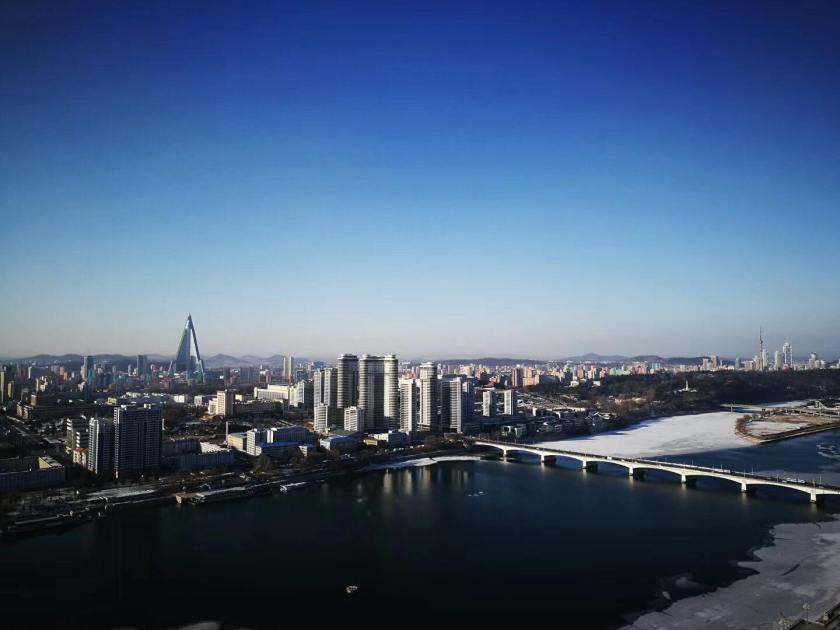
Let’s begin with the economy: the most striking contrast between the DPRK and its Southern counterpart. It’s easy to observe the poverty in the country upon crossing the Yalu River, with the grey buildings and poorly-equipped railway station in sight. But a more impressive point haunting my mind is the wide gap between Pyongyang and other cities. While other cities like Sinuiju and Kaesong reflect the image of the DPRK in our minds, Pyongyang is definitely another world

Image: View of Pyongyang seen from the top of Juche Tower (Source: Runhang Zhong)

Pyongyang is comparable to second-tier or third-tier cities in China with neat streets, tall buildings, and crowds shopping for the New Year in supermarkets. Public transportation is well developed: buses and trams, which are always purchased from former East Germany, come every other minute, carrying people to every corner of the city. Though not a large amount of vehicles are kept, traffic jams do occur at around 7 pm. Electricity shortage remains the biggest problem; the city was completely dark at 8 pm, which I witnessed from the 44-storage high Goryeo Hotel. Despite this being said, computers are accessible for free to Pyongyang citizens, especially primary school students, to get access to local networks for academic papers and resources about science, technology, languages and many other disciplines.

Image: Celebrating the new year of 2018 with Pyongyang citizens. (Source: Fangzhou Zhao)

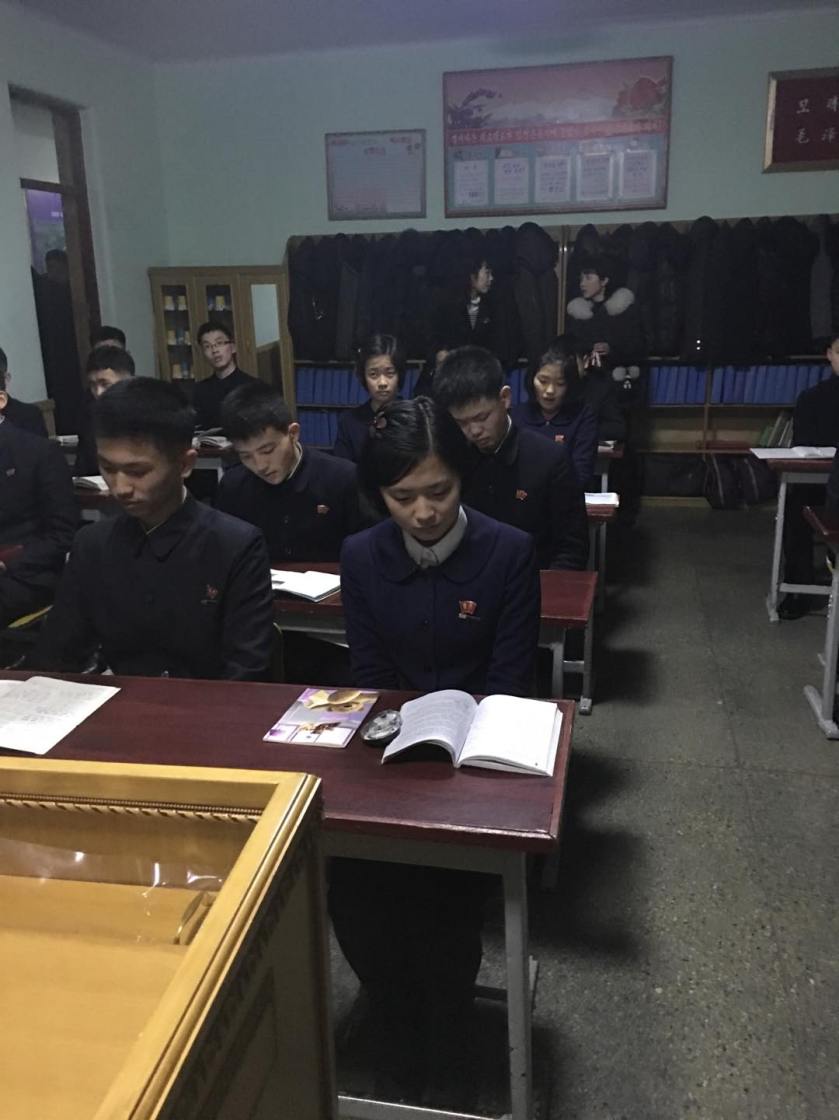
It’d be a unique experience to speak English with North Korean people in Pyongyang. Certainly, they know English, though limited. “Class of Mao Zedong” of East Pyongyang No. 1 High School was not only a class to enchant the Sino-DPRK friendship but also to select outstanding students to serve the country.

Image: The Class of Mao Zedong. They were preparing for the college-entrance exam (source: Ruhang Zhong)

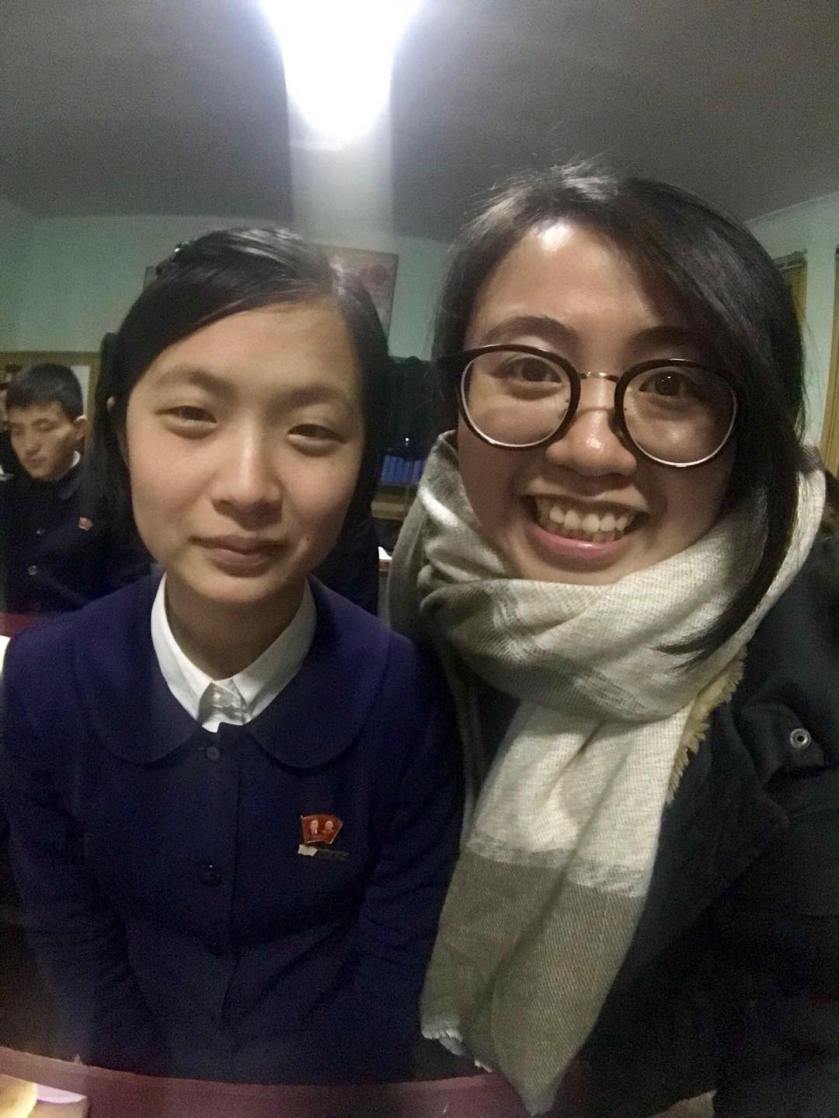
How old are you?” One of our teammates asked.

Sixteen.” Responded a shy girl.

She went on to introduce all her subjects, her favorite, and the fact that she was preparing an exam to get enrolled in a university in April, with English impressive enough for all of us.

Image: The girl who spoke English with us. (Left) (Source: Wanting Hsieh)

But that was only part of the story. Another occasion where I showed off my English was when I encountered a woman selling snacks on the street. She was well aware that I am a foreigner for there was no badge of Kim Il Sung and Kim Jong Il pinned on my chest. I pointed at the snack I would like to try and handed out my Renminbi.

No. No. No, accept Yuan.” Renminbi seemed to be too expensive for her, or perhaps she did not have the correct license to conduct business with foreigners. But “accept” doesn’t sound like a word spoken by a woman who did not study English.

Yes. 5 for 2.” She finally reluctantly accepted my coins. One may make the accusation that her grammar constitutes a solid reason to suspect her as an American spy.

English can be seen even in kindergartens. Displayed together with propaganda posters and portraits of Kim Il Sung and Kim Jong Il, there were toys to learn English which were said to have been smuggled from South Korea because some Korean vocabularies like pencil had been erased to be replaced by more “native” ones.

Some may question those to be “performed” in front of visitors to deliver an embellished vision of the country. Surely the DPRK authority lies sometimes, like what they told us about religious freedom when we were in a Catholic church. But I’m inclined to attribute the seemingly surprising phenomenon to the inequality and hierarchy in North Korean society, within which the most trustworthy social groups are relocated the most resources. And undoubtedly the DPRK requires educated people to sustain the functioning of the regime.

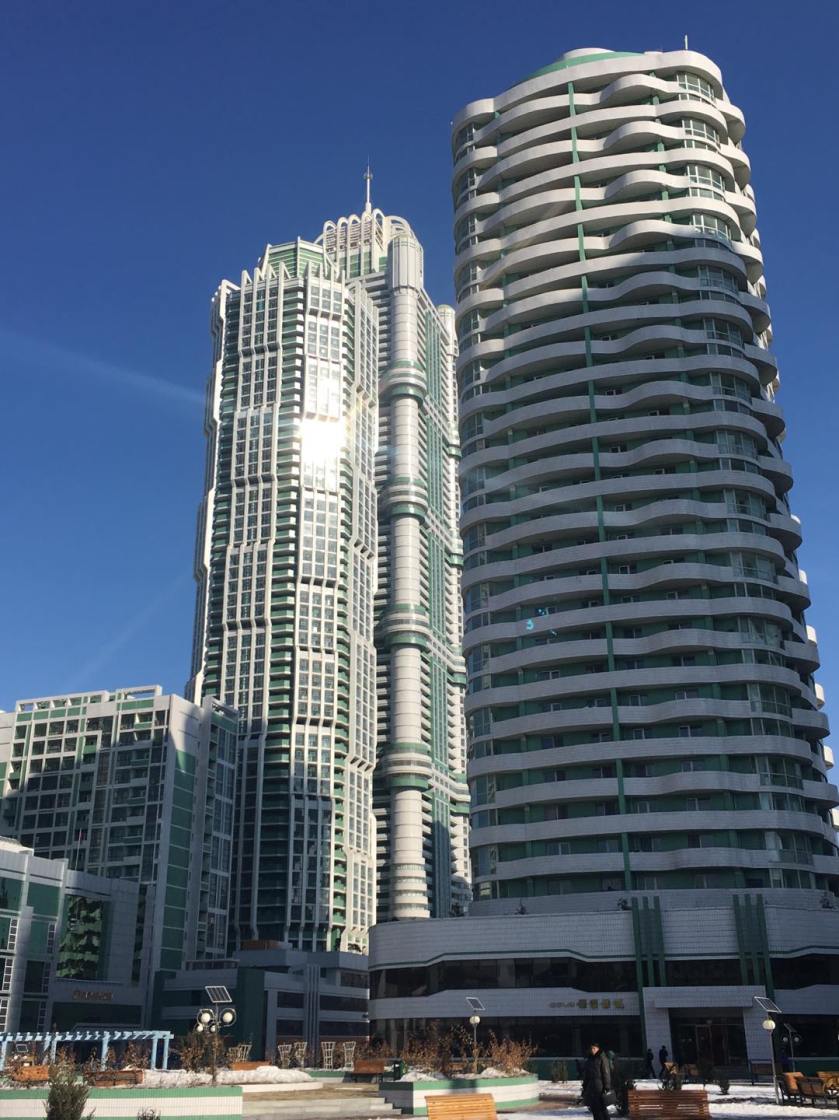
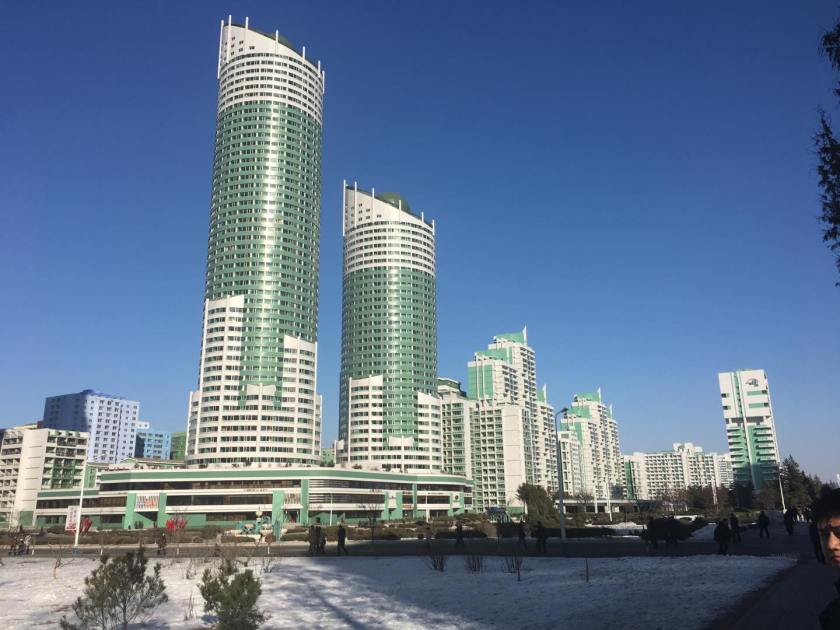
Images: Ryomyong Avenue. Probably it shows an unknown side of the mysterious state (Source: Runhang Zhong)

Let’s conclude with my favorite travel destination, Ryomyong Avenue, which was constructed in March 2016 and was finished the December of the same year. Walking among the post-modernist buildings, I realized the potential of the often mocked and despised state. DPRK reminded me of my own nation, China, in the sense that so many remnants of socialism kept in the North Korean society resembled that of China a few decades ago. China was negligible 40 years ago and was predicted to soon collapse by observers 20 years ago. However it only grew to be the second largest economy, so there’s no harm keeping an open and objective attitude towards the seemingly insane country in our current world, where everything is possible.

Runhang Zhong, also known as Marco, is a second year student from China at Sciences Po Paris, Campus du Havre.

Edited by Paxia Ksatryo.

“Transition Energétiques”: A Class Trip to the EDF Coal Plant of Le Havre

What is to be found at the foot of the far away EDF towers?

On the 16th of April, Roland Lehoucq’s class on energy politics and the move towards renewable energy, entitled “Transition Energétiques”, along with some energy amateurs who joined the excursion via Sciences Po’s newly formed Environmental Association, visited EDF’s coal-fired power plant in Le Havre’s industrial port.

13:29

In the hallway ,excited students are met with M. Lehoucq and M. Fertey to catch the bus headed to the industrial area. Fifteen minutes later, under timid sun rays, the group wanders around empty gravel streets to finally find the entrance to the plant area.

14:05

The group is welcomed by Malvina Devarieux, public relations assistant, who explains the history and functioning of the plant in a small conference room. Created in 1946, EDF played an important role in France’s reconstruction after the war and contributed to its later industrialization. Today, the company is the leading electricity producer in France. In 2014, of the energy produced, 87,8% was nuclear, 9,9% renewable, and 2,3% thermal.

Due to its relative flexibility, the thermal park is used to respond to the variations in consumption. Sometimes, important amounts of electricity have to be provided within a short period of time in order to satisfy the daily demand peak or to respond to a seasonal change. Devarieux explains, “A fall of one degree Celsius in mid-winter is equal to a rise of 7% of electricity demand”. Here, Le Havre’s coal plant has another special advantage on the French electricity market. Thanks to its portal location, it has direct it access to the coal cargo, bypassing costly and time-intensive transportation.

EDF also invests in innovation. Together with Alstom, ADEME and Dow Chemical, a Carbon Capture and Storage (CCS) experiment was conducted on the site of Le Havre and its sister plant in Cordemais. Reaching an overall efficiency of 0,05% for the moment, Devarieux points out that “there are still improvements to be made, but luckily there are also many other laboratories around the world.”

15:10

Students are standing in the coal park, built in 1983, where unit 4 of the power plant – with 600 MW of installed power capacity – is the only one functioning today. Two years ago measures have been taken to make it more efficient and durable: an important modernization of the complex was completed, taking 220 millions of investment. This large financial effort is in stark contrast with the recent decision of the government to close the plant, in order to assure France’s transition towards clean energy. The tour-guide, Sebastien Bertin, points out a key difficulty in energy policy, “the industry is not able to adapt to quick political shifts, as we are not on the same timeline that industrial projects are working on, which is 10 to 15 years.”

15:30

In a vast dark and chilly hall the group discovers the boiler. It is suspended in the air. Underneath, a yellow crab-like machine serves as a recipient of the excess coal falling down. “Back in the days, everything used to be black here, coal was laying around everywhere, and the machine was incredibly loud.”, explains Bertin. Even though on that day the plant wasn’t performing at its top capacity, the many earplug distributors indicate that the noise remains a necessary byproduct of heavy machinery.

15:45

At the upper floor, 12 meters higher, under the roof letting trough some water drops here and there, the group walks along boiler, turbine, and alternator on indicated pathways, listening to the commentaries of the guide.

Second floor of the coal-fired power plant (France 3)

16:05

In the very back of the upper area, behind a heavy door and thick blinds, lays the command room of the plant. “This is the very heart and brains of the plant – the cockpit of the boat, and the people you see working are the captains.” whispers Bertin. The students, fascinated by the many screens, buttons, and phones, inquire after function of every one of them. Learning that the operator (“chef de projet”) is responsible for electricity production sui generis, maneuvering the burners in the boilers for optimal combustion and controlling the good functioning of the entire plant. Assisted by a team of patrols who report everything going on in the different parts of the plant, serving as his eyes and ears around the facility. “In case of emergency, it is the operator who has to stay until the plant is shut down, even at the risk of his own life. Without him the plant doesn’t work.”, Bertin says. “The biggest danger is a “puff”, an explosion in the boiler, which would affect the plant, but not endanger the surroundings. Such a case occurred once in the history of the ‘Havrais’ plant: “They stayed in the smoke, helped by the firemen with oxygen masks until the thing was shut down.”, narrates Bertin.

16:30

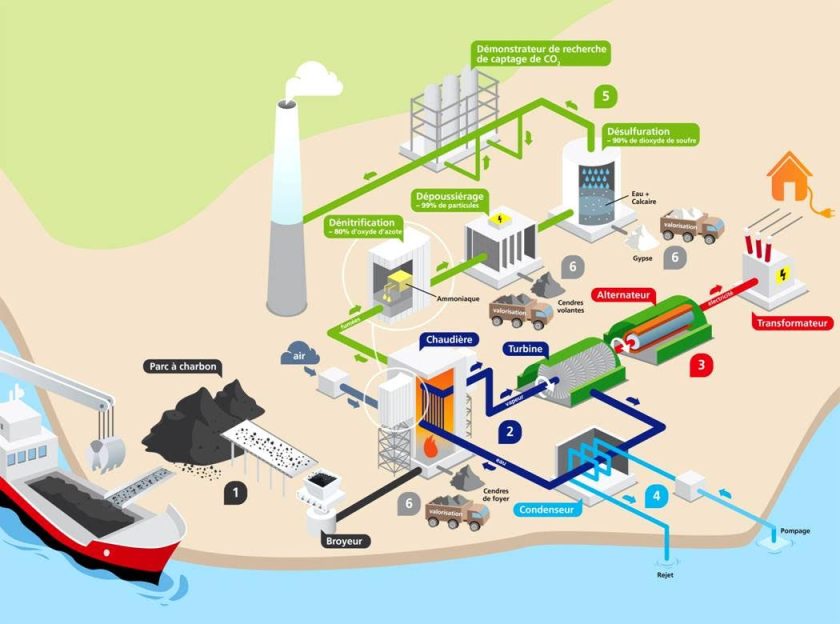
While walking back to the entrance, Bertin answers questions about the environmental matters connected to coal-fired electricity production. He explains the multi-step treatment process which has been added to the regular electricity production to clean the vapor of ashes and toxic particles. First, 80% of the contained azote oxides are washed out through a process called de-nitrification. Secondly, in the smog passes through a dust extractor, where electrostatic current removes 99% of the flying ashes. Finally, desulfurization, that is a “shower of water and chalk”, washes the smoke of fine particles as well as 90% of sulfur dioxide. The byproducts of this treatment process are recycled: the bigger ashes are used for road backfill, trench filling and the making sound breeze blocks. Flying ashes and particles are also utilized in the production of cement.

(dossier de presse EDF 2015)

16:45

The visit is over, “It was cool!”, concludes Roland Lehoucq capturing the general feeling. The students also appreciated the visit. “What surprised me the most was to learn about the strong relationship that can emerge between the machine and the men that are using them day for day over years.”, declares Laureen Calcat, “Another thing that I found interesting is the strong emotional attachment the Havrais have for their coal plant. Le Havre is historically an industrial city and the factory has become an integral part of its landscape. It is also in this idea of affirming the industrial identity of Le Havre that these chimneys were embellished by illuminations that make them shine during the night, like two industrial lights watching over the city. Le Havre would not be quite what it is without the two large chimneys that rise to the sky.

Tshin-Ilya Chardayre is a Franco – Austrian second year student, and an active member of the Environmental Association.