Chaplin in The Great Dictator. Photo credit: Public Domain.
In partnership with Le Havrealisation.
The modern film landscape is, sometimes unfairly, oft-maligned as being increasingly political. Simply put, a common criticism of movies today is that they are “too woke.” Be it the two largest Hollywood blockbuster films of last summer – “Barbie” and “Oppenheimer” – or other contemporary international films such as “Parasite” (2020), many critically acclaimed films of the last decade have had this low-hanging criticism levied against them.
But this is simply not true. Art is inherently political, and film is an artistic medium. Films have, from the very beginning, been used as the conduit through which directors can convey their personal political messages. Nowhere can this be seen more than in Charlie Chaplin’s 1940 film “The Great Dictator.”
Chaplin’s first full talkie (sound film) tells the story of two men at opposite ends of the fictional European nation of Tomainia: its fascist dictator Adenoid Hynkel (a less-than subtle stand-in for Adolf Hitler) and a lowly unnamed Jewish barber readapting to life after World War I in the ghetto. The catch? Both men are played by Chaplin and thus look exactly the same.
Chaplin’s combination of wry humor with social commentary extends beyond the simple premise of the movie. Chaplin, whose name is synonymous with the golden age of silent-era comedies, frequently lampoons the follies of totalitarianism with his signature slapstick comedy.
Hynkel’s runtime is filled with farcical acts such as having an extended “ballet” sequence with an inflated globe or by getting in a food fight with Benzino Napaloni of Bacteria (a parody of Benito Mussolini). On the other hand, the Jewish barber’s continuous optimism and perseverance in the face of extreme adversity serves as the crux of the film’s emotional center. His friendships and relationships develop (albeit sometimes a bit too slowly) over the two hour runtime and culminate in one of the most rousing monologues in film history.
It is important, however, to remember the context in which this film was made. Writing began shortly after Hitler had recently received the Time Person of the Year award, prior to the German invasion of Poland and before the full extent of Nazi Germany’s crimes throughout the Holocaust was generally known (Chaplin himself later stated that the film would not have been made had he known).
Ultimately, “The Great Dictator” has aged surprisingly well in an era where its fundamentally anti-fascist message is, unfortunately, much-needed. Though it may poke fun at one of the darkest moments of human history, Chaplin’s appeal for humanity shines through and enshrines the final product as a testament to the power of film as both an artistic and political tool.
On the 12th of September, I attended a ceremony at the Place du Monument aux Morts, the largest of a series of celebrations, film screenings and exhibitions hosted by the local administration over the course of the previous weeks to commemorate the 80-year anniversary of Le Havre’s liberation from the Nazi occupation. It was not really what I expected. Certainly there was the usual fanfare with marching bands on rue de Paris, speeches by Le Havre’s mayor Edouard Philippe and President Macron, and little French flags waving in the wind – however the usual jubilations felt strangely subdued.
But this is not surprising upon consideration of the city’s history .
The city of Le Havre did not fare well at all in WWII. After France’s shameful surrender in May 1940, the city was forced under the Nazi jackboot and turned into a festung – a fortress city – due to its strategic importance as the largest port on the Channel coast.
This led to the construction of numerous blockhouses, casemates, and other fortifications to combat potential allied landings including the Dollemard battery at Sainte-Adresse, and the incorporation of a German garrison that at its greatest extent reached 21,000 soldiers.
Life for civilians under the occupation was also transformed drastically with the introduction of rationing and virulently antisemitic policies. This transformation began with the removal of Jews from public office, including the town’s then mayor Léon Meyer, and culminated in the arrests of an estimated 900 Jews and deportation of 740 to their deaths. The Nazis also perpetrated violent reprisals against Le Havre’s civilian population in reaction to resistance activities. For example, after the assassination of 2 German sailors on Place d’Arsenal, 1 100 PCF (Parti Communiste Français) and CGT (Confédération Générale du Travail) members were rounded up and deported.
Nor did the arrival of the Allies in June 1944 bring respite. The importance of the port made seizing it a top priority for allied commanders in order to supply the allied armies driving to Paris and beyond.
According to historians Corinne Bouillot and John Barzman, while an attempt was made to compel the German garrison to surrender peacefully after the D-Day landings, garrison commander Hermann Eberhard Wildermuth rejected the offer citing the order given to him by Adolf Hitler to fight to the last man. As an alternative resolution, Wildermuth reportedly countered the Allies with an offer to evacuate the remaining civilians. The offer was not taken up, with Lieutenant-General John Crocker who led the assault arguing that it would take too long, thereby allowing the Germans time to prepare and execute a counterattack which would halt the allied offensive in its tracks.
Under the purview of ‘Operation Astonia’ the city and its defences were bombarded from the sea by battleships HMS Erebus and HMS Warspite with more than 4,100 t of shells over the course of several days starting on September 5th to 12th with a further 10,000 tons of bombs being dropped on the city by the RAF.
The bombardment was considered a success as it silenced German batteries and allowed the Allies to advance into the city relatively unimpeded due to the German garrison being too shell-shocked to fight back, however its gains came at a horrible cost.
Of the city’s 41,000 buildings, 13,500 were completely destroyed, including key buildings like the Hotel de Ville and the Natural History Museum. Only charred, smoking husks remained. Around half of Le Havre’s population (approximately 80,000 people) was left homeless. Nor was the destruction limited to the residential quarters, with bombings targeting the submarine and torpedo boat pens in the port which gave Le Havre its name, destroying about 85% of its 1939 facilities.
80 years on, the memories of victory are still tainted for many of the citizens of Le Havre. Many are able to celebrate the city’s momentous regaining of its freedom, however some will always wonder whether the price it had to pay was too high.
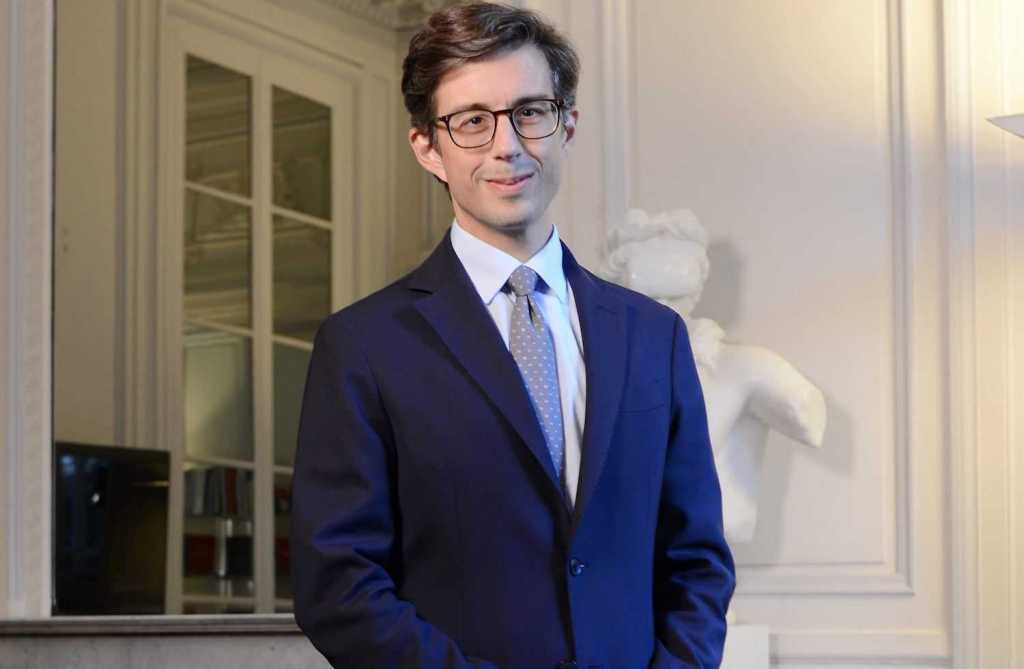
On Friday the 11th of October, journalists Rita Zeefal and Syontoni Hattori-Chatterjee from Le Dragon Déchaîne were lucky enough to have a few words with the new director of Sciences Po Paris, Luis Vassy, during his visit to the Le Havre campus. In the conversation transcribed below, Mr. Vassy shares insights from his diplomatic career and delves deeper into the foundational principles of his project for the school.
RZ: You have stated that your three years as French Ambassador to the Netherlands taught you of the importance of integrating democratic approaches to budgetary planning. And you stated that you would like to introduce this approach to the budgetary planning on campuses like ours too. Are there any other matters relating to the functioning of Sciences Po in which you would like to give students more decisional power?
LV: I found, during my time as ambassador, that the Netherlands was an incredibly participatory society. I think statistics show that they have among the highest proportion of young people who volunteer. There is also a culture of open dialogue, negotiation, and consensus. Even little children are trained from very early on to negotiate their way through life. There is also the whole Polder system that I admire a lot. And indeed, we all try to build on the experiences we’ve been able to have throughout life, and it’s true that my 3 years in the Netherlands as ambassador have opened me to this way of organising a community and a society and I think there are lessons, indeed, for the community like the one we represent. We have a chance to encourage the practices of taking responsibility and forging a culture of consensus and compromise.
So, among the ideas that I brought up in my programme, are those related to seeing if we could create these spaces where discussion and responsibility-taking could be developed. And I hope there are other ways of doing it, but I really strongly believe in that balance between responsibility and the health of a community.
SHC: Yeah. And sort of leading off of that as well, regarding your program and the manifesto that you talked about, and different types of more participatory mechanisms that take into account the diversity of our Sciences Po network and institutions, especially the regional campuses. We’re on one of them right now, of course. If you were to sum up briefly your 3 main priorities as director related to the regional campuses, what would they be?
LV: Well, as you know, there is work going on on the structure of the Bachelor. As I said in the program, I think the priority has to be to make sure that the competencies we develop for the students are completely in tune with the needs of tomorrow’s society – or even today’s society. I really think that there are fields where we can move forward and maybe even be leaders, for example, the kind of competencies students will need in a world that will be strongly dominated by AI. So as I said in another context, and it’s in the project, for example, I understand that from a cognitive standpoint, the capacities of synthesis and writing are very useful. At the same time, I believe that they are personal cognitive assets, but they won’t be professional assets so much in a world where AI will overtake, easily, some of the synthesis and writing part. But there are other maybe deeper, stronger competencies that we can look into.
And that’s why I propose to look into the scientific method in social sciences which will allow students to develop cognitive competencies that will be useful for them. I think it has to do with the ability to distinguish between true and false in a world where AI can actually create a grey zone or difficulties there. Students need to have the ability to go to original sources, the ability to develop hypotheses and challenge them, the ability to doubt, simply, and the ability to experiment and to find solutions to problems that are very diverse.
And the other aspect for the Bachelor’s, that all the candidates came to the same conclusion on, is the necessity to strengthen the common curriculum and the basic disciplines that are taught here in Sciences Po. Why?
Because I believe indeed that in a world, again, where so much knowledge is available digitally, there will be a huge advantage for one that is able to go pretty deep into issues so as to understand the bridges and links we can make between different disciplines when we look at a specific problem. And that means not remaining at the surface of things. It means going very, very deep into each discipline. Then, I also say I’m not a researcher. I’m not a pedagogue, so I will, of course, work on these issues with the whole community and see which kind of conclusions we can derive from this, let’s say, overall analysis.
But I also think there are lots of extremely interesting things to be done here. For example, there is the question of the identity of the campuses. I want to look into other ways of specialisation.
Regarding the geographical specialisation, I believe this development has enriched the Sciences Po community greatly, but the campuses also correspond to a state of the world at the beginning of 2000 where globalisation was a happy thing. And so you will conquer Asia in Le Havre, or you will conquer North America in Reims. There was a very optimistic vibe about the development of the regional minor campuses, which I think we can and should cherish.
But there are also new challenges that we can look into early. What I say here is not definitive – it’s an intuition rather than a definitive decision. But we should also look at having campuses that could specialise on things like climate change, the ecological transition, maybe on digital issues, maybe on international security issues. There may be other ways of looking into the specialisation.
This will be a very open discussion, but since I’m honest in general, I just wanted to share my intuition, let’s say, in these, in these first steps here.
RZ: Do you intend to institute reforms as sweeping as those of Richard Descoings? You mentioned that in the early 2000s globalisation was at the forefront of everyone’s minds. Now we’re 20 odd years on and questions like climate action and the regionalisation of the world are at the forefront of our minds. Do you think that you could react institutionally to these global issues in the way that Descoings did during his time?
LV: I don’t like the word “react” but yes, I think we need to adapt ourselves as we have done constantly over the past 30 to 40 years. Sciences Po is an institution that has always been dedicated to understanding the world as it is. It’s the motto.
The world of the end of the 1800s was not the same as the world of 1945 which is not the world of 1989 to the beginning of the nineties. And it’s not the same world as today. So as I said many times before, it’s true that we are coming out. We have already come out of a world of functional democracy and happy globalisation.
Clearly, the world in which you will have to thrive will be a different one with different challenges. And yes, I think we are at this point of the cycle where we need to readapt the curricula and the intellectual intent of the institution to these realities. That’s what I proposed in the program that got me elected. So I guess there is some support for doing that, and I hope to be able to now operationalise that into concrete decisions.
When I was a student here there was a course that was called Les Grandes Lignes de Partage du Monde Contemporain. It was really just a course on globalisation. One of the fascinating things I find is that it was created in 1989 before Richard Descoings by Lancelot. This means that this institution has always been able to sense very early on the coming evolutions of our time.
And I think that’s the spirit we want to continue – one that always has its eye on the future.
SHC: And finally for us on our end, especially in terms of reacting to the world, and students’ role in that. In light of current events and your first message to the Sciences Po community about them, you expressed your desire to safeguard students’ freedom of expression, within a context of respect for diverse opinions. Obviously, this is also a value very strongly shared by our student community. And so could you further define your vision of freedom of expression at Sciences Po? What’s its scope? What are its potential limits?
LV: I think the scope must be as broad as possible, and the limit is the one set by laws and our international regulations that do not have so much to do with the content of what you express rather than the way you express your opinions. And I think it’s always extremely important for everyone to be mindful of the fact that we are not isolated cells, in the world, that the way we express ourselves individually or collectively also has an impact on others. And so I want to make sure this is a concern that is raised, you have to reach out to students that feel that their opinions cannot really be expressed freely. So what I hope is to make sure that we have a consensus, because it won’t come from the director alone or from the administration, that we have a consensus within the community.
Our endeavour is to make sure that everyone feels safe to express opinions, freely. We live in a very polarised society, in a very brutal world. And so if there is one place where all this should be handled in a civil democratic, pluralistic, open way, it is Sciences Po.
Of course, there will be different opinions. There will be strong emotions. There will be difficulties at times. But if we are not able to do it here, I’m really worried about the state of our society. And I think we have a role, as a role model for the rest of society, to show that disagreements, even deep disagreements, can be handled in a civil manner within a democratic context.
We have this chance – to live here, in France, in a democratic society. Not everyone has that chance. So, let’s keep that in mind and try to have these values of openness, pluralism, ability to deal with disagreements live through us in the way we handle even political activism or, or expression of opinions. So that’s my, that’s my call for everyone..
I was really glad to be here in Le Havre today. It’s the first campus I have visited. I intend to spend one day each week on a different campus, so I can continue touring the whole Sciences Po.
Next week, I will be in another campus of Sciences Po. And so I will continue moving around and be in touch with the realities of the ground and make sure that we are just one community despite this geographical diversity we need to embrace, which is also a chance,and an opportunity that we need also, to make sure that we feel we belong to the same community, and I will be very attentive to it. And in the course of the day, we discussed, of course, very practical issues surrounding that theme, and then we tried to make sure that there is this sense of fellowship within the community.
by Nayantara Maitra Chakravarty and Claude Leroy-Pinto
For the last week, posters have been appearing across the walls of Sciences Po. Who hasn’t noticed them? What are they about? The Year Rep Elections! The elections for 1A year representatives are scheduled for next Tuesday. Numerous students are running, and the themes candidates are putting forward are quite similar: cohesion, coffee machines, support, meetings to share ideas, and administrative help. We have all seen the campaigns on Instagram, and we would like to commend all candidates on their great presentations and remarkable engagement. Although we haven’t made any voting predictions, we wanted to help you make your choice, which is why we have been interviewing all the candidates.
But first of all, we need to know what a year rep’s role is, and who better to talk about it than a year rep? We asked Yasu (a 2A year rep) about his experience. He explained that the role was mainly about creating a connection between students and admin (therefore meeting the administration more than once a week), listening to diverse students, and representing the LH campus across other Sciences Po campuses.
We asked each of the candidates three questions to help you get to know them better and make a more informed decision. Enjoy reading their answers and may the best candidates win!
Responses have been edited for brevity and clarity.
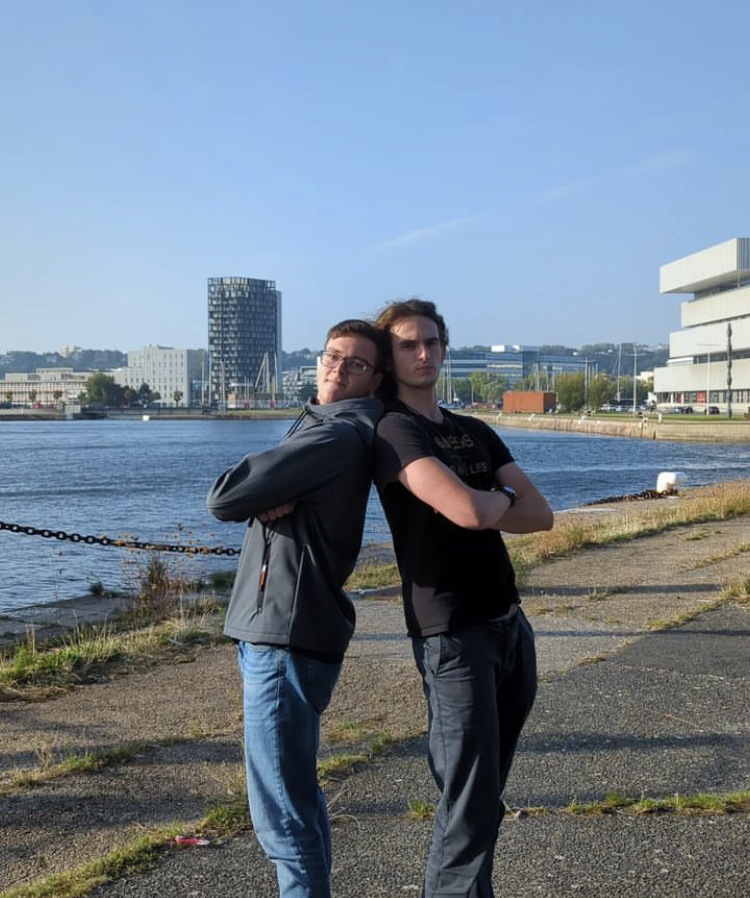
Benjamin Henderson and Alexis Van Troostenburg De Bruyn
Photo Credit: @ab_yeareps_2024 via Instagram
Can you briefly introduce yourself?
Ben: My name is Ben. I’m from Chicago and I’m interested in questions of political philosophy, ethics, and environmental transition.
Alexis: My name is Alexis, from France, and I’m interested in economics, public policy, and Asia.
What is the main goal you want to accomplish?
As year reps, we would like to bolster the role of students in administrative questions. As we have recently witnessed, members of the student body feel that their voices are not contributing to the decisions the administration makes. We would like to start by founding a deliberative body between students and the administration in order to communicate with regard to disagreements, and ultimately reach consensus, or at the very least understanding.
Why should we vote for you and not someone else?
Since we’ve been tasked with representing ALL students, majority and minority alike, we believe strongly in separating our own positions from those of the entire student body. Unlike other candidates who might think they can speak for everyone, we want to let you speak for yourself and will help amplify your voice.
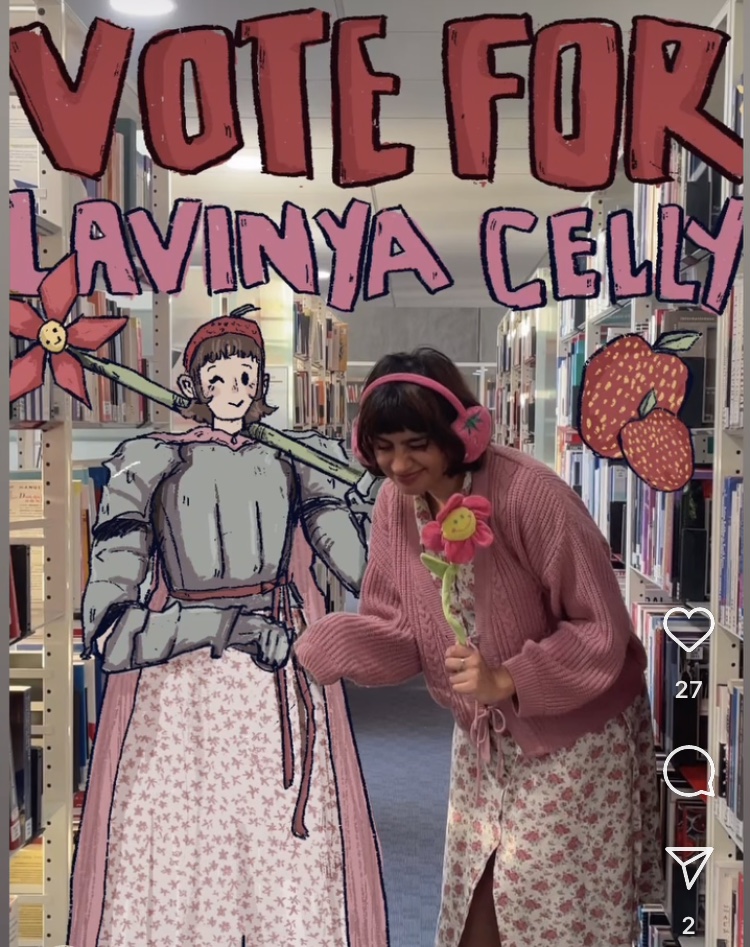
Lavinya Celly
Photo Credit: @straw_berry.knight via Instagram
Can you briefly introduce yourself?
Hi, I’m Lavinya Celly, a recurring 1A student. Dubbed as the ’Strawberry Knight,’ I’m a battle-scarred soldier who is here to lead our charge in pink and glitter!
What is the main goal you want to accomplish?
I wish for every student to feel like they’re at home here. I also want SciencesPo to become a stepping stone for everyone’s goals and dreams, not a bad memory.
Why should we vote for you and not someone else?
I won’t make statements like ‘do not vote for them,’ because I believe there are other candidates who are also worthy of your support. However, I stand out for one key reason: I’ve fought this battle before. Having already experienced the challenges of this year, I know what lies ahead, and I’m well-prepared to handle it. I’ve established a positive rapport with the administration, which means I can effectively represent and communicate on your behalf. Lastly, many of you already know me—I’ve been here, I’ve learned, and I’m committed.
Ultimately, voting for Strawberry Knight means choosing the one who knows the road ahead and has the experience to navigate it successfully 🙂
Junsei Sone and Paul-Aurele Allegrini
Photo Credit: @junseijustice_and_paulopeople via Instagram
Can you briefly introduce yourself?
Paulo: My name is Paul-Aurèle Allegrini, but you can call me Paulo. I’m from Corsica, and I am running to be your future Year Rep with Junsei. I’ve never lived outside of Corsica and was kind of disoriented the first days I arrived. So I can’t imagine how crazy it must have been for international students. I always liked to put myself in the place of others and my fellow students. Finally, I have had experience dealing with the administration, even during trouble, since I’ve been a delegate for all my high school years, and particularly when political trouble erupted in Corsica in 2022.
Junsei: My name is Junsei Sone, I come from Japan, and I’m running for year rep this year. I’ve lived not only in Japan, but I’ve also grown up in California, so I think I have a diverse upbringing. As one of the international kids, I hope to represent the diverse interests of the people as a year rep.
What is the main goal you want to accomplish?
Paulo: My main goal as a year rep would be to truly give a platform for every student to express themselves. Whether it is online, in person, anonymous, or not, I want the students to feel like they actually have a voice. This is why I truly want to be neutral and listen to absolutely everybody and their concerns. I want to really ease the tension and confrontational atmosphere that can exist between the students and the admin. Finally, I want to be a voice and a sword against every type of behaviour that can make students feel bad/ troubled, such as any form of discrimination or bullying.
Junsei: I want to create an air for open dialogue, which is something that I thought after the SJP protests. I’m not trying to criticise them, but after their explanation session about the protests, I feel that opposite stances should also be listened to. I want to achieve an atmosphere of respect and active, open dialogue.
Why should we vote for you and not someone else?
Paulo: Because, firstly, I would (even if the videos we post may make some of you think the opposite) take this role as seriously as possible. I do believe a year rep has duties. And as your year rep, I would respect those duties with my utmost sincerity. Being a voice for ALL students, listening to everyone, advocating for all, fighting every inconvenience (even the smallest) and discrimination, and, very importantly, being neutral, completely neutral to be able to speak and listen to everyone.
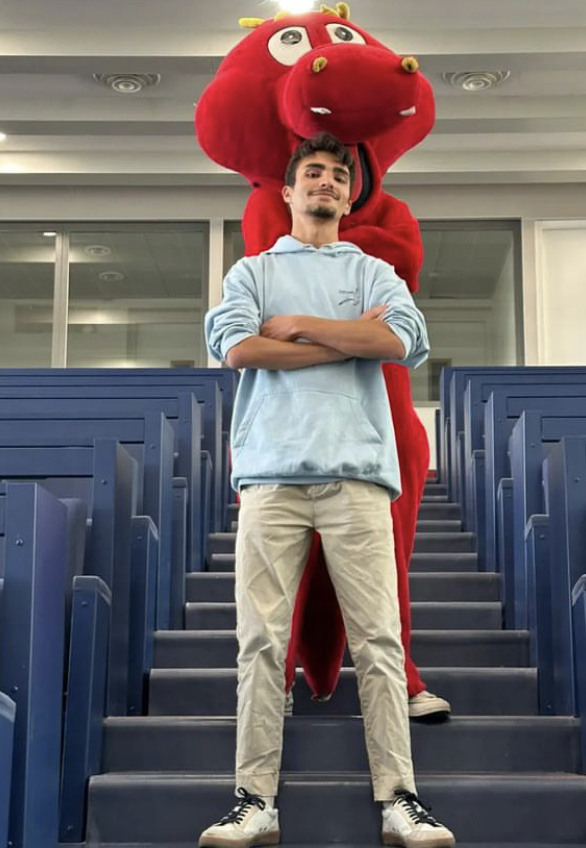
Finally, only one candidate Puts the People in Power ! So remember, vote #Paulo4thePeople and #Junsei4Justice 🗳️🐲!
Junsei: First and foremost, I think that one of my strengths is organisational tasks – going to the admin, negotiating about what we can do – I think that’s something I’m pretty good at. I’ve been doing that in high school too. I think some of my qualities are listening to people, understanding what they are thinking, and seeing things from their perspective. My qualities enable me to bridge the gap between the admin and students and also to negotiate effectively. I think that I am the most passionate about the actual work that the year rep will be doing – I’m not hinting that everyone’s trying to do this for the position or just to add it to their CV – but I actually like listening to different people even when they are in conflict and finding out what they want and what their ideas are. I also wrote in one of my proposals about better organising coursework because everything is so disorganised in my opinion.
Professors send all their deadlines and requirements for coursework by email, while we’re also getting random emails about other events happening on campus. The professors are not the only people sending emails, and in my opinion you should be able to see all the coursework that you have on a single page, because that’s usually how universities work. You have proper pages to organise it. Even with the Student Union negotiations – I am an international student paying the full 14k tuition, and I’m not eligible for any scholarships at this point. This is a problem that concerns me too, so it motivates me to make a change. With these qualities as a mediator and my passion for the work itself, I would like to present myself as the best candidate.
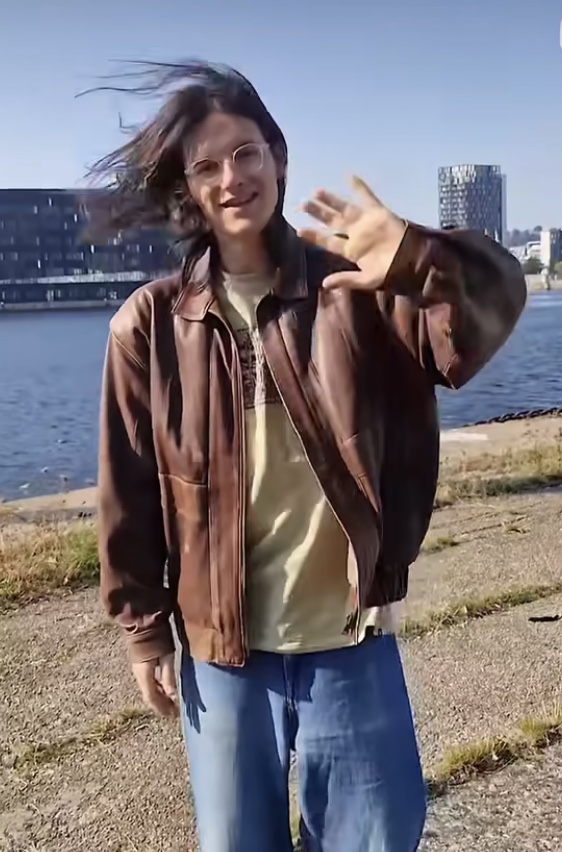
Charlotte Nasser-Belaud-Rotureau
Photo Credit: @charlotte_year_rep via Instagram
Can you briefly introduce yourself?
My name is Charlotte, I’m from the countryside near La Rochelle in the west of France. I would describe myself as a radiant person – I’m always positive, I’m always smiling, and I always want to talk to people and make them feel comfortable. I feel like I’m a safe place, so everyone can talk to me.
What is the main goal you want to accomplish?
I’d like to facilitate academic registrations by allowing more flexibility. I know that some of us didn’t get the choices and time slots that we wanted, so I’d like to create a chat where everyone can get the opportunity to talk to each other and change schedules. While it’s impossible to create a system that’s perfect for everyone, this will at least give those with classes from 8:00 a.m. to 7:00 p.m. a chance to find better options. A practical feature would be to include details of club schedules, allowing students to choose based on that and still participate in the activities or sports that they enjoy. Moreover, I think we need more information about the first year internship – this would help students plan ahead and find more opportunities in advance, especially for those who want to do their internship in their hometown, which can sometimes be challenging. I think that year reps should also keep students informed about the Seas and Oceans certification, as this project influences some of the choices we have to make. We need to be aware of all the opportunities available to us at Sciences Po.
It can be very overwhelming to try to participate in all the events, so I think we should make it easier for students to connect both on campus and off. Different backgrounds and nationalities can sometimes be a barrier, even though we’re quite mixed in seminars. It would be great to create interest-based groups that blend both international and French students to help strengthen our bonds. We have so much to learn from one another, so sharing cultures is an opportunity we shouldn’t miss. International students make up more than half of our cohort, but they still face issues with French administration, so as a year rep I’d like to help both international and French students navigate problems with housing, utilities, or social services.
Why should we vote for you and not someone else?
Everyone knows that a year rep needs to be responsible, approachable, and engaged. But what sets me apart is my commitment to seeing projects through to the end. I want to give students with ideas the chance to bring them to life, and not let them get lost along the way, so I’m really determined to motivate the administration to find quick solutions, and I’ll follow up as many times as necessary to make sure we reach our goals. I may not be the most extroverted person, but I’m sure that my determination will benefit all students. My friends often describe me as a ‘quiet force’, and I think that’s pretty accurate because I always put others before myself and I will gladly make all my resources available to students. I also want to get involved in this project because I love providing support and assistance to those who need it – in high school I helped resolve conflicts between students and teachers or with the administration, so I know that my temperament and listening skills will allow me to successfully meet everyone’s needs.
Anh Nguyen
Photo Credit: @anh_your_anhswer via Instagram
Can you briefly introduce yourself?
I am Anh from Vietnam, and I’m in the Dual Degree with Columbia. I grew up moving around a lot around Southeast Asia and Australia, which gave me a sense of curiosity and understanding about other cultures. I am interested in journalism, human rights, and law.
What is the main goal you want to accomplish?
I aim to foster a more inclusive community where each and everyone of us could be heard, and their concerns addressed. Our cohort happens to be a very diverse and dynamic one, which is amazing, but which could also mean not all of our voices are not equally heard. I aspire to be the approachable year rep who you could come to with your concerns and suggestions, and the action-oriented year rep who you could trust to deliver tangible adjustment in the community to best suit your need.
In terms of agenda: In terms of student life, I plan to urge for our common spaces more well-kept, more comfortable and more friendly to co-working. I further plan to—of course—better our diet on campus: less costly, healthier, more diverse, and functional food and drink options! With regards to the facility, I will push for a form to timely report issues, be it with the power sockets, dysfunctional clocks, or broken toilets. In terms of academics, I will urge for recording of lectures, because life is tough, and sometimes you just cannot make it to one of them.
Why should we vote for you and not someone else?
I believe that I am highly approachable and compassionate—I am a safe middle ground for you to speak up, be it about your actionable suggestions or simply your random rants. I further believe that I have a capability to coordinate, as I have experience from my nationwide student organization back home, which hosted twice the number of students on our campus. I further have a strong determination to bring about tangible result, from the tiniest changes up, which I believe is much more powerful than lofty, grand, yet unachievable promises.
And for such reasons, I believe that I should be your Anhswer!
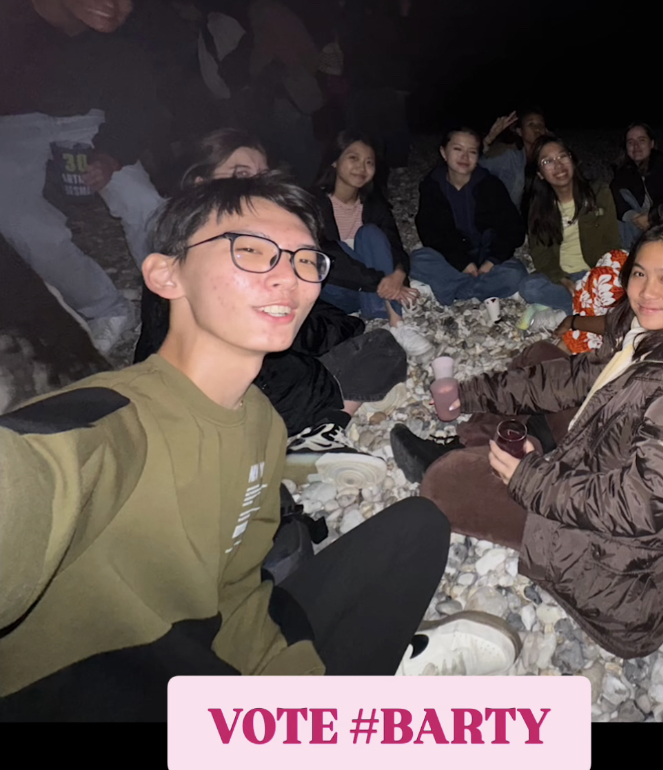
Bartholomew Loh
Photo Credit: @bartyearep via Instagram
Can you briefly introduce yourself?
My name is Bartholomew teck hou LOH, you can just call me Bart and Barthol, or Barty. I come from Malaysia, which is a very diverse country, and I love Sciences Po because it is as diverse as my country, if not more.
What is the main goal you want to accomplish?
So first things first, I think about the vending machine. We should have a democracy system where everyone can choose, like we should do a Google form about what we want to have in the vending machine. The second thing I think about is the international students and their relation with the French students. I think what we are missing is some people willing to really talk to each other. On the French side, there’s people who are very outspoken as well as international students, and everyone is kind of friendly. We just lack those kinds of people that can bring everyone together, so if there is an international student and a French student as the year rep this year, I think it really can bring everyone together rather than just two international students.
Why should we vote for you and not someone else?
I think it would be great having a girl and a boy, an international and a French student.
I have this experience for like all my whole life that I can do things before the deadline. I always submit things before the deadline. I have the experience in my school, so in my high school I do in my student association, and I have been a club president, so I do have the skills to organise things. I basically think I have the right skills for this job!
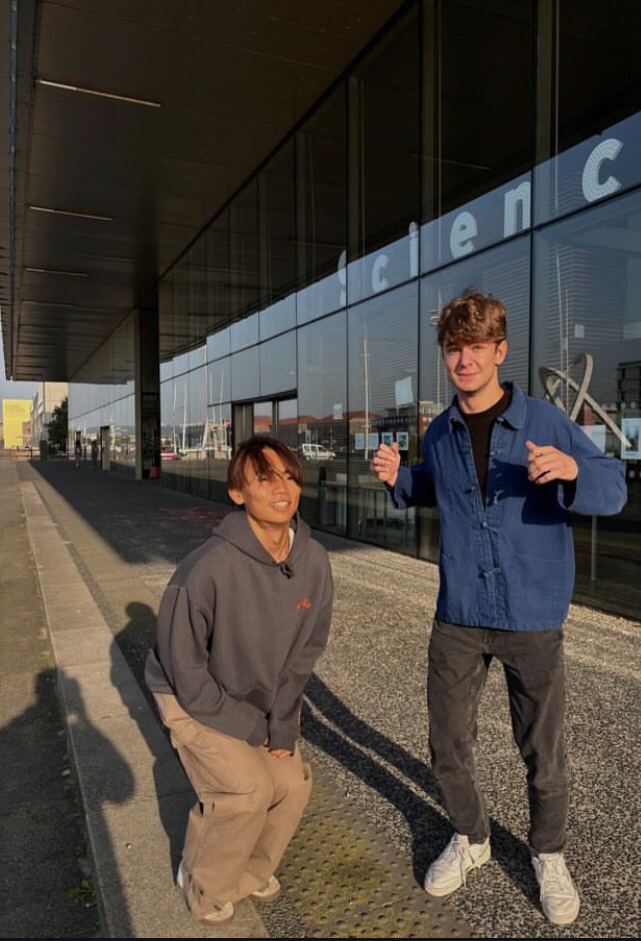
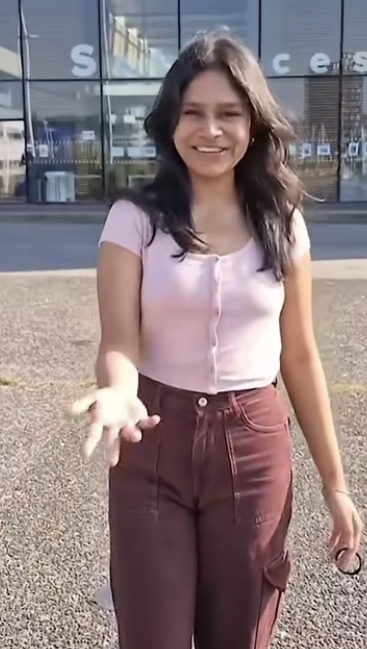
Paul Colas and DC
Photo Credit, left to right: @dc.for.year.rep via Instagram
Can you briefly introduce yourself?
DC: My name is Debashmi. I go by DC over here because no one can pronounce my name properly. I’m an international student from India. I love cats, dumplings, and adventure sports. I’m still trying to figure out how to settle in and call Le Havre and its weather home.
Paul: I’m Paul. I’m from southwest France, like far from here. (I say chocolatine. Don’t get fooled by people that tell you otherwise they are wrong.) So, well, I have never done representation through high school or middle school, which I don’t think is a problem because I have done representation before; I’ve been a scout for 10 years, 11 now. As a scout, I’ve done representations of my units at a territorial and national level.
What is the main goal you want to accomplish?
DC and Paul: We have so many issues on the campus; we’re sitting right now in front of the vending machines, in which there is nothing except a bag of Skittles and a can of Coke. And as a campus that has the second largest hypermarket, Carrefour’s CEO on its board, that’s really concerning. I think the BDE is getting new vending machines. So that’s not why we’re running. We just wanted to highlight the fact that there aren’t going to be enough options, like not even a sandwich. Also about the vending machines, we understand that it is obviously not our job to do something to replace it and everything. But our job is to make the student heard, like make their voice go to the admin. So that, like, what we can do about it is we heard that the students want more diversity, want more health, want more healthy snacks, and everything intervention machines. And that is something we can do. Like that is a message we can bring to the admin. We cannot guarantee you that we will be; [we can try].
We want to work on an academic level, regarding peer support groups in terms of just having a better student community, like for the PI readings, where everyone’s struggling collectively. That’s why we want to have support groups in place, like with regards to academics or emotional support. It’s not on the Wednesday evening when everybody has a club that people are going to work on the PI readings.
Also, the clubs have started, and we often don’t know where they are, and when they are, they’re just all over the place. And we all find it important to have extracurricular participation; that’s a topic on which we would like to work.
One more point we just wanted to highlight was especially the access to the events that happen on the main Sciences Po campus. When guest speakers come to Le Havre, we often don’t have access to the conferences, or they are scheduled when we have classes. So if you are not free, you’re sort of excluded from it. On the main campus, they have truly good events, and we’re not always aware of it because we don’t receive emails every time.
So maybe like a board like Moodle where you have all the Sciences Po Paris events, even doing like a video or sharing in order for you all to have access to the events.
We’re still under the Sciences Po banner, all campuses should be aware of what is happening. If we can’t use the advantages that come with being a Sciences Po student, like listening to world leaders and attending their conferences, it’s pretty useless, right?
Why should we vote for you and not someone else?
DC : Paul and I chose each other because I feel we were very diverse people. We identify as different genders. We come from very different places. He comes from the south of France, and I come from India. He’s from a Francophone country, and I’m from an Anglophone country. So when it comes to representing everyone on campus, I think we make a really good fit because we’re one of the most diverse duos running in practically every [way].
Minbi Roux and Elena Friess
Photo Credit: @elena_minbi.4yearrep via Instagram
Can you briefly introduce yourself?
Elena: My name is Elena. I’m in the dual degree with HKU at Sciences Po Le Havre. I’m running for a year rep because I want to represent the promotion in front of the admin and to build projects for the whole class, and I would be glad to be elected with Minbi.
Minbi: I’m Minbi I’m in the normal degree with Sciences Po. I’m French and Korean, and I would like to present myself for year rep in order to like every other year rep to represent students but also to kind of make a better cooperation with the admin rather than having the impression of having two opposite blocks, like just to make life easier here as a student.
What is the main goal you want to accomplish?
Elena: I think we wrote it in our Instagram post that our main goal was to be attentive and reliable for people, to listen to their needs, problems, and projects, and to carry their voice to the admin. So that’s why we are not only proposing projects and ideas but also showing that we are the ears that they need if you want to.
Our goal is not only to transmit projects of people to the admin but also just to help them personally because we know that as French students we already know that administration in France is quite difficult, so I don’t imagine how it can be like for international students, so just even as a person, if we can help them, rather than just being a year rep. Help them as a friend, as a co-student. So if we would remember like one project, would it be like helping more like international students get used to the French way of functioning and French administration? I think we should build cohesion between all students. Rather than having a division between French and international students, just to make a pause.
How would you create this unity? Like, how would you manage to reassemble?
I think first it will be like we said to be 24/7 reachable and attentive for international and French students. We’re available in person also with our Instagram account, for which we also made an email address so that you can write to us, and it could be totally private with us. You don’t need to go to see us, and to show that you go to see us, it’s more like you can write to us, and it will be private and confidential.
Why should we vote for you and not someone else?
Minbi: I think you can talk about us as a duo, but as for me, for example, I have been a member of the city council of my hometown for at least two years during high school, so it’s not the first time for me to like to talk in front of an administration and to convey concerns or like to just put in place some projects that are important for us.
I think I might be suitable for this post because I just won’t be afraid of administration because that’s something I’m used to.
Elena: I know I like these functions. I was class representative for the last seven years and also represented in different reunions like administration councils or international section councils in Strasbourg, and I could represent the students and the students of my high school, and I liked just the functions to represent them, and I know I can deal with all the work it came with. If there is any problem with the admin about protests, for example, I think we would have to stay neutral about it and even if we have some ideologies or ideas about it we would have to be neutral and it won’t be a problem for us to stay neutral about it.
I don’t know if people know about it, but I’ll take an example. In the 80s or 90s, one of the directors of Sciences Po thought about canceling or suppressing scholarships for some of the students. At the time, students back in the day decided to protest against this measure, and at the end, the decision of the director was cancelled.
So with this example, I think that’s one of the stakes. One of the main goals of being a Sciences Po student is to represent our ideas and to make people know about them. I think what matters the most is to represent our values. The most important thing for Sciences Po students is to represent their own values because we’re in Sciences Po; we’re in a social science school, so it’s one of the goals of our institution, I guess.
What matters the most is to represent our values, but at the same time, I think we have to differentiate the values and the way to express them. The separation between being a Sciences Po student and being the representative of Sciences Po students is in all. We will be able to differentiate what they want and the way they want to show it to the world. We would understand it, but we would have to stay neutral to make it possible.
Sara Cipriani
Photo Credit: @sara_for_year_rep_ via Instagram
Can you briefly introduce yourself?
My name is Sara Cipriani, I’m 18 years old, I’m French and Italian, and I come from the south of France. I wanted to come to Le Havre because I studied Chinese for 7 years and wanted to explore that culture deeper and this language that I am really passionate about. I am really interested in the link that Europe has with Asia in general, that’s why I chose this campus.
What is the main goal you want to accomplish?
I want to make this campus a safe place for everyone, to make everyone able to speak their minds and be listened to because this is a really big problem in Sciences Po and I really want to make sure that the admin can hear us and so be sure that the campus becomes a safe place for everyone since there’s a zero tolerance policy against any violence for any reason.
I’ll install weekly or monthly meetings in order to host events in the amphi so everyone will be able to tell me what they’d like to change and what they want to improve on campus. I also want to create an anonymous chat box about issues people don’t want to talk about in public, and I also wish to be really accessible for everyone to reach out to me because in university it’s hard to always know who you’re supposed to talk to depending on the issues you are facing. That is why I want to be a link between the students and the admin.
Why should we vote for you and not someone else?
I think you should vote for me because I am great at representing others, already have experience for representing people and to bring others voices at higher level
like when I was in the south of France I was in the youth parliament of my region so that helped me to listen to my fellow friends and to be able to make their voices heard and respected.
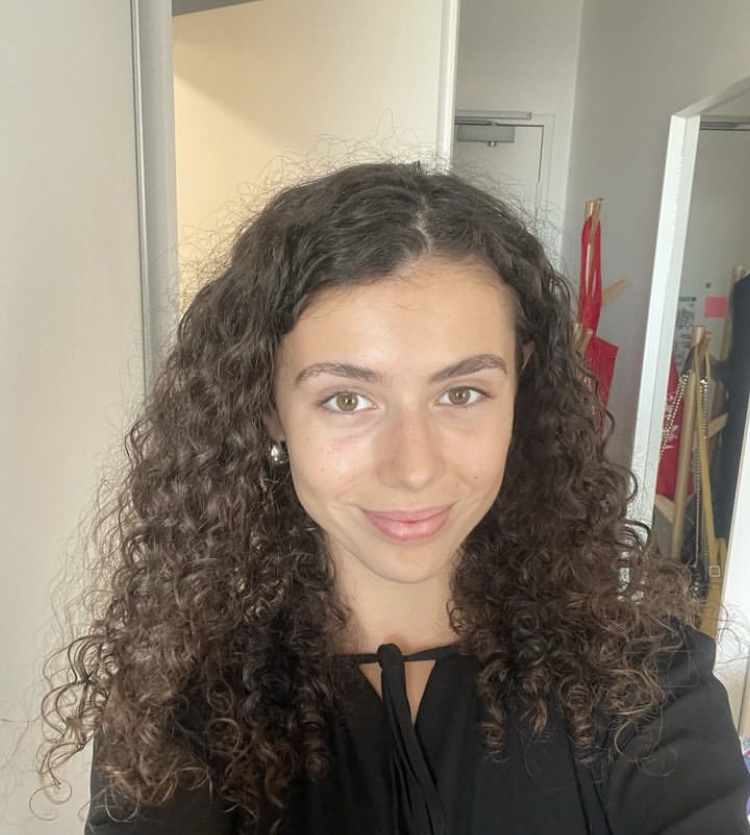
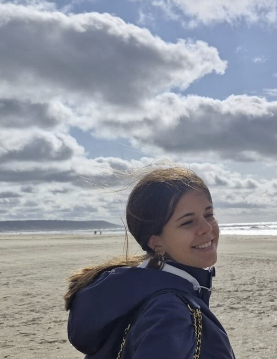
Camille Platon and Paul Ramperez
Photo Credit: @camille_year_rep_ via InstagramPhoto Credit: @votepaulyearrep via Instagram
Could you please introduce yourself?
Camille: My name is Camille Platon, and I come from the south of France. I can speak English, French, and a bit of German, and I’m currently learning Mandarin. I’m also half French and half Vietnamese, so I have a double culture, and I would say that I’m mainly influenced by my Asian family who come from Vietnam and Laos.
Paul: I’m Paul Amperez, I also come from South France. My main hobbies are playing guitar and meeting new people. I’m pretty sociable, and I like to engage myself with others in general.
If we should remember only one thing about your program and the main ideas you want to fight for, what would it be?
Camille: I think it would be to make sure that there’s no gap between the international and the French students, because as we are the most international campus of all the Sciences Po campus, it’s really important that we all stick together, and that our cohort is connected, and I don’t want any person to feel left out and to have problems of integration. I want you to see me as someone with whom you can talk with no pressure and no judgment.
Paul : We have pretty much the same ideas, I really want to focus on integration, and notably because the diversity of this campus is certainly the thing that I prefer, so I would like to create solidarity and mostly cultural exchange between the people.
And about concrete measures, I will insist on communication through an Instagram page, where we will post all the news about the administrative stuff, but also where people will contact us about integration, cultural exchange, and all the issues they could encounter, problematics, and notably through an anonymous chat.
Why should we vote for you and not for other candidates?
Camille: Because I would say that I have really great communication skills that I got with my personal experiences. I worked since four years in an sailing club, so I have encountered a lot of different people, from the elderly to children, so I don’t have any problem with communication, and I’m also not afraid of conflict, so I will not hesitate to speak to the face when there’s an issue that needs to be solved, and I will be ready to defend the ideas and the point of view of the students in front of the admin.
Paul : I’m really involved in all the things I do, and I think I’m social and empathic, so I will be there to understand people and to really find a solution for every issue there.
And there — you’ve seen it for yourselves, readers. This year we have a whopping 15 candidates running for year rep – we’re spoilt for choice! With so many appealing options, choose wisely, Mushus!
Last weekend, we stumbled upon Le Havre’s annual maritime festival!
All photos by Yu Xuan Neo and Syontoni Hattori-Chatterjee.
9 September 2024
After our brunch at Brunch & Bowl, we were drawn towards the bustling street lined with dozens of booths. It was the annual La Fête de la Mer organized every first weekend of September in Le Havre!
So what is this exactly?
According to Bee Le Havre, it is meant to “celebrate the sea through multiple animations.” Seafarers, merchants, port workers — basically anyone in the maritime world comes together to celebrate the festival. This is a key event in Le Havre (a port city, as we all know): the sea is its lifeblood.
Entry 1:Yu Xuan – The Forbidden Babymobiles
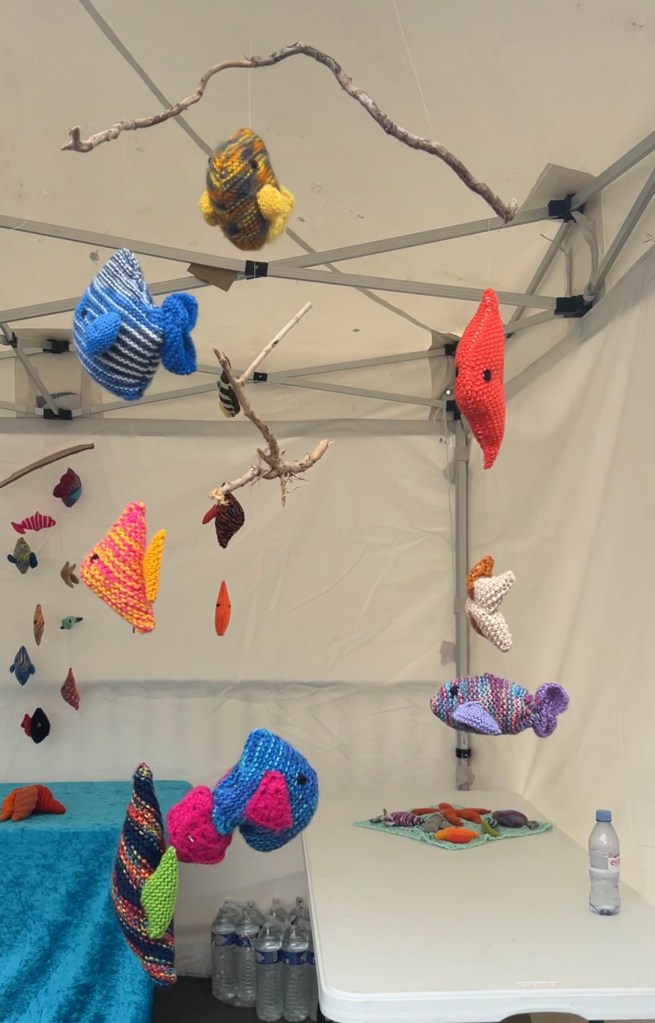
The first thing that caught my eye were the adorable sea-themed babymobiles that were hand-made and crocheted.
P.S. I wanted to buy one really badly, but they said it was only meant for decoration purposes for their workshop 😦
The fête sold absolutely everything you can think of, ranging from crystals, pastries to even spices: we paused at every booth to admire their products. I couldn’t help but appreciate how the constant flow of people and the happy chatter around us injected so much life into our little city!
Entry 2: Sy – Spicy Pirates
Speaking of spices, shout out to the nice man at the spice booth who saw our wandering eyes and let us try some fun ones for free. Sesame seeds flavored with prune umeboshi made me think of my aunt’s house and sesame flavored with kimchi reminded me to make a quick trip to Hoa Soung (RIP but not RIP if you’ve been keeping up with LDD’s other articles).
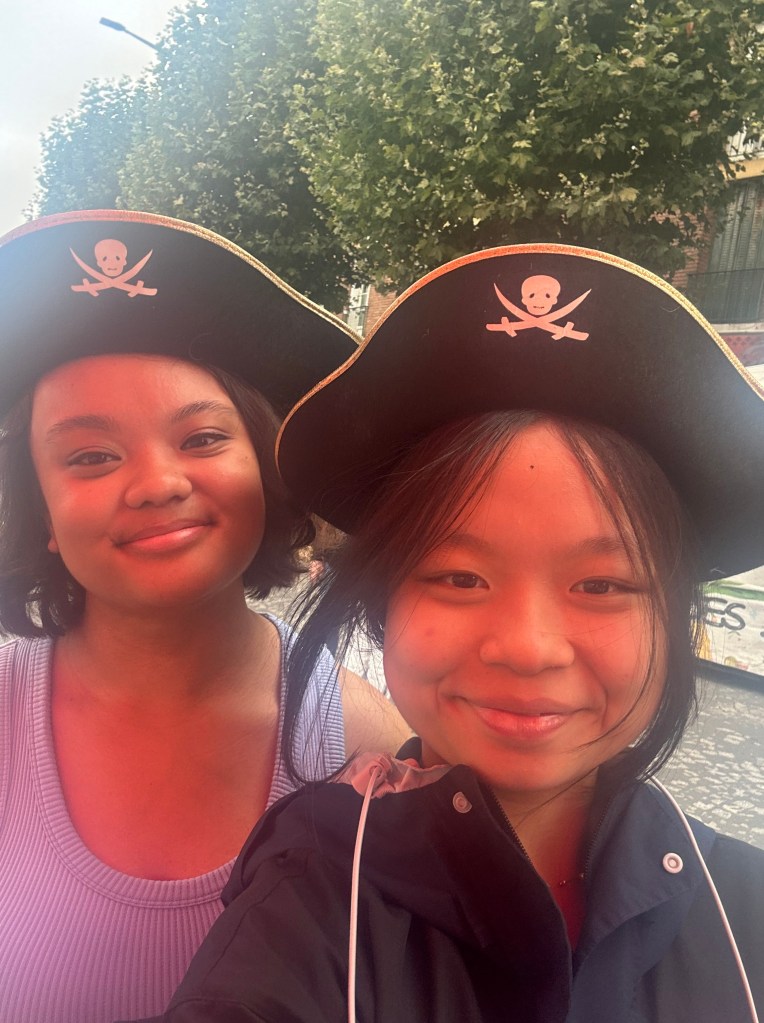
Yu Xuan and I also tried on some pirate hats but decided to go as something a bit less on the nose for Halloween in Le Havre
Entry 3:Sy – Vintage Postcard Tea
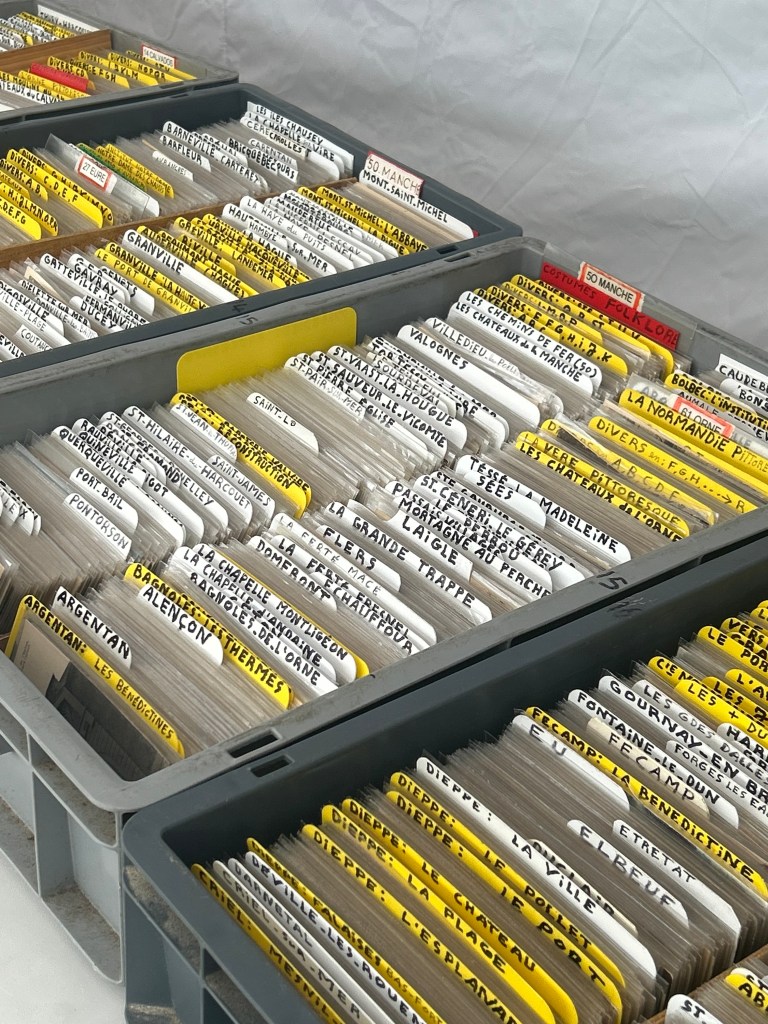
As we walked on further, we found a stand with dozens of boxes filled with old postcards from all over France and all over the world. We rifled through tabs from Toulouse to Saint-Lo and found that they were not merely vintage keepsakes, but actual postcards that people had written in and sent to their loved ones decades ago. I could have spent forever at that booth, perusing gorgeous illustrations and black and white photographs of French and world landmarks and then reading glimpses into the everyday lives of the people who visited them. From sweet messages to siblings, passionate letters to lovers, and cheeky notes to friends, the nosy drama lover and journalist in me certainly got her fill of old-timey tea.
Entry 3: Yu Xuan and Sy – Buttery Brittany Deliciousness
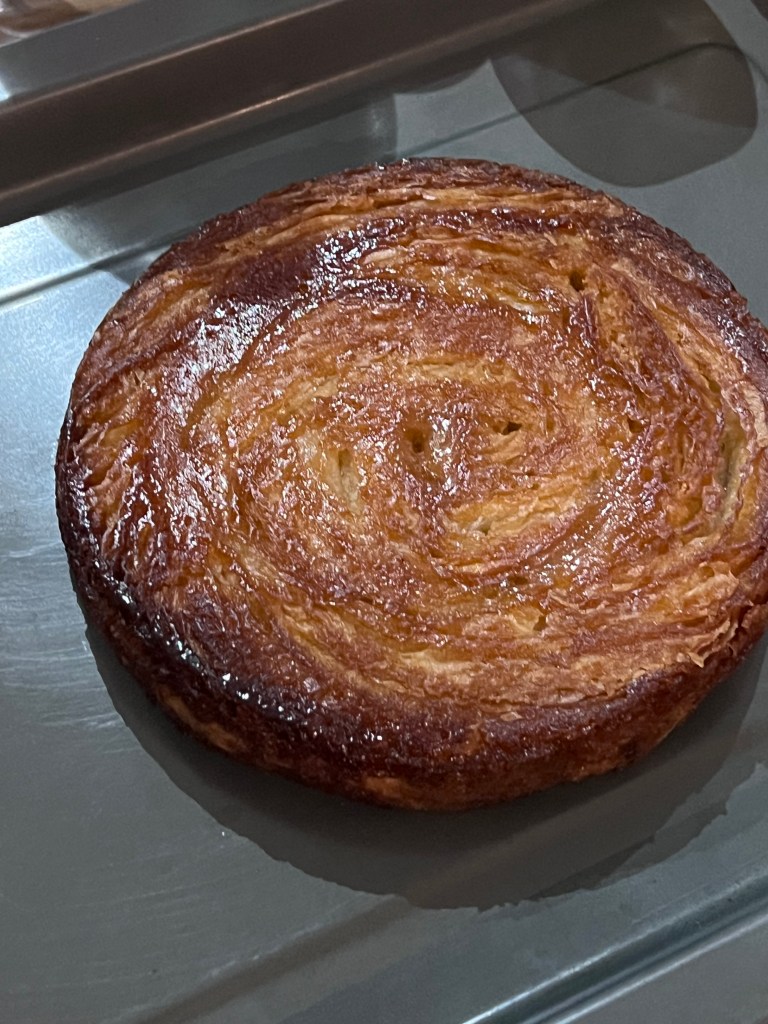
Y: We also chanced upon Elise, who introduced us to the famously buttery Brittany delicacy Kouign Amann sold in the fête! We were won over immediately and RUSHED to cop some to share!
S: I brought mine to a dinner with friends that night and it was a massive hit. Shout out Hotel California for hosting and the great people of Brittany for making a pastry that tastes as close as possible to literally just eating butter.
Entry 4:Sy – Mini Boats, Mini Boat Cars, and Houses With Feet
Next, the swashbuckling sound of seafaring music drew us to the LH Port Center stalls. First, we took a moment to watch the motorized mini boat races in the pool next door (go Canada!) Then, Yu Xuan and I excitedly waited for an opportunity to get into a mini boat on wheels and ride though the maze showcasing countries along worldwide shipping lanes. Unfortunately, we discovered that despite our childlike height, we were too old to partake in this activity designed for children. And yes, it was embarrassing to ask about it and get turned down. Nevertheless, I overcame this L and had a nice conversation with an LH Port Center intern and the director about their upcoming public reopening in November. For kid-friendly and more adult-oriented programs to discover the industrial portuary activities that dominate our city, I highly recommend going to check them out.
A bit further along, we gazed amusedly at a new Un Été au Havre sculpture. Since 2017 when Le Havre celebrated 500 years since its founding, the city has sponsored new public art installations every summer to bring new charm, character, and occasionally confusion to its streets. Fan favorites remain in Le Havre once the few months of sun has passed, such as La Catène de Containers and my personal favorite, the Narrow House. What do we think of this one: does it really have “No Reason To Move”?
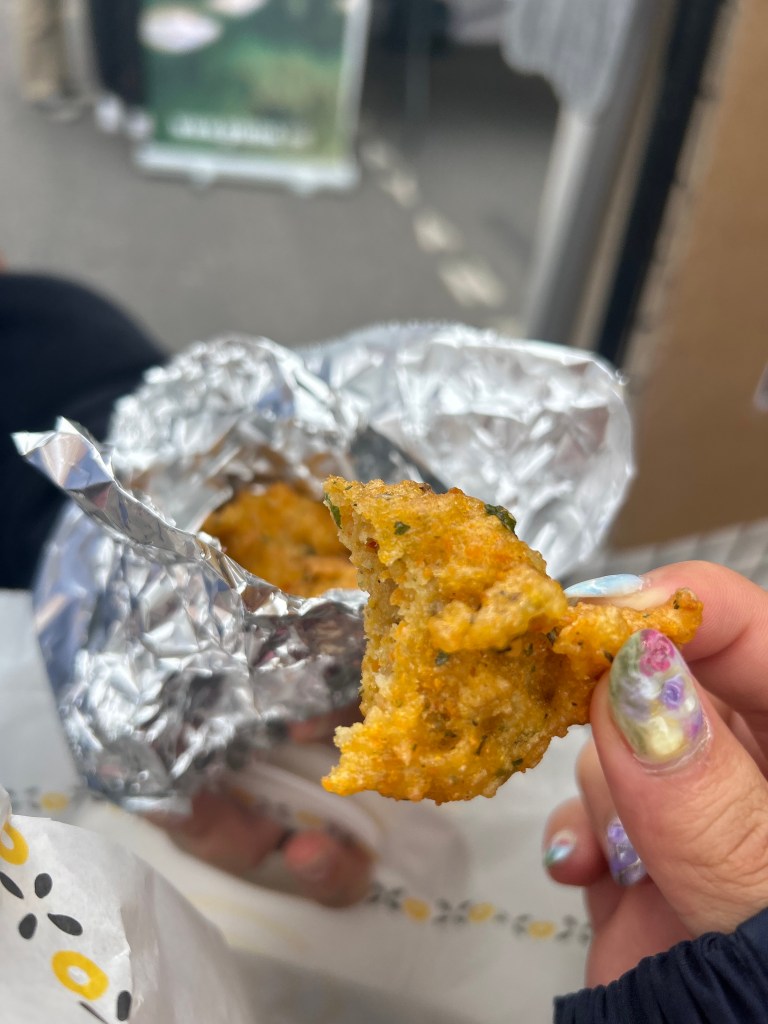
Entry 5:Yu Xuan and Sy – Snack Time! Y: As we walked further into the street, we bought some carrot fritters to share from the stand dedicated to Culture Antillaise! They were priced at 2 euros for 6, and they were fried to perfection. Crispy on the outside and soft on the inside, they were the perfect midday snack! It kept us warm as we wandered through the light breeze.
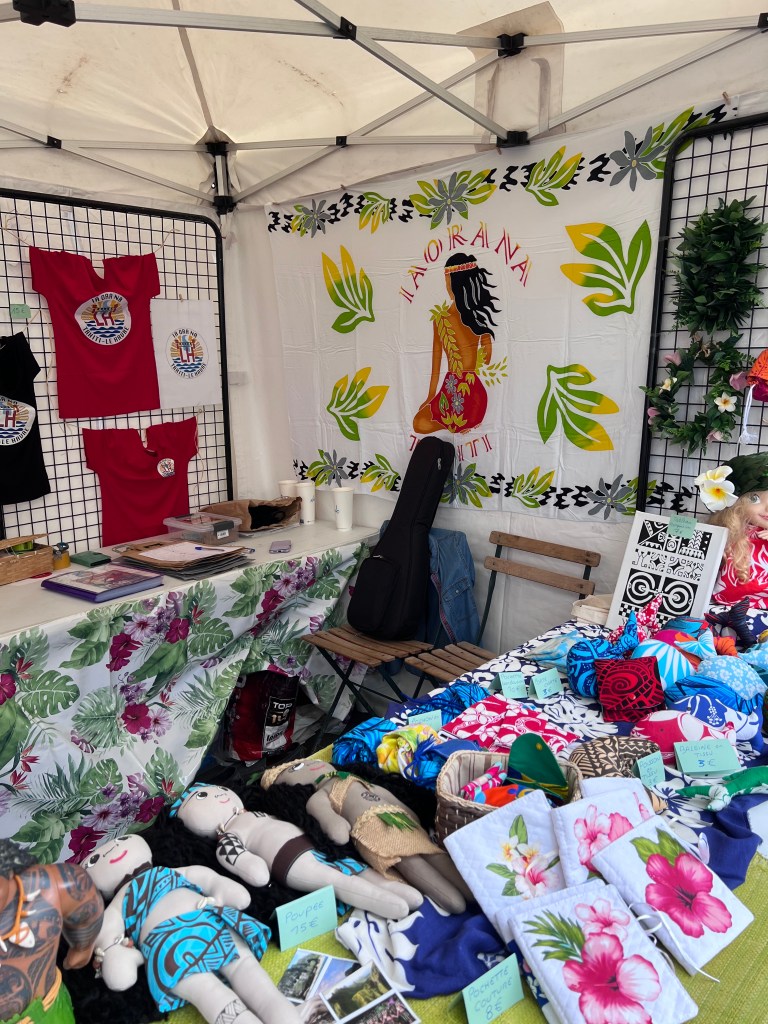
S: We also chanced upon a booth for Le Havre’s Polynesian and Tahitian culture association. They had more yummy treats as well as handmade dolls. They told us about the dance and singing workshops they conduct for their members and the community they build for Polynesian students in Le Havre and people interested in Tahiti and Polynesia.
Entry 6:Yu Xuan – Diving Into Le Havre Associations
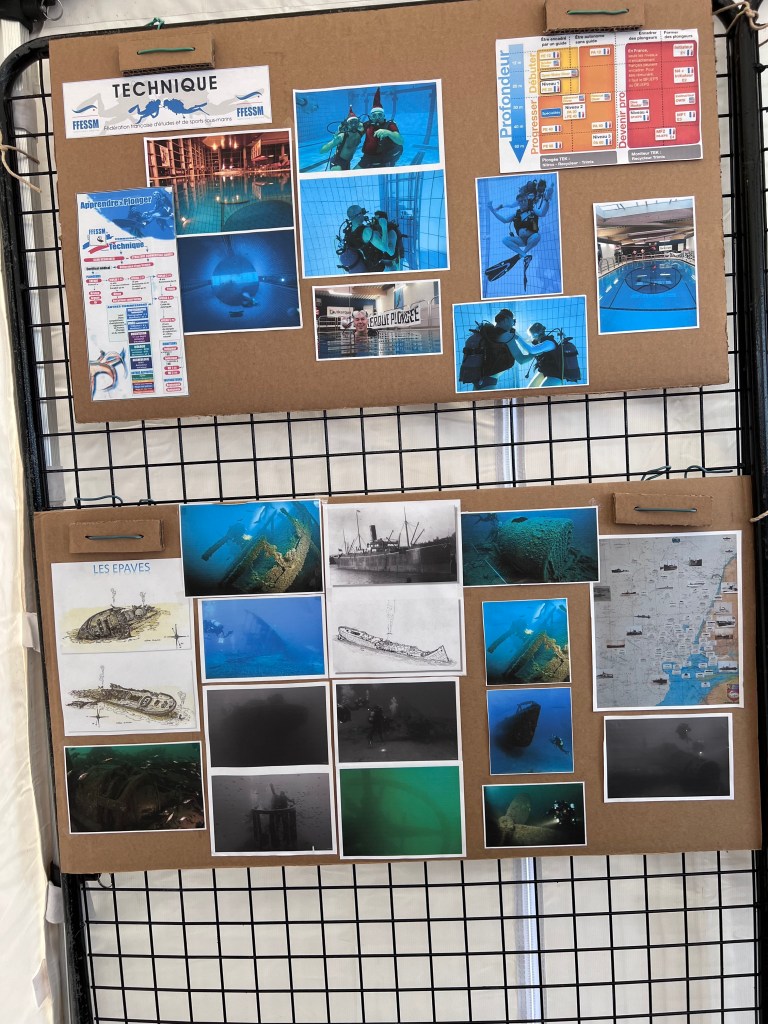
Afterwards, we approached a diving booth. The booth was decorated with colorful pictures, and it even included a documentation of weekend diving explorations in one of Belgium’s reworked diving basins called Todi. Apparently, it was an old mining silo, and eventually, a whole ecoSEAStem (haha) grew there, with fishes of varying shades of the rainbow. Enraptured by the pictures, I asked for more information. As they told me, they offer bi-weekly diving sessions in Le Havre, on Wednesdays and Saturdays! There were 2 types of diving sports that they offered — one was plongée; while the other was more professional (training one’s holding of breath underwater). For a year-long subscription for their diving equipment and diving lessons (fromSeptember to June) held in the Piscine de la Mare Rouge, it was approximately 210 euros in total. Definitely an unusual but unique hobby!
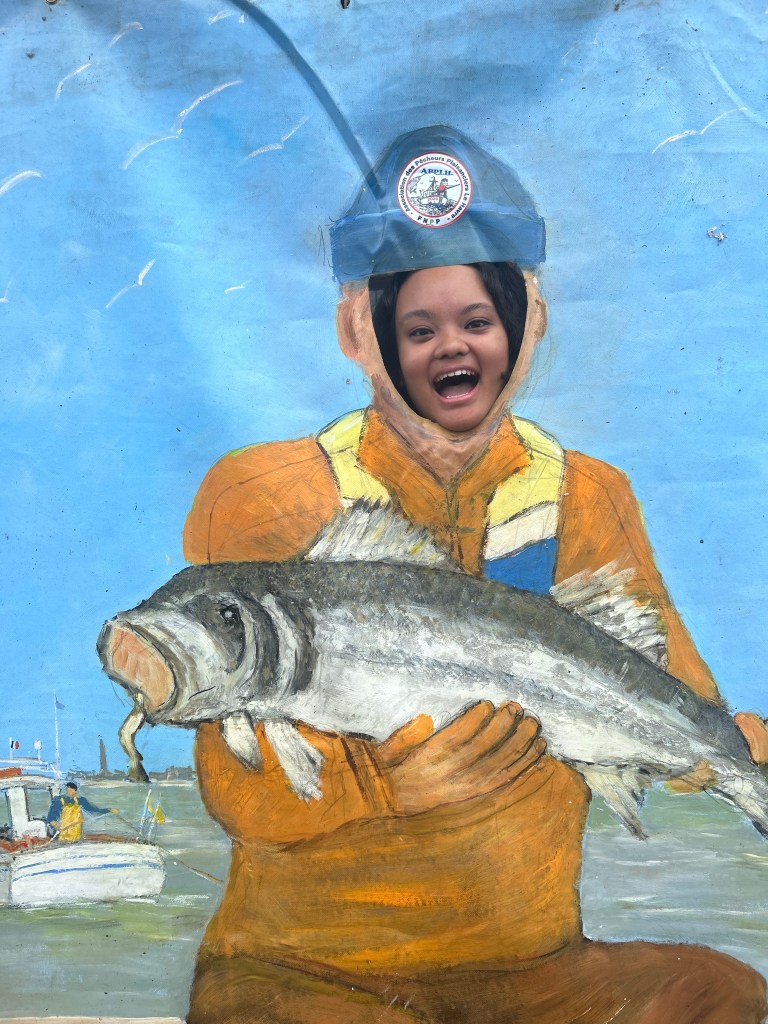
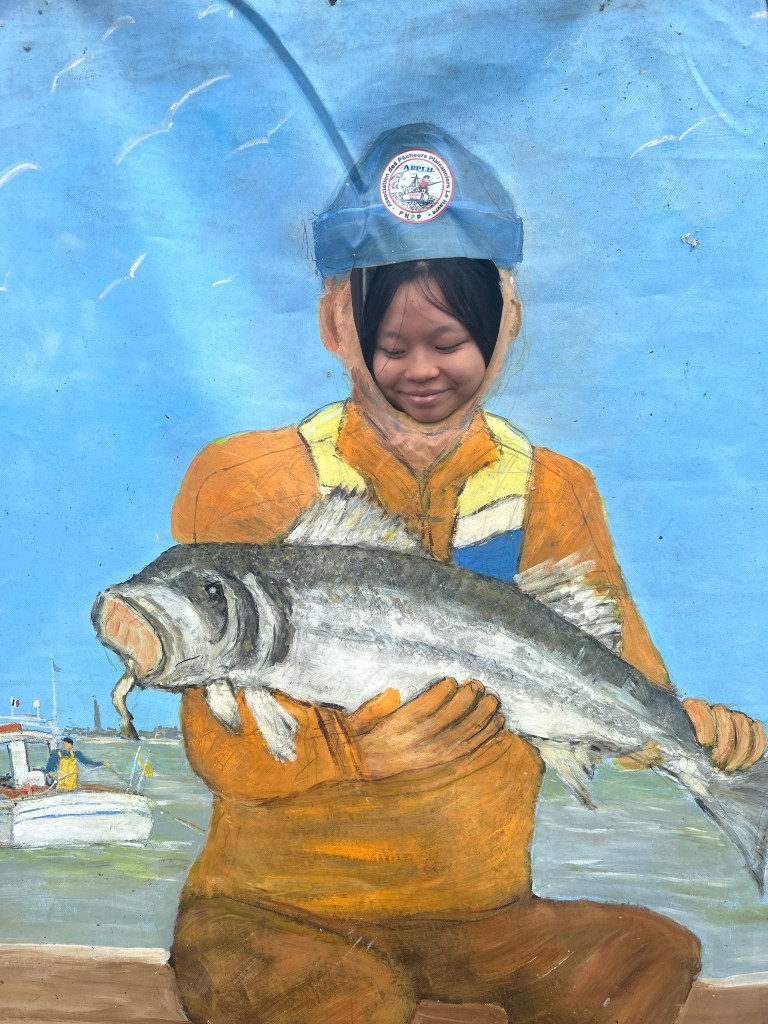
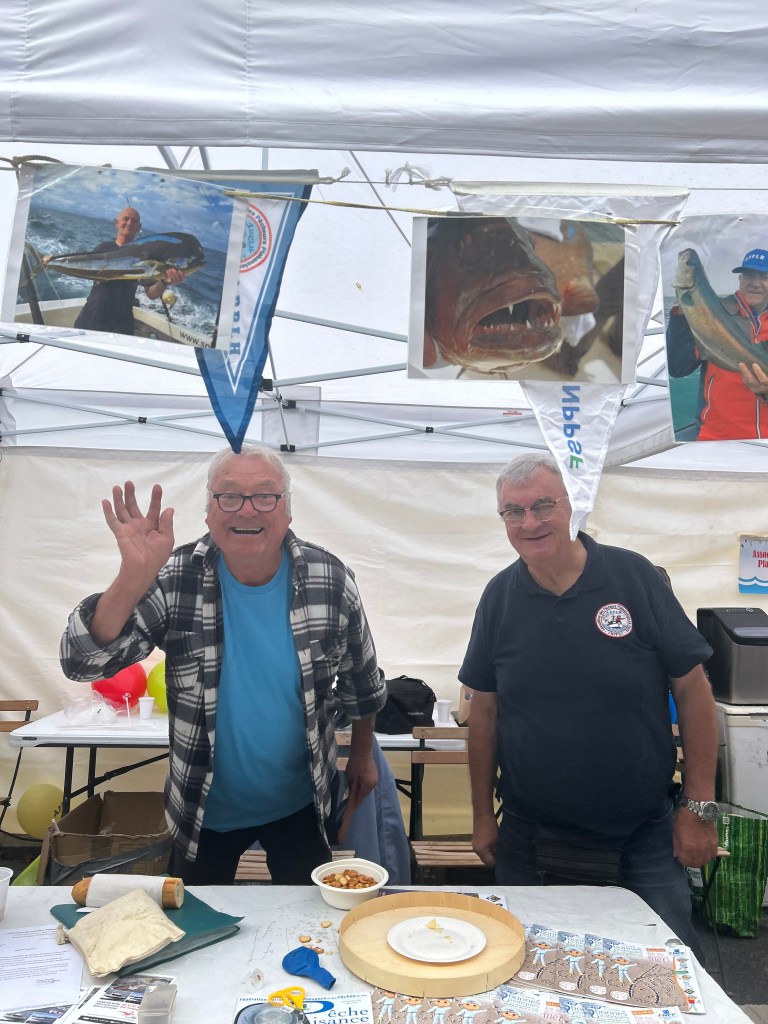
Entry 7: Yu Xuan – Friendly Fisherman Nearby, there was a long stretch of stands that were bustling with life, which seemed to belong to the same association. Intrigued, we walked closer and we found that it was a LH fishing association. The fishermen proudly displayed their array of pictures — including the terrible looking dorade fish. I was especially impressed by their passion and welcoming spirit, as they were trying their best to communicate in English with me due to my dismal French skills. They sat us down, while demonstrating in real time how they fish, what kinds of specialized hooks they use, and displaying their different kinds of hooks. How fitting it was that they gave us goldfish biscuits to snack on! Pushing dozens of fishing brochures to us before we left, we walked away with our arms (and hearts) full.
Entry 8: Yu Xuan– Sciences Po Sailors
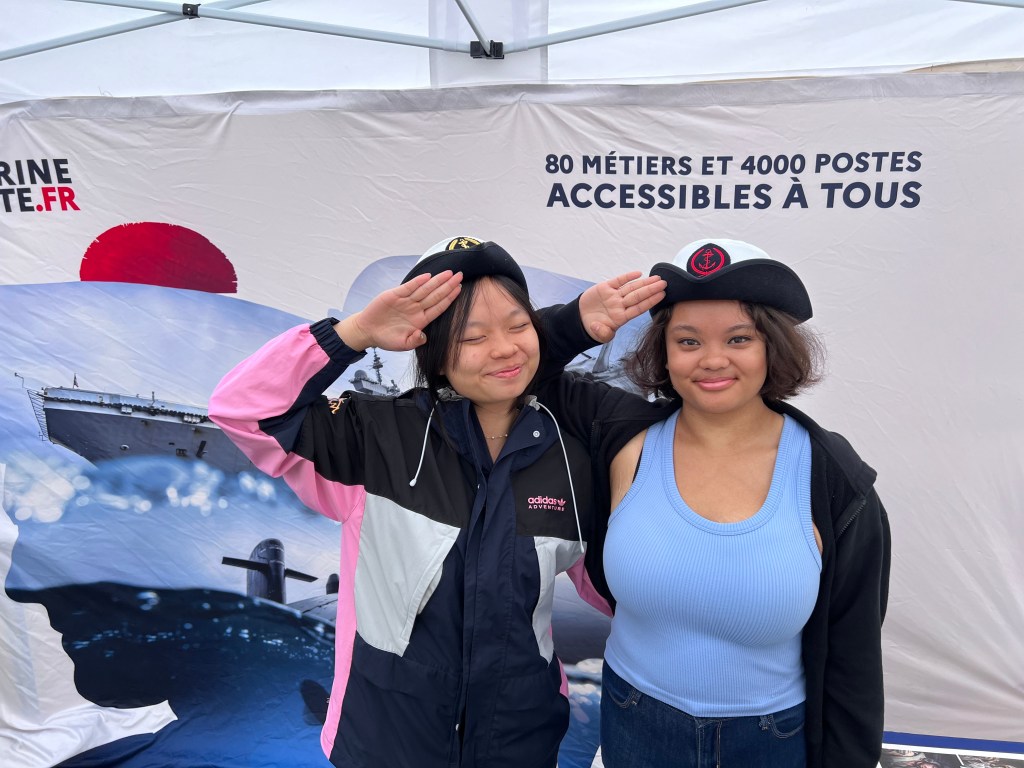
Lastly, we found ourselves in a navy booth! My eyes were drawn to the TV screen and the Augmented Reality Headset. It was an AR experience where you get to go into the augmented navy ship, experience flying on its helicopters, boating on the ferries, and exploring the ship. I could’ve sworn I felt the wind blow as the helicopter that I “was on” took off! It was a surreal experience and I loved every bit of it. While I was trying on the AR set, Syontoni had a chat with the navy officer manning the booth, and that was when we found out that he was Baptiste, a senior from SciencesPo Le Havre! He’s currently pursuing his Masters at SciencesPo in Paris, and he was back in Le Havre to reminisce about his parcours civique experience that took place in the navy.
In conclusion, we had an amazing afternoon exploring La Fête de la Mer and learning more about all of the maritime activities and cultures that the city of Le Havre has to offer. We hope you enjoyed our diary entries and for 1As that they might have convinced you to check it out next year!







 Le Dragon Déchaîné