On being French and Vietnamese, and the issue of Vietnamese immigrants.

Inspired by the Humans of New York platform, first year student Jason Trinh interviews Lucas Lam. He intends to write down the stories of our students on campus, and connect them with the bigger relevant issues in society.

You have heard of Vietnamese Americans. Their stories are everywhere, some of them best sellers like Thanh Nguyen or Ocean Vuong. But what about the Vietnamese French? Today I will tell you the story of Lucas Minh Duc Lam.

When I first arrived on the Sciences Po campus, the most commonly asked question, both by other students and by me when greeting new people, is “Where are you from?”. I answered the question easily, and admittedly I even felt a little bit proud of the answer I could offer, knowing that I was the only Vietnamese student going to the Le Havre campus this year. I was born in Vietnam to a Vietnamese family, speak Vietnamese fluently as a mother-tongue, had a Vietnamese upbringing and attended Vietnamese schools. It’s the life of an average Vietnamese. However, my I was surprised once when I answered the question with the same answer. The person went, “I think there is another Vietnamese”.

It turned out that the Vietnamese mentioned was Lucas Minh Duc Lam, but unlike me, he is not the “average Vietnamese”, or at least that was my impression when I saw and talked to him at one of the first social events. His vibe let me know immediately that there was some familiarity; he is humble, a little bit shy (maybe because we spoke in English?); he even looks like one of my cousins, who is really thin with slender hands and a short, carefree haircut. I couldn’t help but feel extremely curious: being in Vietnam for my whole life and surrounded by other typical Vietnamese, I did not really understand the life of Vietnamese abroad – those who are originally Vietnamese, but officially some other nationality. I have heard of the Vietnamese-Americans: they are easy to recognise as most of them call themselves Vietnamese, most of them migrated to the United States after the Vietnam War by highly dangerous ways such as boats, hence the birth of the term “boat people” which is often used to describe first generation Vietnamese-Americans. Some of them are very widely known authors such as Viet Thanh Nguyen and Ocean Vuong. But I have never heard of the Vietnamese French. I decided to interview Lucas directly, and this article is the recap with some reflections with the talk I had with him.

***

We had our talk in the library, one Friday afternoon right before the Fall break. I texted and asked for Lucas’ participation before, with his first response being, “I’m afraid I’m not an interesting person”, reaffirming my impression of him as a very humble one. I started the conversation with some very basic question: his childhood, his upbringing, his parents, etcetera. Lucas’ parents are of Vietnamese origins. Officially, Lucas is French. He was born and raised in France, around Paris, speaks French fluently as his mother-tongue, had a French upbringing and attended French schools. He was even named a French name, with his Vietnamese middle names rarely used. Spiritually, he is… also French. Lucas does not speak Vietnamese well; he does not identify as a Vietnamese, not because he is not proud of his origins, but rather because his parents raised him as an integrated French citizen, and now he just feels more French than Vietnamese. “It seems to me that there are two types of Vietnamese here” – Lucas told me – “The first type is the very patriotic one. My friends from secondary school, some of them have Vietnamese parents,and they were raised in France. Whenever somebody asks for their identity, they say they are Vietnamese. The second type is me.”

However, he also expressed that his parents helped him appreciate his culture and reminded him of his origin: they “only cook Vietnamese food” for him when he is home (which he admitted that he enjoys very much) and sent him to a school that had Vietnamese in his subject choices (there are only two of them in Paris). Lucas still identifies as French not Vietnamese, because other than the food and some of the basic spiritual or celebratory rituals like the Vietnamese New Year festival Tết or the famous Vietnamese food phở and bánh cuốn, he admitted that he doesn’t know much about the Vietnamese life. “My parents don’t want to erase my origin, but they wanted me to integrate into French society, to feel like a French person. After all, Vietnamese is just my origin; French is my nationality.” He also told me that among the Vietnamese community in France, it’s not always the same, but in his case, even his parents feel very French nowadays, as they have lived in France for more than thirty years. “I think it’s very nice to be allowed to be a part of French society and at the same time respect your own origin.”

I asked him more about his parents and their political opinions as the discussion moved to a more political sphere. His parents, from small provinces of Vietnam in both the North and the South, came to France as a result of the Vietnam War; but unlike most first-generation Vietnamese Americans who are highly anti-communist, his parents are said to be neutral in Vietnamese affairs. They just wanted to maximize their opportunity abroad, he said. I asked him if the community of French people whose origin is Vietnamese holds the same political position. “It depends, really. Many of them are very anti-communist, yes. But many are just like my parents who feel more French than Vietnamese, therefore they now only care about French politics.” He also admitted to me that his parents do not talk to him much about Vietnam.

He spoke of his experience as being “the only Asian in the whole school” back in the time when he lived in the countryside near Paris. He was mocked at school, but fortunately he was backed and defended by many friends. When he moved inside Paris which is a melting pot with many different people, he and even his friends never experienced racism again. He told me that there are many stereotypes – or “cliché”, to use his word – about Asian people, but most of them are good ones, such as Asian people are hard-working, intelligent and good at math. “I think the racist, bad cliché targets black and Arab people, so it’s much harder for them.”

***

At the end of the conversation, we talked about Sciences Po, about why we chose Sciences Po, about our future occupations. When asked about his plans for his future kids, if any, he told me that he would try to teach them about Vietnamese culture, about Vietnamese food, but it will be hard to teach the language.

I said goodbye to Lucas and went home to prepare for the Fall break. But the conversation with him has stayed in my head for a while, until now, whilst I’m writing it down. I have always felt like the serious conversation about the Vietnamese abroad is rarely had among the Vietnamese at home; if they do exist, they are mostly offensive jokes on the internet made by the Vietnamese at home about betraying and leaving the motherland, about refusing the identity. On the other side, the Vietnamese abroad (many times the Vietnamese Americans) talk of the Vietnamese staying as the “commies”, as uncivilized and uneducated, authoritarian-loving people. The Vietnamese at home and the Vietnamese abroad, mostly Vietnamese Americans, are even divided by the version of Vietnam they identify with. The Vietnamese at home identified with the Socialist Republic of Vietnam and the red flag with a big yellow star in the middle. The Vietnamese abroad identified with the Republic of Vietnam (the old South Vietnam regime back in the Vietnam War) and the yellow flag with three yellow stripes. The division is deeper than anything non-Vietnamese people can imagine. Many people are surprised when I tell them that I could not walk into a Vietnamese-owned phở restaurant in the United States and speak Vietnamese, because then my Northern Vietnamese accent would be exposed, and Vietnamese Americans might behave badly as a response.. The understanding between the Vietnamese at home and the Vietnamese abroad is almost non-existent. That is why when President Donald Trump decided that he could deport Vietnamese migrants from the Vietnam War back to Vietnam if they have any criminal offences, it hurt the Vietnamese community abroad in an unimaginable way: the Vietnamese government wouldn’t recognize or accept those people into Vietnam, and the Vietnamese people also wouldn’t sympathize with the deported people.

Maybe because of the strict censorship in Vietnam. Maybe because of the deep, penetrated hatred inside the people abroad who fled the country out of fear. But the conversation has never occurred, and I’m just very glad that I had the chance to talk to a Vietnamese who has grown up in a Western country, from the other side of the world, the other side of the conversation. Maybe the Vietnamese community in France isn’t as hateful towards the current Vietnamese regime as the community in the States, but there are undeniable differences in our mindsets, our lifestyles, our upbringings, and our opinions.

The current event in which 39 bodies were found inside a container in the United Kingdom, most of them suspected Vietnamese nationals trying to immigrate, sparked conversation among Vietnamese people. Vietnam nowadays is not having any wars and the economy is growing very fast, but the trend of immigration is still visible because many (mostly poor) people dream about the Western life and then follow the smugglers to migrate to Western countries. Is it illegal? Yes, but one thing that rather privileged people like you and me don’t understand is the desperate feeling of having no choice, of wanting to be better and to provide better for your family.

It is important to remember that not all immigrants’ stories are warm-hearted stories. People like Lucas and his parents can be said to be very lucky, to not only successfully come to France but also to successfully integrate into society. But somewhere out there, there are immigrants who die in freezing containers at -25*C, with their desire to have a better life unfinished, and we shouldn’t forget about them.

Photos: author.
Nostalgia in North Korea: traveling to the DPRK

It is a great pride for me to be invited to talk about the misconceptions of North Korea. Admittedly, traveling to North Korea is not commonplace, nor totally safe. However, my journey to North Korea this winter was a rather brief one. I’m not capable of interpreting the social phenomena in the country like a geopolitics expert, but it’d be useful to review our impression of the state that media has imposed on us in the light of what we have experienced and witnessed.

(above) click on image to view full gallery. All photos provided by Runhang Zhong

To clarify, I am not, and will not in the short run, glorify the regime. Nor will I state that what the media has told us may be wrong or biased to undermine the fact that North Korea is falling behind. It is by no means a paradise, with an ironic hierarchy in a revolutionary state, a strict control of society, a culture castrated by the government, and of course, after paying attention to the poor conditions of roads in Kaesong it is self-evident that the economy is far from prospering.

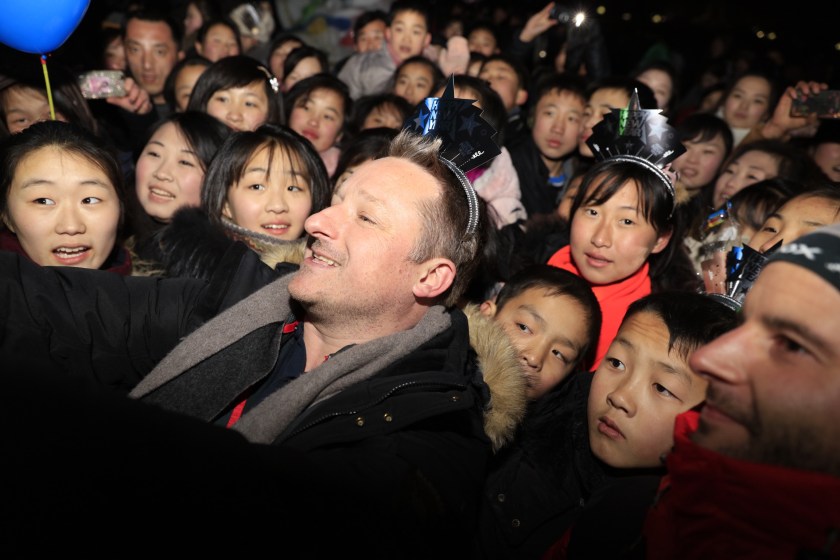
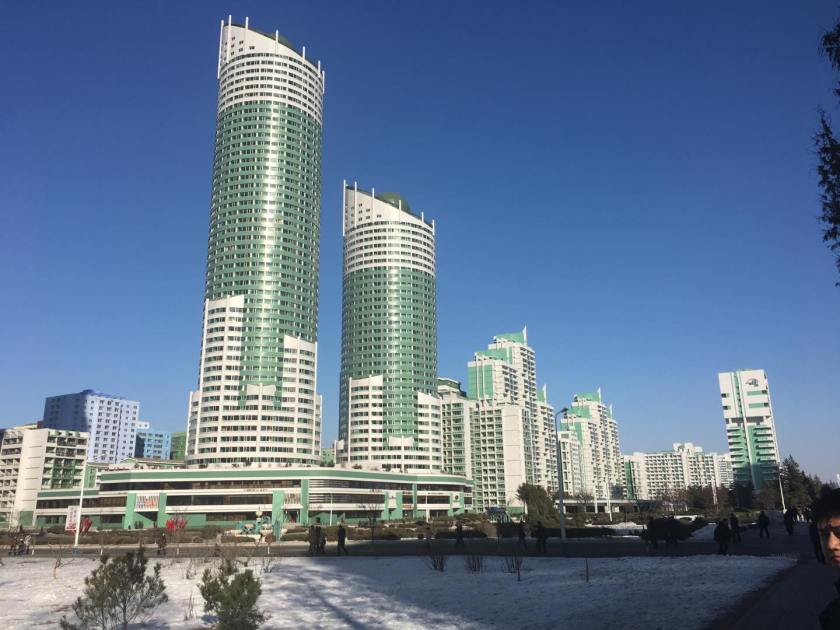
But these are less exposed to and less known by the public; Ryomyong Avenue rose from dust in nine months; 4D films are available in the Palace of Science, Technology, and Culture in Pyongyang; citizens of Pyongyang chanted and danced happily with us foreign visitors to celebrate the new year of 2018. North Koreans are not as dull and emotionless as one may imagine. It should never be forgotten that the DPRK is, rather than a keyword of international politics’ news, a state where 25 million people are living.

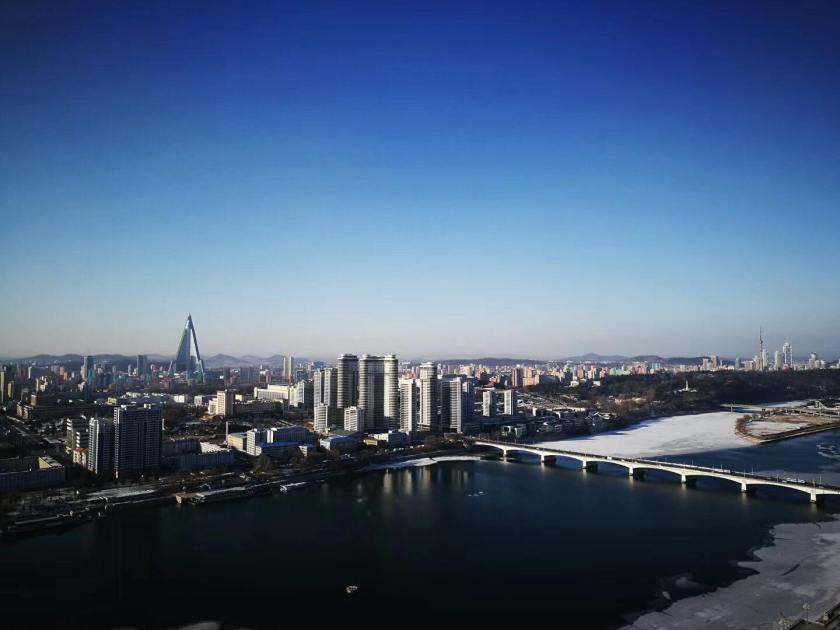
Let’s begin with the economy: the most striking contrast between the DPRK and its Southern counterpart. It’s easy to observe the poverty in the country upon crossing the Yalu River, with the grey buildings and poorly-equipped railway station in sight. But a more impressive point haunting my mind is the wide gap between Pyongyang and other cities. While other cities like Sinuiju and Kaesong reflect the image of the DPRK in our minds, Pyongyang is definitely another world

Image: View of Pyongyang seen from the top of Juche Tower (Source: Runhang Zhong)

Pyongyang is comparable to second-tier or third-tier cities in China with neat streets, tall buildings, and crowds shopping for the New Year in supermarkets. Public transportation is well developed: buses and trams, which are always purchased from former East Germany, come every other minute, carrying people to every corner of the city. Though not a large amount of vehicles are kept, traffic jams do occur at around 7 pm. Electricity shortage remains the biggest problem; the city was completely dark at 8 pm, which I witnessed from the 44-storage high Goryeo Hotel. Despite this being said, computers are accessible for free to Pyongyang citizens, especially primary school students, to get access to local networks for academic papers and resources about science, technology, languages and many other disciplines.

Image: Celebrating the new year of 2018 with Pyongyang citizens. (Source: Fangzhou Zhao)

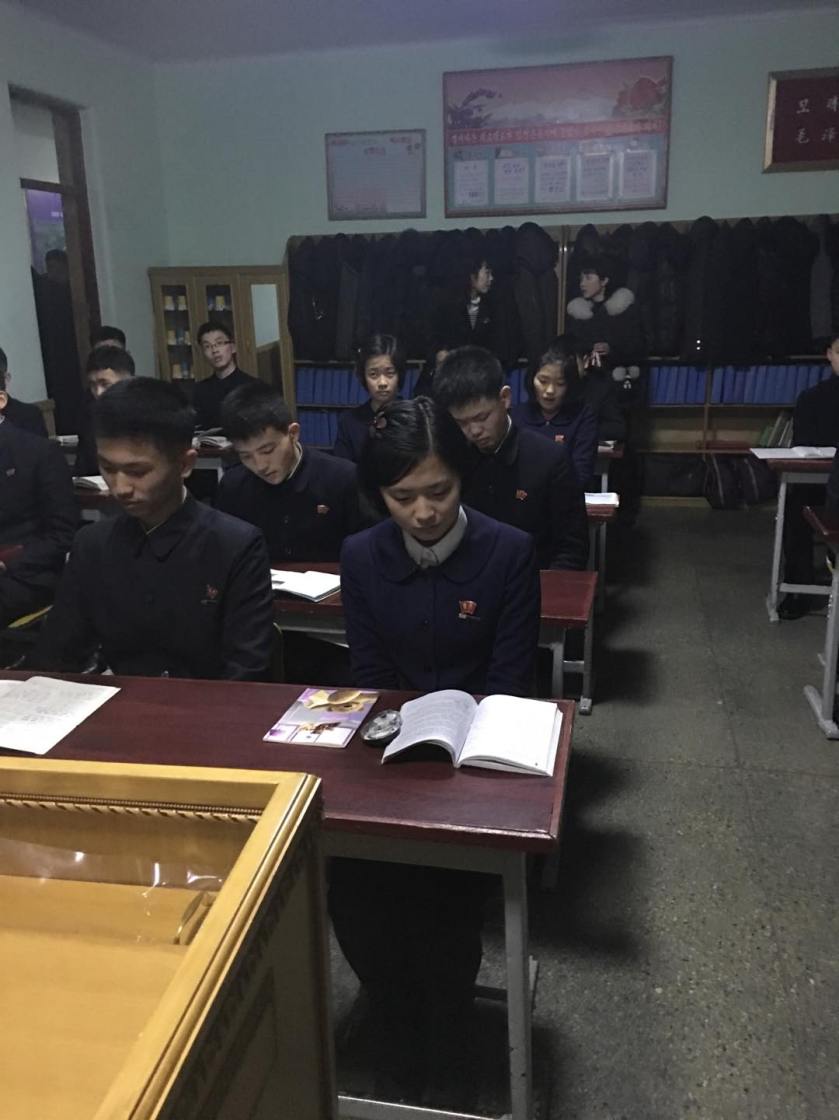
It’d be a unique experience to speak English with North Korean people in Pyongyang. Certainly, they know English, though limited. “Class of Mao Zedong” of East Pyongyang No. 1 High School was not only a class to enchant the Sino-DPRK friendship but also to select outstanding students to serve the country.

Image: The Class of Mao Zedong. They were preparing for the college-entrance exam (source: Ruhang Zhong)

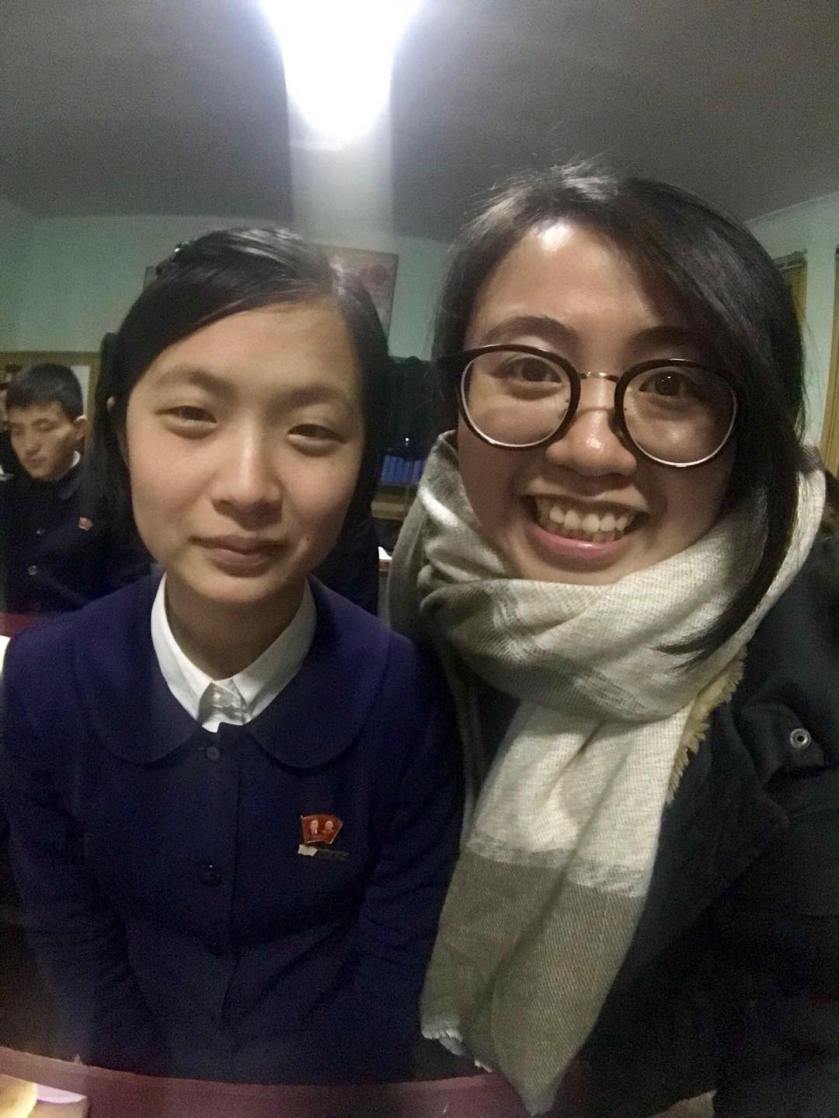
How old are you?” One of our teammates asked.

Sixteen.” Responded a shy girl.

She went on to introduce all her subjects, her favorite, and the fact that she was preparing an exam to get enrolled in a university in April, with English impressive enough for all of us.

Image: The girl who spoke English with us. (Left) (Source: Wanting Hsieh)

But that was only part of the story. Another occasion where I showed off my English was when I encountered a woman selling snacks on the street. She was well aware that I am a foreigner for there was no badge of Kim Il Sung and Kim Jong Il pinned on my chest. I pointed at the snack I would like to try and handed out my Renminbi.

No. No. No, accept Yuan.” Renminbi seemed to be too expensive for her, or perhaps she did not have the correct license to conduct business with foreigners. But “accept” doesn’t sound like a word spoken by a woman who did not study English.

Yes. 5 for 2.” She finally reluctantly accepted my coins. One may make the accusation that her grammar constitutes a solid reason to suspect her as an American spy.

English can be seen even in kindergartens. Displayed together with propaganda posters and portraits of Kim Il Sung and Kim Jong Il, there were toys to learn English which were said to have been smuggled from South Korea because some Korean vocabularies like pencil had been erased to be replaced by more “native” ones.

Some may question those to be “performed” in front of visitors to deliver an embellished vision of the country. Surely the DPRK authority lies sometimes, like what they told us about religious freedom when we were in a Catholic church. But I’m inclined to attribute the seemingly surprising phenomenon to the inequality and hierarchy in North Korean society, within which the most trustworthy social groups are relocated the most resources. And undoubtedly the DPRK requires educated people to sustain the functioning of the regime.

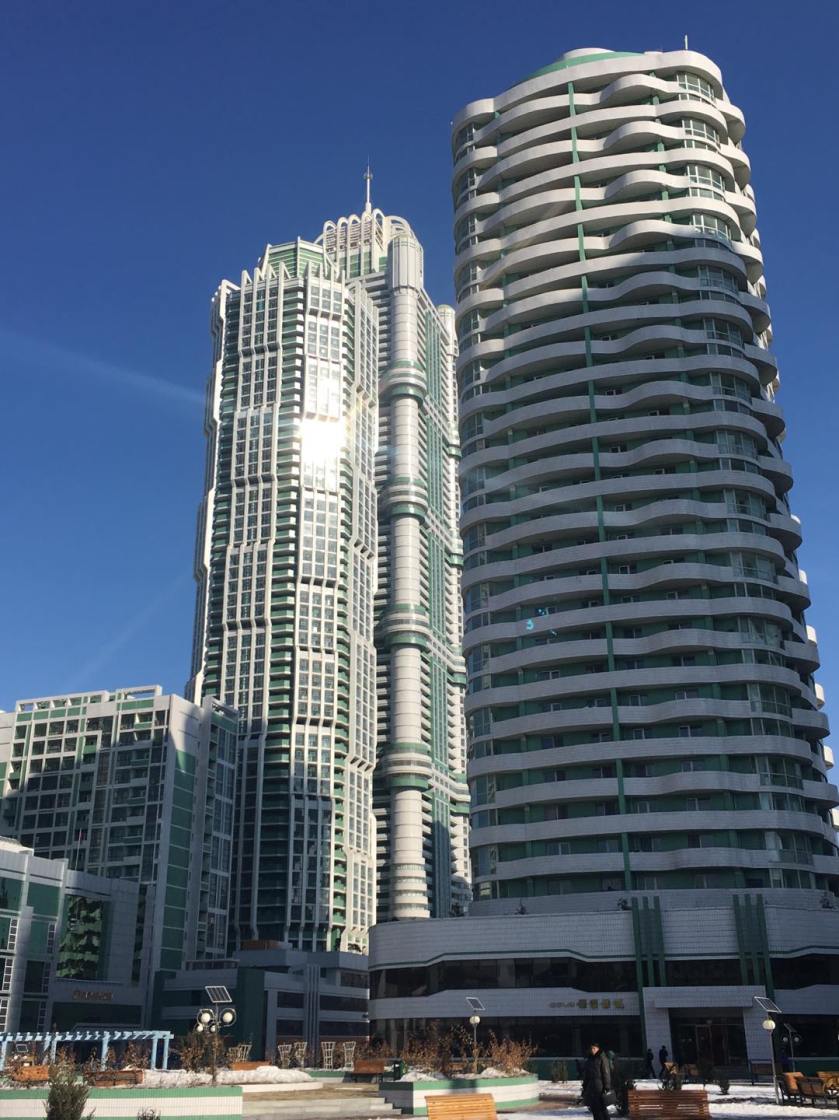
Images: Ryomyong Avenue. Probably it shows an unknown side of the mysterious state (Source: Runhang Zhong)

Let’s conclude with my favorite travel destination, Ryomyong Avenue, which was constructed in March 2016 and was finished the December of the same year. Walking among the post-modernist buildings, I realized the potential of the often mocked and despised state. DPRK reminded me of my own nation, China, in the sense that so many remnants of socialism kept in the North Korean society resembled that of China a few decades ago. China was negligible 40 years ago and was predicted to soon collapse by observers 20 years ago. However it only grew to be the second largest economy, so there’s no harm keeping an open and objective attitude towards the seemingly insane country in our current world, where everything is possible.

Runhang Zhong, also known as Marco, is a second year student from China at Sciences Po Paris, Campus du Havre.

Edited by Paxia Ksatryo.

“Transition Energétiques”: A Class Trip to the EDF Coal Plant of Le Havre

What is to be found at the foot of the far away EDF towers?

On the 16th of April, Roland Lehoucq’s class on energy politics and the move towards renewable energy, entitled “Transition Energétiques”, along with some energy amateurs who joined the excursion via Sciences Po’s newly formed Environmental Association, visited EDF’s coal-fired power plant in Le Havre’s industrial port.

13:29

In the hallway ,excited students are met with M. Lehoucq and M. Fertey to catch the bus headed to the industrial area. Fifteen minutes later, under timid sun rays, the group wanders around empty gravel streets to finally find the entrance to the plant area.

14:05

The group is welcomed by Malvina Devarieux, public relations assistant, who explains the history and functioning of the plant in a small conference room. Created in 1946, EDF played an important role in France’s reconstruction after the war and contributed to its later industrialization. Today, the company is the leading electricity producer in France. In 2014, of the energy produced, 87,8% was nuclear, 9,9% renewable, and 2,3% thermal.

Due to its relative flexibility, the thermal park is used to respond to the variations in consumption. Sometimes, important amounts of electricity have to be provided within a short period of time in order to satisfy the daily demand peak or to respond to a seasonal change. Devarieux explains, “A fall of one degree Celsius in mid-winter is equal to a rise of 7% of electricity demand”. Here, Le Havre’s coal plant has another special advantage on the French electricity market. Thanks to its portal location, it has direct it access to the coal cargo, bypassing costly and time-intensive transportation.

EDF also invests in innovation. Together with Alstom, ADEME and Dow Chemical, a Carbon Capture and Storage (CCS) experiment was conducted on the site of Le Havre and its sister plant in Cordemais. Reaching an overall efficiency of 0,05% for the moment, Devarieux points out that “there are still improvements to be made, but luckily there are also many other laboratories around the world.”

15:10

Students are standing in the coal park, built in 1983, where unit 4 of the power plant – with 600 MW of installed power capacity – is the only one functioning today. Two years ago measures have been taken to make it more efficient and durable: an important modernization of the complex was completed, taking 220 millions of investment. This large financial effort is in stark contrast with the recent decision of the government to close the plant, in order to assure France’s transition towards clean energy. The tour-guide, Sebastien Bertin, points out a key difficulty in energy policy, “the industry is not able to adapt to quick political shifts, as we are not on the same timeline that industrial projects are working on, which is 10 to 15 years.”

15:30

In a vast dark and chilly hall the group discovers the boiler. It is suspended in the air. Underneath, a yellow crab-like machine serves as a recipient of the excess coal falling down. “Back in the days, everything used to be black here, coal was laying around everywhere, and the machine was incredibly loud.”, explains Bertin. Even though on that day the plant wasn’t performing at its top capacity, the many earplug distributors indicate that the noise remains a necessary byproduct of heavy machinery.

15:45

At the upper floor, 12 meters higher, under the roof letting trough some water drops here and there, the group walks along boiler, turbine, and alternator on indicated pathways, listening to the commentaries of the guide.

Second floor of the coal-fired power plant (France 3)

16:05

In the very back of the upper area, behind a heavy door and thick blinds, lays the command room of the plant. “This is the very heart and brains of the plant – the cockpit of the boat, and the people you see working are the captains.” whispers Bertin. The students, fascinated by the many screens, buttons, and phones, inquire after function of every one of them. Learning that the operator (“chef de projet”) is responsible for electricity production sui generis, maneuvering the burners in the boilers for optimal combustion and controlling the good functioning of the entire plant. Assisted by a team of patrols who report everything going on in the different parts of the plant, serving as his eyes and ears around the facility. “In case of emergency, it is the operator who has to stay until the plant is shut down, even at the risk of his own life. Without him the plant doesn’t work.”, Bertin says. “The biggest danger is a “puff”, an explosion in the boiler, which would affect the plant, but not endanger the surroundings. Such a case occurred once in the history of the ‘Havrais’ plant: “They stayed in the smoke, helped by the firemen with oxygen masks until the thing was shut down.”, narrates Bertin.

16:30

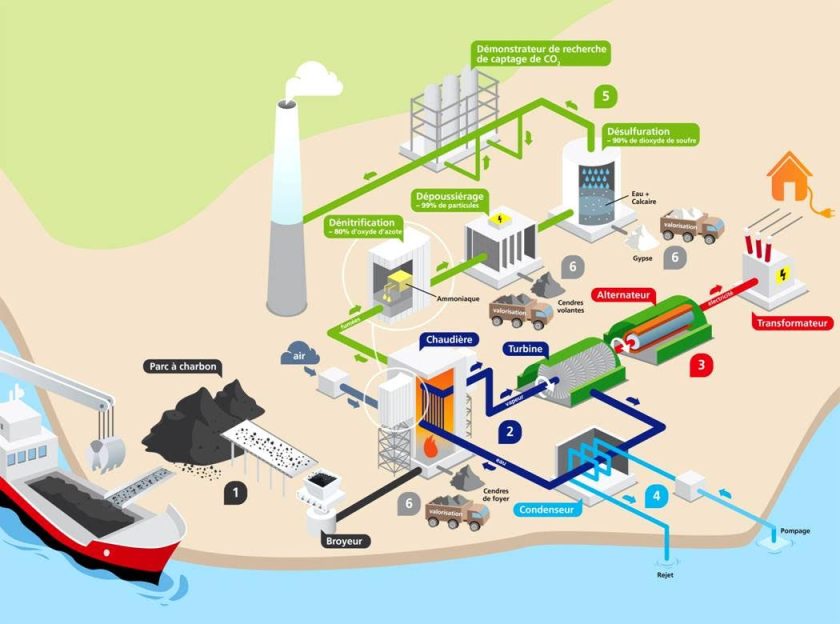
While walking back to the entrance, Bertin answers questions about the environmental matters connected to coal-fired electricity production. He explains the multi-step treatment process which has been added to the regular electricity production to clean the vapor of ashes and toxic particles. First, 80% of the contained azote oxides are washed out through a process called de-nitrification. Secondly, in the smog passes through a dust extractor, where electrostatic current removes 99% of the flying ashes. Finally, desulfurization, that is a “shower of water and chalk”, washes the smoke of fine particles as well as 90% of sulfur dioxide. The byproducts of this treatment process are recycled: the bigger ashes are used for road backfill, trench filling and the making sound breeze blocks. Flying ashes and particles are also utilized in the production of cement.

(dossier de presse EDF 2015)

16:45

The visit is over, “It was cool!”, concludes Roland Lehoucq capturing the general feeling. The students also appreciated the visit. “What surprised me the most was to learn about the strong relationship that can emerge between the machine and the men that are using them day for day over years.”, declares Laureen Calcat, “Another thing that I found interesting is the strong emotional attachment the Havrais have for their coal plant. Le Havre is historically an industrial city and the factory has become an integral part of its landscape. It is also in this idea of affirming the industrial identity of Le Havre that these chimneys were embellished by illuminations that make them shine during the night, like two industrial lights watching over the city. Le Havre would not be quite what it is without the two large chimneys that rise to the sky.

Tshin-Ilya Chardayre is a Franco – Austrian second year student, and an active member of the Environmental Association.

Macron: France’s best communicant

20:00, 7 May 2017. France breathes again.

After more than ten months of one of the most rampant electoral campaigns France has ever known and the rise of populist parties – from the Insoumis to the National Front – Emmanuel Macron is elected President. Since the very beginning of his mandate, Macron emphasized on the use of symbols more than ever before. For those who were in France at the time, you surely remember his long walk in the Palais du Louvre as “Ode to Joy” blared through the speakers. Ten months later, one could consider Macron as the European Trudeau: the same youthfulness, but perhaps the same hypocrisy too? Let me offer him my congratulations first.

Just a few weeks ago, during the World Economic Forum in Davos, Macron addressed world leaders stating: “France is back”. Even if we can’t credit the originality of the expression to him (and I’d rather not compare him to Ronald Reagan), we can agree with him. Indeed, France is back. We’ve faced tribulations: a President that looked and acted like a six-year old child, and another one that was unable to execute his proposals. We had a vulnerable country facing enormous socio-political tensions. Macron is young, handsome, clever, and he speaks English: he has everything needed to get a job, especially if this job is called “President of the French Republic”. Since he came to power, France seems to have gone through a phase of transformation. A new type of government, made of specialists (such as Blanquer, former director of ESSEC who is now Minister of Education), a reformed national assembly full of new deputies; younger, more globalized and closer to the realities of the population? This is debatable. Closer to the realities of a population for sure: the population that has succeeded, the one that has the money, that speaks English. But what about the other part: the poorer half, the ones who did not have the chance to pursue further education? This part of the population seems to be placed on the sidelines by the start-up nation; a country where everyone can be their own boss! The election of Macron and his policies have, to me, furthered the social tensions in France.

However, these tensions arise between alternative classifications of the society. From a country that opposed the rich part of the society to the poorer one, we now enter a conflict amongst those who do and those who do not embrace globalization. But don’t you dare worry, because France is back and that’s the most important.

Yes, we’re back. We have a whole new president that is going to China, speaking MANDARIN with Xi Jinping because he’s COOL and made the effort of learning a page of Mandarin. He’s cool, right? Routinely, he uses this handy phrase that will trigger the media’s curiosity: “la meilleure façon de s’acheter un costard c’est de travailler” (The best way to afford a suit is to get a job) ,“une gare, c’est un lieu où on croise des gens qui réussissent et des gens qui ne sont rien” (A train station is a place in which you can find people that are succeeding and people who are nothing), etc. Macron knows he’s being filmed when he’s saying that, he knows this will be used by the media and “répété, amplifié, déformé”, as some would say. Nevertheless, he loves it, he gloats about it. Why? Because it raises questions. Is working the best way to get yourself a suit? Can we really find people who are nothing and people who have succeeded in train stations? More seriously, even though we may and will have opposite views on what the answer to these questions are, and to what extent Macron’s words are condemnable, we all hold these feelings. Macron wants to change French society. Now, his project is highly contestable. Personally, I am a Macron defender in most facets, although I do have my reservations on some points. However, putting political opinions aside, one cannot object that he is trying to change society. Step by step, through reforms, he wants to get France back on the tracks of world leadership. Macron is not aiming at an American-style hegemonic leadership, rather a multipolar one in which France can compete with other world powers. Changing a society that says “no” so much that it could say no to a proposal of increasing all wages (never forget that the only candidate that implemented universal income in his program ended up obtaining 6% of the votes) is a challenging task. In a society where our politicians love themselves so much that they turn themselves into holograms, it is all about appearance.

Right from the get-go, his mandate has always been a question of communication. Take for example the documentary about Macron’s campaign which was broadcasted the day after his presidential victory. After six months of one of the most violent political campaigns France has known… we were looking at a startup filled with young and joyful people who speak English and look like they are having the best time of their life. Where is the violence? Macron himself complained facing very violent attacks during his campaign about his wife, his alleged homosexuality, etc. None of this was shown in the documentary. Macron knew he was being filmed, he knew everything he would say could be in the final product. He contained himself. Because it was all about communication, again. But then, where is the line between communication and propaganda? This documentary is considered by many to basically be a 45-minute advertisement for Macron. What do you learn from it? Nothing. And that’s exactly what Macron wanted: he managed to survive this campaign, to avoid falling in the traps created to shatter his image. He managed to retain his image as the innocent boy, far away from the dirty work of politics. Macron introduced a whole new way of doing politics. I completely acknowledge the claim that his policies can be contested and disagreed upon. But I think we should all agree that he is an excellent communicator. Instead of letting Trump take the spotlight at every occasion, Macron uses his counterpart’s notoriety to achieve his own goals. “Make America Great Again” transformed into “Make Our Planet Great Again”. I don’t think Macron’s call for the environment would have had the same notoriety if he didn’t spoof Trump’s infamous campaign slogan.

Macron’s opponents like to compare him with a macaron: beautiful on the outside, empty on the inside, and certainly only for the rich. While the comparison is understandable, it is completely wrong. Macron has a project for France: he wants to succeed in leading it, and he will use everything in his power to do so. Thanks to his communication strategy, the French society is becoming the least of his problems in this fight.

Nathan Lefievre is a second year French student at Sciences Po Paris, Campus du Havre.

Edited by Alex Kloß and Paxia Ksatryo

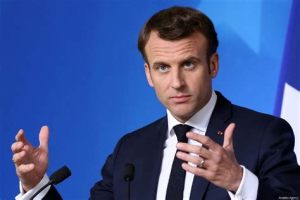
Image: middle east monitor

Diplomacy: an Olympic Sport.

A Unified Korean Olympic Team as a Push Towards Peace.

Symbol on the ice hockey’s uniform symbolizing a Unified Korea

30 years after hosting its first Olympics at Seoul in the summer of 1988, South Korea hosts its second Olympic games: the 2018 Pyeongchang Olympic and Paralympic Winter Games. The event, joined by athletes from 92 countries, began on 9 February 2018 and will last for 17 days. One of the highlights of the event is the North and South Korea Unified Team; however, while this unification is a historical one, it is not unprecedented.

The first unified Korean team was formed in 1991 for the World Table Tennis Championship Tournament in Japan, proving to be a great success as the team won first place. In the same year, a second unified Korean team was formed. Competing at the World Youth Football Championship, they placed in the top 8. Despite the results achieved by both unified teams, further attempts to collaborate proved unsuccessful. Nevertheless, North and South Korean athletes entered together under the same flag during the Opening Ceremony of the 2000, 2004, and 2006 Olympic Games without the official unification of the two teams. Thus, the formation of a unified team for the 2018 Winter Olympics is a remarkable achievement and coincides with the spirit of the Olympics itself – harmony and unity.

Thee Grand National Party of South Korea (now Liberty Korea Party) initiated the “Enforcement Decree of the Special Act on Support for the 2018 Pyeongchang Olympic And Paralympic Winter Games” in 2011 upon being selected as the host for this year’s games. The act clearly approves the conception of a unified team “for rapport between South and North Korea and peace of Korean Peninsula”

After heated discussions between the International Olympic Committee (IOC) chairman and North and South Korea officials, the IOC officially announced – on 2nd January 2018 during the North and South Korean Olympic Participation Meeting held in Lausanne, Switzerland – the creation of the first unified North-South Korean women’s ice hockey team. The team consists of 23 South Korean players and 12 North Korean players with the coach being Sarah Murray of the South’s national team. The unified team competed under the KOREA team (COR for short). “Arirang” – a Korean folk song that has also been the unofficial national anthem of Korea – was played instead of the national anthems of either country. The Korean peninsula flag was raised and the athletes wore a uniform bearing the initials ‘COR’.

Whilst the unification was a significant achievement, the sporting results did not live up to its predecessors. The unified women’s ice hockey team was defeated by Switzerland and Sweden with a score of 8:0 for both games. On February 14, the team lost to Japan, scoring 4:1. The unified team played against Switzerland again for the ranking game and showed improvement with a smaller loss of 0:2.

Nevertheless, discussions on the pros and cons of the unified team persist. While proponents argued that a unified team would be a foothold for the Peace Olympic Games, encouraging a positive future for North and South Korea, others dissented. Counterarguments followed stating that the South Korean ice hockey athletes were disadvantaged, as they trained exclusively with each other for the Olympics over the span of four years. Additionally, the merging of both teams was announced only shortly in advance, leaving no time for joint practices. Finally, allegations that the Olympics were being excessively promoted for political reasons also existed.

It is undeniable that the unified team has made the 2018 Winter Olympics a memorable one. The unified team conducted a joint team-building exercise; although it only lasted for a short amount of time, the harmony between athletes from North and South Korea is touching, with North and South Korean cheerleaders supporting each other being especially heartwarming. As the games continued, some public backlash against the unified team changed its perception positively after witnessing the harmonization of the two Koreas. Subsequently, the Minister of Culture and Physical Education Dong Jung-hwan managed to put tensions at bay by stating that he will compensate the South Korea women’s hockey team who was partially disadvantaged due to this political maneuver.

However, there are some immediate challenges faced by North and South Korea. Firstly, the Olympics was highly politicized; it was easy to sense that plenty of attention was placed on North Korea which obstructed the sporting focus of the games. Secondly, North Korean nuclear threats are still prevalent and unresolved. Even though North Korea showed their efforts towards building a peaceful relationship with South Korea, there has been no mention of a resolution of nuclear threats which remains a major obstacle to reconciliation. Thirdly, North and South Korea would have to maintain constant contact with one another in order to establish the unified team permanently and successfully. These challenges must be addressed, and further efforts to foster interactions between the two countries must take place in order to achieve long-lasting peace in the Korean peninsula.

Jungwon Kim is a first year student from South Korea

Edited by Alex Kloß and Paxia Ksatryo.