April in May

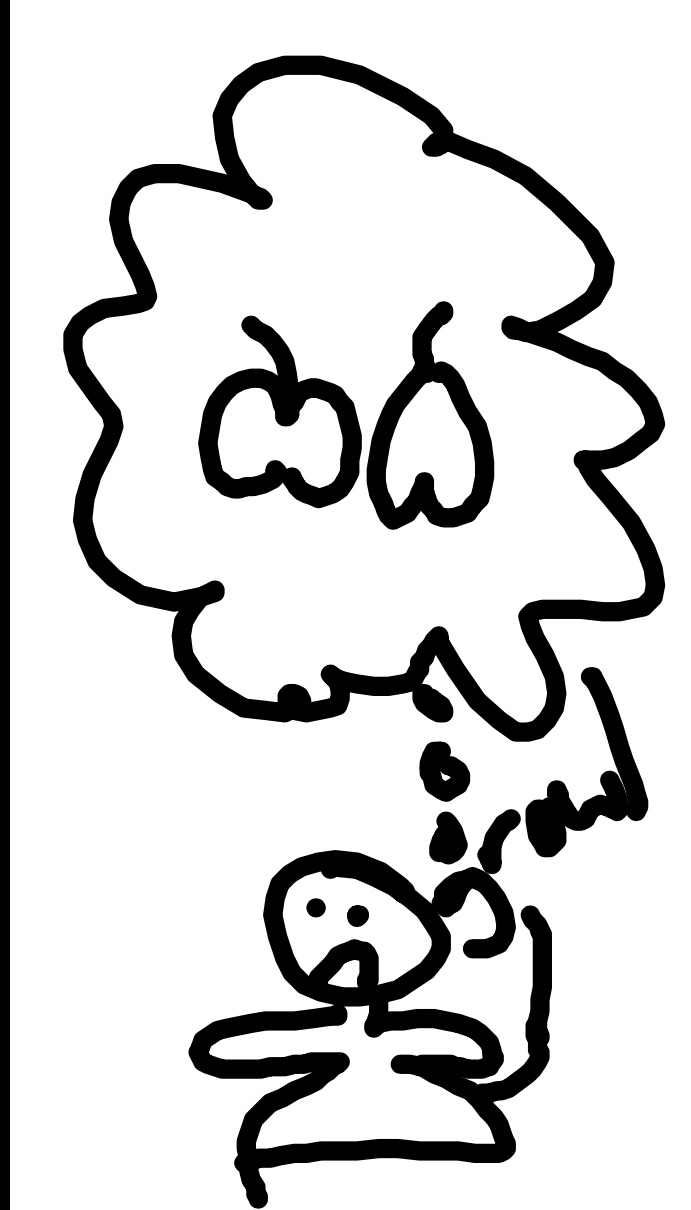
Picture: drawn by Justin Wong

4:57 am: The minute goes by painfully. I turn on my side but my eyes remain wide open. I am a distracted thinker. I feel a compulsive need to have eight different thoughts at once. At this minute, my thoughts occur to me in four different languages. Almost as if I was thinking about the uncertainties in four different ways.

My routine has collapsed. I am doing productive activities but strangely enough, I don’t feel productive. I feel unrooted, stripped of a proper goodbye. I try to shut my eyes but a voice tells me that it is sunny there. The weather becomes nice close to Easter. It’s close to 1:30 in the morning there, I am usually up.

The strange thing about uncertainties is that we try to mend them. We try to mimic our routine as much as we can, to cope, to breathe, and to feel alive. To feel normal and to reassure ourselves that eventually, everything will return to normal.

It’s a conflicting feeling, a feeling of guilt. A guilt of being in a safe place but feeling inadequate and insufficient. A guilt of privilege that, what’s keeping me up tonight is so minute compared to what people outside my tiny bubble are enduring.

Knowing this, I can not stop myself from being disoriented. My life from a few weeks ago is now a memory. Plans for the future are now ‘what could have been’. Then, there are the memories that you etch into your mind, in fear, that you may not remember the times you laughed, cried, or merely lived life without much of a care for tomorrow.

Saying goodbye is always hard but it is exceptionally so when it is not foreseen. It’s even harder when the unexpected just requires us to look closer. In Chronicles of A Death Foretold, Gabriel Garcia Marquez writes the journey of an impending death. A death that is expected and certain, slowly creeping up on you but still surprises you. In many ways, for many of us, the sudden ending of a chapter in our lives was upon us, ever so slowly approaching but it was there. So while I try to convince my insomniac state that uncertainties are just unobserved spectacles, I think of the weather. I think of it here and there. April is upon us.

April is usually a lovely time of the year. I’ve always thought of April as the start of a new year, a new cycle. April is when nature’s cycle begins. Peeking outside my window, I wait for the sun to rise and dream of April. It’s cold outside, there is a chilly morning breeze. It’s usually warmer this time of the year. Warmer in April. I guess I’ll be searching for April in May.

On the eve of U.S. elections: Responsible politics as a tool for addressing today’s climate cris

By Natasha Raseta and Joaquín Gosálvez Castillo

Natasha Raseta is a Masters of Landscape Architecture student at University of Toronto’s Daniels Faculty of Architecture, and Joaquín Gosálvez Castillo is a Political and Social Sciences student at Sciences Po Paris Campus du Havre. They are participating in the Hart House Global Commons, an international dialogue initiative that supports student connection and engagement on global issues related to climate change facing youth.

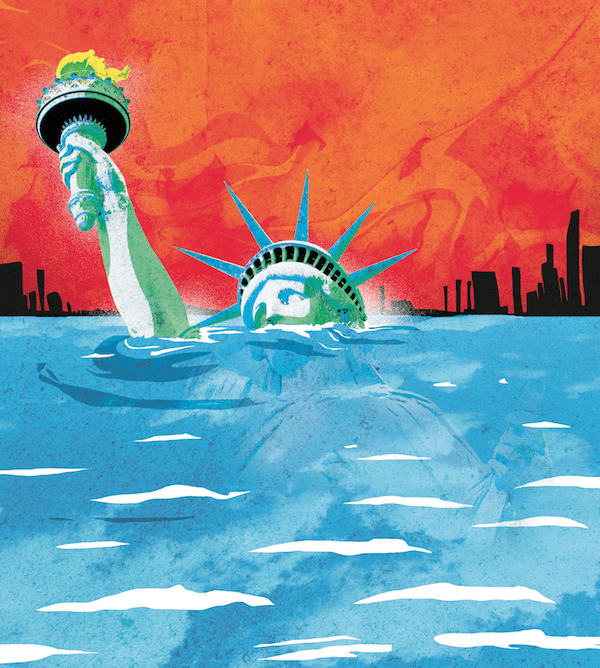
A quick glance at the official U.S. White House website portrays a wholesome Trump Administration that has made significant, ‘never-seen-before progress’ on important national issues of today. They have focused their accomplishments on reversing unemployment rates in the United States, reclaiming “more than 400,000 manufacturing jobs” since his election in 2016. This list of accomplishments boasts the fact that they “withdrew” from ”the job-killing Paris Climate Accord”, and canceled the “so-called Clean Power Plan”. Their choice of words says a lot about their political stance on today’s climate crisis, and leaves us wondering not only why environmental efforts have not been sufficient enough, but why be so quick to deliberately oppose environmental opportunities of our future at all? After a year of climate news and strikes, let us better understand the issues in the way of more meaningful political responsibility. If we analyze the current balance sheet of environmental policy decisions made by the Trump Administration, we can reflect on more effective solutions that could increase job creation, boost the economy, and tackle the urgent threat of today’s climate crisis.

It comes not as a surprise that the current U.S. Administration carries an attitude of unjustified and uninformed denial of climate change, which has manifested through a history of concerning political decision-making. Investigation of regulatory capture in regards to Trump’s Environmental Protection Agency (EPA) looked into agendas covered by political appointments, rhetoric, executive orders, and restructured science advisory boards, which favours economy and job creation over mitigating the effects of climate change. One of the first important issues of today’s climate crisis involves supporting ecosystem biodiversity. The Trump Administration’s environmental record has shown a different course of action. Many laws protecting the environment that were intended to start as an energy transition initiative have been repealed. Notable examples include: the withdrawal of Paris Agreement; the dismantling of the Clean Power Plan—aiming to reduce carbon emissions by 32% by 2030; and the deconstruction of the EPA—a key piece of legislation protecting important ecological and natural land. Trump also removed climate change from national security priorities in 2017, allowing massive logging on public land a few weeks afterwards.

There are contradictions on what the Trump Administration says they are trying to achieve versus what opportunities are actually available, which leads us to question his credibility. In July 2019, Trump mentioned that his Administration found the perfect balance between economic growth and environmental protection. However, our research reveals that they have been negligent in taking environmental protection efforts into account. An article on the Trump Administration and the Environment offers advice for dealing with reductions in evidence-based policy, the constant oppression and irrelevance of scientists in environmental policy decision-making, endangering funding cuts, environmental monitoring and protection. The main take-away is that “scientific evidence does not change when the administration changes”, that “cutting funding is certain to leave uncertainties unaddressed”, and that “it would be inappropriate and potentially disastrous to pause action on mitigation” efforts in regards to environmental quality policies.

This complicated situation opens the way towards the reflection of more appropriate solutions to balancing sufficient environmental policy as well as economic and job security. If the Trump Administration were willing to invest all the energy they have used to oppose environmental policy into the creation and implementation of a circular economy, they would achieve both economic growth, stable job opportunities, and ensure the safety and wellbeing of population health. An article on the future of sustainability explains further that “when we think differently about materials, there is an economic benefit there. If you can make things from your waste stream, that’s a wonderful economic gain”. Not to mention the multitude of jobs that could be created within this process of upcycling—“in which products are made, used, and then remade and reused”. In this case, a single material source can easily be turned into new products after the life cycle of the original product. There is also emphasis placed on the creation of local jobs, which speaks more appropriately to the U.S. Administration’s accomplishments mentioned above. Re-ratifying the Paris Agreement would allow for further measures to be taken to comply with these opportunities.

The U.S. plays a key role in the deciding factors of other influential countries, and can set a more constructive example for being able to make progress on all level of the climate crisis. There is an obligation for all of us who defend politics as a fundamental means of resolving and fighting the ecological crisis. While today’s citizens are increasingly aware of their role in favour of ecology and will respond accordingly, there is also a heightened responsibility for politicians and legislators to take this lead and unite and vocalize efforts for effective protection of the finite resources available on Earth.

Qu’est-ce que je dois faire ?

By Joaquín Gosálvez Castillo

Joaquín Gosálvez Castillo est un étudiant dans sa première année à SciencesPo. Il nous fait part de sa réflexion sur les défis environnementaux et les actions que nous pourrions et devrions prendre face à une crise écologique toujours plus alarmante.

« Vous allez connaître la fin du pétrole », cet énoncé court, clair, percutant m’a énormément impacté lorsque je l’ai entendu en cours de Science Fiction. Pourtant je le savais déjà, mais très souvent on préfère oublier, cacher dans un tiroir secret ce que la conscience ne peut pas supporter par simple instinct de survie…

L’année 2019 semblait avoir laissé derrière elle les terribles feux de l’Amazonie qui ont ravagé l’équivalent de 906 000 stades de football. L’année 2020 ne commence pas mieux : les incendies en Australie persistent, la surface brûlée est plus de 18 fois supérieure à celle ayant connu le même sort en Amazonie, tout cela sans parler des 6 500 bâtiments brûlés et des 28 personnes mortes… À ce stade, le lecteur pourra penser qu’il s’agit d’un autre article ennuyant sur l’environnement qui ne cherche qu’à faire la morale. Cet article est plutôt une invitation à la réflexion sur notre action tenant compte de l’état des lieux de la vie dans notre planète, des solutions efficaces qui peuvent être menées et de la question de la responsabilité et de la volonté de résoudre cette crise écologique, tant au niveau individuel que collectif.

Abordons tout d’abord le diagnostic. En effet, il n’est pas bon! Si la simple observation et le constat empirique de l’accroissement des catastrophes naturelles sont déjà effrayants, alors le fait que la pollution soit la sixième cause de mortalité dans le monde et que l’OMS affirme que 9 personnes sur 10 respirent un air pollué, devraient nous faire paniquer. D’ailleurs, un million d’espèces animales et végétales sont menacées de disparition à cause du réchauffement climatique comme le démontre une étude dirigée par le scientifique Chris Tomas et publiée dans la revue Nature, cela entraînerait de même de graves conséquences comme une pénurie aggravée des ressources alimentaires sachant que les animaux pollinisateurs sont fondamentaux dans le processus de production d’aliments. C’est justement de cette raréfaction de ressources provoquée par l’action humaine, profondément corrélée avec notre économie, notre mode de production et le dérèglement climatique, qui est avant tout un vecteur de crises pour les êtres humains. Il s’agit donc d’un problème principal qui remettra directement en question la survie de l’espèce humaine et de nos modes de vie actuels, ainsi qu’il mettra sur la table la définition de la politique comme la gestion sociale de la précarité. Pour comprendre l’ampleur de ce dernier défi croissant, il suffit de signaler ce que les études actuelles sont en train de démontrer : tandis que nous atteindrons prochainement un pic de population d’environ dix milliards de personnes, les ressources fossiles et nucléaire sont vouées à leur épuisement aant la fin du XXIème siècle, à l’exception du charbon. De même, des métaux comme l’or, l’argent et le zinc disparaîtront avant 2050, tout comme les matériaux utilisés dans la production actuelle des énergies renouvelables tels l’indium pour les éoliennes ou le plomb et l’antimoine pour les batteries de voitures électriques. Il faut également tenir compte du fait que la production d’énergie renouvelable nécessite d’infrastructures qui sont construites grâce aux énergies fossiles. En effet, la transition énergétique ne s’est jamais faite puisque la consommation d’énergie croît tout comme le recours aux énergies fossiles qui représentent 80% des énergies produites mondialement.

Ces problèmes complexes et menaçants font appel à des solutions efficaces tant au niveau collectif qu’au niveau individuel. Je ne peux que modestement proposer au lecteur d’analyser avec lui quelques idées qui incitent à l’action concrète. Tout d’abord, il est essentiel de parler de l’agriculture relocalisée qui est une excellente mesure tant pour les agriculteurs locaux qui travaillent dans des conditions sociales dignes que pour la prospérité du corps et de la planète. En effet, j’ai pu vérifier lorsque je faisais mon TPE sur la production écologique de papaye à Malaga que la consommation de produits agricoles locaux peut être mille fois moins polluante que la consommation de produits importés – notamment ceux qui proviennent du Canada après la signature du CETA – mais qu’il est de même crucial que le choix de cultiver certaines espèces végétales respecte les conditions de terrain et de météorologie locales. Ainsi, en tant que citoyen responsable et consciencieux, acheter des produits aux AMAP du Havre est une attitude à encourager. D’autre part, la plantation massive d’arbres peut permettre de stocker l’excès de dioxyde de carbone atmosphérique dans les forêts, mais cette solution ne peut être que temporaire car la mort des arbres provoque une libération de carbone qui, par oxydation, repasse à l’atmosphère sous forme de CO2. Ceci étant dit, il est indispensable, en tant que bon citoyen, de promouvoir cette solution qui, bien que temporaire, est nécessaire, notamment par l’utilisation du moteur de recherche Ecosia: une démarche plutôt simple. De même, manifester pour le climat, s’engager dans des projets écologiques, adopter des modes de vie plus respectueux de l’environnement sont des actes indispensables si l’on veut véritablement résoudre la situation de crise écologique et existentielle à laquelle nous faisons face.

En ce qui concerne les solutions que peuvent apporter les Etats, il y a un répertoire de propositions chiffrées disponible sur le site Project Drawdown, parmi lesquelles la construction d’éoliennes s’avère une solution efficace du point de vue environnemental, en plus d’être très rentable avec un rapport de 1 à 6 entre dépenses et bénéfices sur le long-terme. Parmis les solutions proposées, on retrouve la réduction du gaspillage alimentaire, l’éducation des filles dans le monde ou encore l’interdiction mondiale de l’utilisation du HFC dans les appareils réfrigérants selon un amendement du Protocole de Montréal, par exemple. La piézoélectricité, bien qu’en phase expérimentale, est une autre idée innovante qui pourrait permettre la récupération d’énergie à partir du contact et de la pression de nos pieds lorsque nous marchons ainsi que des voitures. Les Etats devront aussi investir massivement pour mettre en place l’économie de l’avenir. Sachant que la décroissance ne peut qu’être une phase transitoire entre notre modèle économique actuel et un autre que beaucoup nomment déjà l’économie circulaire, basée sur le triptyque: réduire, recycler, réutiliser. Des prémices de ce nouveau modèle sont déjà visibles dans l’Union Européenne mais aussi dans certains pays asiatiques à l’instar de la Chine, notamment avec la loi de 2008 sur la promotion de l’économie circulaire. Ici en Normandie, nous avons un bon exemple d’une des idées phare de l’économie circulaire qu’est la méthanisation, et qui, dans notre cas, permet de récupérer de l’énergie électrique et thermique à partir de dizaines de milliers de tonnes de déchets organiques, qui sont ainsi revalorisées.

Enfin, au-delà des défis immenses et des solutions souhaitables, une question émerge. C’est celle de notre volonté et de notre responsabilité. Peut-on qualifier un gouvernement de responsable alors que certaines mesures en faveur de l’environnement coexistent avec le refus de fermer des centrales de charbon ou avec le maintien de certains perturbateurs endocriniens extrêmement nocifs pour notre santé ? C’est de cette hypocrisie dont nous devons réfléchir nous-mêmes dans un souci de cohérence. Si la vie sur Terre est une priorité ou un devoir pour nous, alors nos actes doivent démontrer la responsabilité écologique qu’est la nôtre et que nous ressentons, c’est-à-dire que nos actions concrètes doivent être respectueuses et engagées vis-à-vis de l’environnement, le cas contraire cela signifierait que nous n’avons pas de véritable volonté de préserver la vie sur notre planète. La vie est-elle suffisamment importante pour nous pour que nos actions et notre volonté soient en compatibilité avec elle ?

He Saw Me Crumble

The first time I listened to the song Truth Hurts by Lizzo, I knew I was a bad bitch. I’d grown up listening to countless pop anthems preaching the Power of Woman: Hollaback Girl by Gwen Stefani, Bust Your Windows by Jazmine Sullivan, nearly every Beyonce song. They taught me to stand up for myself against toxic masculinity, and it had the intended effect: no matter what anybody else said, I was proud to be a powerful woman.

Though I felt like a superhero, the society I was raised in left little room for me to test my powers. The walls in my house were paper thin and my parents weren’t very receptive to the prospect of me having male friends. Anytime I went out past 21h00, I was obligated to send messages every thirty minutes letting them know where I was, who I was with, and what I was doing. So, I was a sheltered superhero. My powers worked in close proximity and that was good enough for me — until I got to university, that is.

Being alone for the first time in my life meant two things: one, I was incredibly lonely, and two, I had every ability to ease my loneliness through the company of friends, whether they be girls or boys. My single apartment became a nesting ground for unparalleled memories, jokes that could never be understood outside of my four walls and stories that spilled over like waterfalls.

Independence was like a drug, and it wasn’t long before I started to test my limits. I kept alcohol in the fridge, stayed out until 04h00, and, god forbid, did not make my bed every morning. And then, as I reached the peak of my ballsy-ness, I decided to do the unthinkable: invite a guy into my home.

The first time I did this, nothing remarkable happened. I made food, we ate, we talked about our hometowns, and then he left. The second time I invited a guy over, it was a similar situation, except that this time the conversation revolved more around common interests than anything else. Therefore, when the third time rolled around, I didn’t expect anything out of the ordinary. Sure, this guy and I had been flirting a little bit, and sure, I knew that in some cultures, alone time together does qualify as a date. But for me, it was an opportunity to get to know somebody better, whether it be romantic or not.

He had been dropping signs all afternoon, so when he tried to kiss me, I wasn’t necessarily surprised that he made a move as much as I was taken aback at the abruptness of it. Before anything could happen, I pulled away.

“This is a bad idea.”

But it was like he couldn’t hear me. Rather than becoming discouraged from my lack of interest, he took it as a sign to try harder, trapping me on my bed and kissing me again. It was through a burst of luck that I managed to pull away and make a joke if only to hide how absolutely shaken I was. Still, he persisted. It took a few tries before I was finally able to push him away, saying with as much assertiveness as I could possibly muster up, “I don’t want this.”

And he stopped. He sat down. And he looked pissed.

I wish I could say that I kicked him out at that moment. I wish I could say that I immediately told my friends about his aggressiveness, warning them off of him in case he tried to make a move on them too. Hell, I even wish I could say that I posted a shady message about him on the Le Havre Confessions and Compliments Facebook page. I wish I could say anything other than what really happened. I stared at him for a few seconds, assessed his anger, and then begged, “I’m sorry. Please don’t be mad at me.”

It’s hard to explain why I said this. In those few seconds, a trillion thoughts ran through my mind at the same time: What if it’s a cultural difference? What if I’m overexaggerating? What will he tell his friends? Will he tell them I’m a prude? Will he tell them I put out? What if I gave the wrong signs? What if it was my fault?

He told me that it was hard not to be mad, considering the situation that I put him in. He demanded that I explain myself. He wanted to know why I wouldn’t hook up with him.

I should have told him that no means no, regardless of why it is being said, and that I didn’t owe him any explanation. That’s what Lizzo would do. That’s what Beyonce would do.

Instead, I made up a lie. I justified my not wanting to get with him for no reason other than I didn’t want to bruise his ego, for fear that he would spread rumors like wildfire when I wasn’t looking. Every word out of my mouth knocked me down a step further until I was standing at the bottom of a mountain that I had worked all my life to climb. My superpowers were gone, and I was helpless at the hands of toxic masculinity.

I keep telling myself that he’s not a bad guy. My friends tell me the same thing, but I can’t seem to separate him from his birdcage hands. I knew then as I know even now the power of his word. He could tell anybody anything, and they would believe him because he was witness to the situation and I was too ashamed of my weakness to say anything about it to anybody other than my closest friends. I tried to remind myself of the cheesy poster that hung in the hallway of my old school: that if I lived my life in a way that was good and honest, then nobody would believe any negative rumors about me. But I didn’t feel good about what happened, nor did it feel like an honest representation of who I always thought I was.

Empowering songs couldn’t stand a chance against how I was influenced by the way the community around me painted women: ten of my words held less worth than one of his, and no matter what, he would be able to fill the room while I would shrink out of it.

Even now, as I write this, I wonder what you will think: She’s clearly exaggerating what happened. This isn’t even a big deal. It’s hookup culture, she needs to get with the times.

I know that this doesn’t qualify as sexual harassment. I know that there are women in this world who are ten times more powerful than I can even imagine who have gone through a hundred times worse and lived through it. I know all of this, and yet I can’t help the slight twinge of discomfort I feel every time I see him. I can’t help but intentionally hold eye contact, just to try to prove to him after the fact that I am a powerful woman, and that if it happened again I would not crumble the way I did that day. I can’t help but stay friendly, because if I start to act differently then maybe his friends will begin to believe whatever lies he may or may not have told them. There’s a lot I would like to do, and yet I can’t help but not do it.

I grew up listening to songs that taught me the Power of Woman, but I also grew up in a society that taught me to hold my reputation near and dear, because you never know what other people will say. There’s a certain fear of societal rejection that keeps pulsing through my heart every time I hear his name, because I don’t know how people will react to a story like this. A girl who was way out of her element thought she could destroy the patriarchy by dismantling the throne of superiority it sits on, and was then proven wrong. It’s not uncommon, but it is unfortunate.

There’s no easy way to end this. Though it’s painful for me to admit, I will probably continue to smile at him and make light of the situation I was placed in. I will probably continue telling myself that nothing serious happened, and that there is nothing for me to feel uncomfortable about. But I will say this: we learn in life only through experience. Our hearts grow stronger only through pain, and our skin gets tougher only through burns. It doesn’t make the process any easier, and it doesn’t always work. I don’t know how I will react next time I’m put in that situation. Maybe I won’t have even the strength it takes to push an aggressive guy away. But I hope I do.


The glory of fans in Eastern and Western traditions

Our beloved Sophie writes a paper on the role of fans in different cultures.

Hand fans have very practical reasons to exist. They are used to create a small cooling breeze to refresh people but also to chase away flies or any other pest insects and finally to fan flames. At the very beginning, tree leaves, bamboo sticks, a piece of bark were used for this purpose. Later on, the use of fan developed worldwide and using a fan became a sign of social position, all the more as they became lavishly adorned and thus highly fashionable.

The existence of hand fans in Africa or in the Americas has been proved thanks to travel logs. For instance, when Christopher Columbus came back from India, he presented the Spanish royal couple with six hand fans, on behalf of the Aztec people. There are also early evidences of the presence of fans in Africa, especially when we consider Egyptian carved reliefs and artifacts adorned with ostrich feathers (Maat symbol), or when amazing metal carved fans were discovered in Tutankhamen’s tomb. Other styles of fans were found in Sudan, made of peacock feathers, some being a thousand year old.

We will however concentrate on two continents: Europe and Asia and focus mainly on social etiquette and elegance.

I/ Asia

  1. History of Hand Fans
  • In China.

In the first Chinese dictionary, complied in the 2nd Century CE, a fan is interpreted as a door panel that hung from the ceiling. This type of fans became known as the Chuke fan. There was however fans made from different types of feathers and this is the reason why the word for hand fans is the same as feather. According to the type of feathers used, you could determine the social status of its owner: goose feathers were for common people whereas peacock, cranes or pheasants feathers were used for the sake of the gentry. The Pien Shen was also used; it was a simple one, not fit for ceremonies. Anyone could make one with woven leaves or bamboo. They are referred to in Chinese literature since the 1st century BCE.

The practice of writing or painting on fans is also recorded very early. A companion of the emperor Ch’eng of the Han dynasty, around 33 BCE, wrote poems and lyrics on fans. During the Sung dynasty (960-1279 CE) painted circular fans became popular at the Court and among the nobility. It is during that period that folding fans were introduced in China from Japan. They were called wo-shan, referring to Japanese fans.

Gradually, but especially under the Yuan and Qing dynasties, artists started to use fans as artistic supports and, in the 16th century, they would start signing them. The Three Excellences of the Chinese art were applied to the decoration of these fans: painting, calligraphy and poetry. The materials used were mainly bamboo, whale bone, iron and ivory for the ribs and paper for the leaves. Leaves could be changed but the ribs were seen as valuable when their patina was aged by the handling. They would be treasured in families.

During the 18th and 19th centuries, most of the production of hand fans was sent to Europe as they were so much in demand. These decorated fans corresponded more to a western taste than to a Chinese one. At the turn of the 20th century, the Chinese Empire collapsed and a Republic was born after years of turmoil. This was thus depicted on hand fans, as testifies the hand fan made by Chinese artists in reaction to the Tientsin events. Colons asked the governor to stop the diffusion of this hand fan that was nonetheless duplicated in many copies.

In the 1960s, because of the Cultural Revolution launched by Mao Zedong, many hand fans were destroyed as mere vieilleries and their cultural and social hierarchy aspects were despised.

  • In Japan

The material trace of the first hand fan in Japan is on a wall painting in a burial mound dating from the 6th century in Fukuoka. This type of fan, a flat one, called Uchiwa, probably came from China, passing through Korea.

A century later, Japan invented folding fans, mostly for women, which were composed of 39 ribs[1] One night, during Empress Jingu’s reign, an artist paid great attention to a bat that was opening and closing its wings. It gave him the idea of a more practical fan: the folding fan. This first fan was called komori or bat. They were made from slips of Juniper wood, sewn together at the top with a string and tied together at the other end so that they opened in a radiating way. The oldest surviving paper folding fan is documented as dating from 1188.

The first literary reference to this folding fan was found in the Japanese dictionary compiled around 935 that lists two types of fans, the Uchiwa and the Ogi. It rapidly became a desired work of art at the Court. The fan developed in this part of the society was called Hiogi and was made only for the sake of the Tenno. However, the nobility eventually used it. It was composed of 34 to 38 wood blades and the particularity was about the rivet[2] that had a bird shape on the obverse[3] and a butterfly shape on the inverse[4]. Painters used bright colors to depict brightly animals, nature or landscapes.

As well as in China, during the 18th and 19th centuries, Japanese fans evolved with the apparition of trade (even though limited and controlled till the end of the Edo period[5]) with the West. The ribs and guards were more adorned. Hand fans also became really popular in the Japanese high society and there was almost a Fan-mania. In order to preserve society from any conflict or high society from any bankruptcy, the Tokugawa Shogun decided in 1701 to forbid the fabrication of too valuable hand fans. Folding hand fans became the symbol of a sophisticated lifestyle to the Japanese – as the radiant ribs were seen as the sun dawn. The rise of the Ukiyo-e prints, pictures of the floating world, depicting daily life scenes had great success in Japan and soon abroad as well. It was not really expensive, considered as craft more than art at first, and it was easy to buy prints from street vendors who had many for sale. Ladies holding fans were featured in those prints, especially by Hokusai, Harunobu, Utamaro or Hiroshige. Portraits of beauties (Bijinga) depictions of warriors or Kabuki theatre characters include fans as a common accessory.

  • In the rest of Asia

At Cambodia’s peak – the period of the splendor of Angkor – fans were also used. Indeed, we can see – on some Khmer bas-reliefs – large fans used to refresh the king or even military officers. Wooden fans could be also found in what is modern day Malaysia.

In India, hand fans were, as in China, called after the word feather, or bird’s wings: pankhas. Indian fans were various in their uses and materials. There were fixed fans, which are held to fan, revolving fans, which can be shared by people sitting and enjoying the cool air and lavishly decorated royal fans, which are shaken by strong men and used to fan large congregations of people in the rajahs or maharajahs’ courts. There were also small ritual fans, which were used daily to fan the statue of Krishna, fly whisks, which were used to fan the Sikh holy book at gurudwaras and those which were used in mosques during Muslim festivals.

  1. Numerous uses of Hand Fans
  • The Three Excellences plus one

Dance: In Japan, as well as in China, fans were used in artistic performances. The Japanese Noh actors, professional dancers and then geishas became masters of elegance. Any position of the fan would describe a precise word, just like hands and fingers in Cambodian or Indian dance. The hand fan could successively represent a bird, water or even a tree. In China, fans were used in many types of dance, including Ping Tan (Chinese storytelling, usually accompanied by musical instruments) and Quyi (story telling with music and performances). There are many favorite poems about fans and its different meanings during a dance. “Waving a feathered fan, wearing a silk handkerchief, he joked and smiled; and reduced the enemy’s ships to flying ash and smoke.” These words show confidence of the character, expressed wittily in a natural and unrestrained style. “Holding a round fan while bowing with clasped hands is like holding a full moon; waving a fan to feel the embracing wind.” The expression this time shows precision and gracefulness. The fabrication of dance hand fans was quite particular. In order to be more practical during dances and throws, the gorge was weighted, meaning that some metal was added.

Painting: fans were also convenient supports for painters. Landscapes, gardens and scenes de genre were highly praised.

Calligraphy: according to a Chinese legend, the first calligrapher who used hand fans as a canvas was the famous Xi Zhi Wang. When going to the little city of Shao Xin, he saw an old woman desperately trying to sell bamboo hand fans; he told her that he would write characters on them so that she could gain more money. This is what happened and the success gave incentive to calligraphers to use hand fans as a support. The Tang emperor Tai Zhong was a great calligrapher and offered his officers fans he wrote on as a present during the Dragon Festival.[6]

Poems: hand fans were both a support for poems and a topic for poem. For instance, a famous hokku from Sokan[7] says: « In the full moon/ if you adapt a stick / a beautiful fan.”

  • A representation of social rank and politeness

Having a carved wooded fan, or a refine silk fan was synonymous of wealth and a certain social status. Fans were used both by men and women in Japan. At the Japanese Imperial Court, the handling of fans was part of the etiquette. Women were taught to use it in the proper way.

Holding a hand fan is also a sign of respect. If we do consider the tea ceremony, in Japan, we notice that the guest will always come to the tea reception with a folded fan before him. It symbolizes the traditional barrier between the guest and the tea master.

  • Wrestling tools

Once more we are going to focus on China and Japan, where hand fan is commonly used in wrestling sports.

In China, it is used noticeably during Kung-Fu matches. It is a tool used to protect oneself from hits and give some hits as well. Indeed, you could prevent your adversary to see what kind of punch you would give him.

In Japan, hand fan are employed during Sumo fights. The judge or referee of the game, also called gyôji, would get a fan out of his dress and present it. It is part of the ceremonial that when he turns it on the other side, the game can start. According to some historians, the ancestor of the hand fan was called the gunbai, which was a war fan. It is mostly made of plain lacquered wood. At the end of the game, the gyôji will use the fan to point out the winner and to put on it the envelope containing the award.

  • Politics

Wars: In Japan particularly, fans were tools used by commanders to lead their troops. They are called gusen. On horse backs, commanders were at the head of the soldiers. To make subordinates understand their will, the fan was really a practical device for samurais. (Remember a famous scene in Kurosawa’s Kagemusha). There were two sorts of gusen: folded fans in metal and wood fans that actually looked like panels fitted into a stick. The folded fan often depicted a rising sun, symbol of Japan. A description survives of Hacheman-Taro’s Gunsen: “In front with mica fold sun device, the reverse with mica and a silver moon device […] 12 bamboo sticks lacquered black and heavy with a metal oya-bone (guard).” When it was opened, it meant that the direction showed should be taken or it was a sign of rallying. When it was closed, it was a symbol of protection, and a warning to stay on guard.

Weapon: fans could also be transformed into powerful weapons. In Japan, they were called tessen. The frame was made out of iron, a strong metal able to pierce the adversary’s armour. Their creation is due to the prohibition of weapons in different places such as tea houses, or temples. In order to react in any case, an invisible weapon had to be created: a metal hand fan. Men and especially women had them in their sleeves.

Trial: in China, fans were used by judges while sitting in court of justice. After listening to the defendants and the victim, the judge would pass judgment. One by one, the leaves of the fan were folded and the sentence was set. One can see a specimen of this kind of fan dating from the 19th century in the Fan Museum in Paris.

Propaganda: Fans were a support for paintings as previously mentioned but also for song lyrics that were not always too kind or nice to the government. The positive point was that you could fold it and closed quickly if authorities were around.

  • Religion

Buddhism: During the studying of the precepts, meaning that – as a biku – you are on the path to become a Buddhist, a priest would give you a new name and either a bead necklace or a fan on which your name would be written. In Myanmar, hand fans, called yap were and still are one of the only material things a monk can possess.

Shinto ceremonies: in the Shinto rites, Kaguras are ancient shamanic dances. In the oldest one, called Miko Kagura, which is still practiced as a heritage dance nowadays, the dancer uses bells and hand fans to make circular movements with emphasis on the four directions. It was meant to appease the spirits from the North, South, East and West.

II EUROPE

  1. History of hand fans
  • Importation from Asia

The presence of hand fans in European culture is both an original invention and later the result of trade with Asia. Europe had obviously, since Antiquity, knowledge, crafts and use of hand fans. In Greece, Tanagra style terracotta statues represent gracile ladies with spade shaped fans. A huge fan would be used to provide fresh air in Roman circus when games were held. Anthony Rich, in le Dictionnaire des Antiquités (1883) wrote that hand fans of Greek and Roman ladies were made out of lotus leaves, peacock or ostrich’s feathers or any material of this kind. They were not brisés[8] but straight and had long handles as slaves were appointed to shake them.

During the Middle-Ages, in the Italian peninsula, les dames élégantes appreciated particular hand fans, today called screen fans, shaped like a flag hold on a stick. It was used by most of the population, without taking into consideration social rank. As the early Tanagra statuettes, women depicted in paintings, clad in sophisticated draperies were often holding fans.

During the Renaissance, European countries sent around the world navigators to develop seaborne trade, to find new markets and new resources, to promote Christian faith and to learn more about the unknown. Fans were luxury goods that would soon be much in demand in Europe. Importation of hand fans from Asia to Europe started after their introduction thanks to traders and religious orders from Chinese East coast. Importations were mostly to Spain and Portugal at the beginning but were also an incentive to create new types of hand fans. Little by little, fans from Asia would be appreciated gifts and trinkets a woman of taste was to have among her fashion accessories[9].

Elizabeth I of England and later the courtesans in Versailles popularized this object which was also seen as an expensive and prestigious work of art. Under the reign of the Sun King Colbert organized the production, creating “la corporation des éventaillistes» on February 15th 1678.

  • An incredible development

Hand fans were to be popular during the 17th century. Mostly in France and Italy, they would be used as supports for reproductions of famous painters and engravers’ works of art. Folding fans will be more appreciated than fixed ones. Technically speaking, leaves will be done not only with paper but with skins – noticeably swans’ skin- which make them more resistant. The monture was adorned with ivory and little by little, carvings and mother of pearl marquetterie emerged. Some were even made in precious metals, golden coated or inlaid with pure gold or silver. It was however a luxury fancy object, reserved to nobility and royalty.

It is amusing to notice that at that time, the fans were decorated on both sides. The high society parents gave classical education to their daughters and they wanted everyone to know how learned they were. Thus, the delicate flowers, such as roses and tulips of the obverse, were relegated to the inverse –the part of the fan that the young ladies could see- and replaced by mythological or historical scenes for everyone to behold. It was a sign of how educated the young women were. Yet, behind a fan, you could also mock, whisper, giggle and gossip unchecked.

In the 18th century, Europe produces high quality hand fans but importations, noticeably through the East India Company, were extremely important. Chinoiseries were highly fashionable. Beautiful as they were, many people did not realize that these fans were produced by the Chinese artists to please ‘barbarian’ tastes and were not used by Chinese themselves, as for example the ‘thousand faces’ or ‘mandarin’s fan. It is at this period that the creativity concerning fans developed the most in Europe, differently according to the countries. On the 1st of December 1783, in the Jardin des Tuilleries in Paris, the first hot air balloon was sent to the sky by the Montgolfier brothers. In France, then, every gift à la mode had to be à la ballon. Thus, balloons were drawn on événementiels hand fans!

In Italy, for instance, from the 1770s onwards, most fans were painted with classical ruins, in Pompeian decoration and antic style. There were also dramatic views of Vesuvius erupting and of the bay of Naples. However, they could represent many topics: military victories (Nelsons’ in England) or game instructions (How to play Whist and not lose your temper at the same time…). A ‘hand fan code’ was created. The 18th century is also the century of the French Revolution, which allowed printers to use hand fans as a mean to spread information. At the end of the century, hand fans were available to all the society strata as picture printings developed and lowered the production prices.

  • A modern decline? And a revival.

In the early 19th century, the fan size diminished and, during the Restoration, there was many brisés, mainly made from horn and ivory, feebly decorated. Nevertheless, we can still find real jewel fans and extravaganza. In France, hand fans were used to mock Napoleon. Spain, that did not really produced fans but imported them, started its own fabrication. They depicted corridas and pastoral landscapes. Spanish women were really attached to them and the complicated handling would be soon used in Flamenco and Hispanic dances in general. Théophile Gautier, in «Voyage en Espagne” (1843) wrote that he hadn’t met any woman without a fan during his journey. To his amazement, they could have satin shoes and no socks but they had an elegant hand fan[10]. A beautiful Spanish tale recalled two girls who used a fan, one who was nice and sweet would become more and more beautiful as she refreshed herself but the other, selfish and cruel, would become uglier and uglier by doing so. The magic fan would reveal indeed moral beauty or flaws.

This was also a period for international exhibitions. The Crystal Palace exhibition was first held in 1851 in London and many fans, both exhibition fans, and advertising/souvenirs fans survived. Still in 1931, during the Colonial exhibition in Paris, thousands of hand fans would be given freely as tokens, advertising for brands or depicting in an exotic way the remotest territories of the French Empire. A fan would be a beautiful gift for a wedding present or a birthday keepsake. This is the clue to understand fully the plot in Oscar Wilde’s Lady Windermere’s fan, a play first performed in London in 1892.

Japonisme would also lead to have fans depicted in paintings as in the famous portrait by Monet of a dancing lady (his wife) in an embroidery kimono. Edouard Manet, Auguste Renoir painted on éventails while Camille Pissarro designed and illustrated dozens of them. We also know 26 hand fans painted by Paul Gauguin on silk canvases. Art Deco artists would also produce intriguing feminine statues. It was but a swan song.

At the turn of the 20th century, as Le Petit Echo de la Mode would provide testimony, the hand fan would decline and soon wouldn’t reign anymore in celebrations and salons. After the First World War, this trinket or babiole was almost forgotten as women emancipated. However, haute couture creators tried and gave the hand fan a re-birth. It is noticeably the case with Christian Dior and his Spring Summer 2007 collection. Not to mention Karl Lagerfeld personal iconic display of fans.

  1. Use of hand fans
  • Proof of a social rank & sign of fashion

It was very often used between the 17th and the 19th century more for what it could represent than for the practical purpose of providing ladies with cool air. The quality of the hand fan, meaning the materials used to make it, the author of the leaves painting and its origin determined the value of it and thus, the social rank of its owner. The more valuable the fan was the highest rank the owner had. Those coming from the East were seen as treasures, because they were rare and exotic. Some made in Europe, by the designers of Maison Duvelleray & Alexandre, in France, were really appreciated. Until the development of printing machines on material, only the nobility and the upper middle class could afford such fans.

Hand fans were part of a lady’s corbeille de mariage. In the Fan Museum of Healdsburg, a French fan is painted with garlands of gold roses, Venus attended by Cupids and an empty birdcage with an arrow. Hand fans started to be collected and the Duke Augustus of Saxe-Gotha-Altenburg was one of these hand fan fans. He bought them thanks to a certain Mr. Meyer in England, as their correspondence testifies. It is also said that on the eve of his wedding to Queen Victoria, his grandson Prince Albert presented her with four fans, which she referred to in her diary and treasured afterwards.

A 18th or 19th century English lady of the aristocracy class would have a whole collection of fans: fans to use in the morning, fans to use in the afternoon, fans to use at charities or galas, concert fans, ball fans, black and grey fans to use when there was a death in the family. The fan was the continuation of the wrist and hand. Its handling was a proof of savoir vivre.

  • A secret language

In reaction to the strict moral code, in Europe, meaning that each individual had the duty to seek salvation and to live consequently and that courting and romance were forbidden, a secret code little by little appeared in Spain and would be used in France, Italy and the rest of Europe. It was a secret code – as les mouches on a white complexion – to flirt secretly.

Here are some examples :

  • Hold it in the right hand in front of theface : follow me.
  • Hold it in the left hand in front of the face: I would like an entrevue.
  • Make it slip on your cheek: I love you.
  • Make it slip in your hand: I hate you.
  • Present it closed: do you love me ?
  • Put it on your lips: kiss me.
  • Put it on your left ear: I would like you to leave at once.
  • Make it turn in your left hand: we are spied.
  • Make it turn in your right hand: I love someone else.
  • Hold it in your right hand: you are asking too much.
  • Hold it in your left hand : you have a chance to touch my heart.

And a lot more to convey messages: I’m a married woman, I am engaged, you are cruel, come and talk to me…

A 17th century English writer, Joseph Addison, wrote: “Men have the sword, women have the fan, and the fan is probably an effective weapon too.”

  • Propaganda & advertisement

Fans, after the development of printing machines for materials were easy to manufacture, distribute and sell. Since that time, fans would be used in France during the French Revolution (republicans and patriotic fans on which decrees were written or symbols… or royalists’ fans with the royal family members ‘portraits), for the anti-Napoleonic propaganda, for advertisement, to support French troops during the Tonkin war and more.

The word fan, meaning a sporty devotee comes from hand fans. Fans were given to spectators at sporting events. The use of the word “fan” is thought to derive from the word “fanatic” but some are adamant that it is only because of a 19th century baseball writer who used it to describe all the audience waving supporting hand fans.

  • Vanities and liturgy

In orthodox churches, fans (called ripidion), as well in catholic churches, fans (called flabellum) were used to announce the holy wafer procession, the coming of the pope or of dignitaries. It was an honorary gesture towards the “successor of Peter”, directly coming from the roman imperial protocol. In the Apostolic Constitutions, written in the 4th century, we can read (VIII, 12): “Let two of the deacons, on each side of the altar, hold a fan, made up of thin membranes, or of the feathers of the peacock, or of fine cloth, and let them silently drive away the small animals that fly about, that they may not come near to the cups”. However, if it is still use in orthodox churches, it was forbidden in Catholic tradition by the second council of Vatican

Fans were seen traditionaly as vanity objects and therefore had to be renounced to by christian girls aspiring to sanctity.

To read further:

Avril Hart and Emma Taylor, Fans, Victoria and Albert Museum publishing, (V and A), London, 1998.

Anne Sefrioui, Éventails Impressionnistes, Citadel, Paris, September 2012 (along with the Musée d’Orsay catalogue on the temporary exhibition held on Impressionism and fashion in 2012).

Maryse Volet and Annette Beentjes, Éventails, Editions Slatkine, Genève, 1987.

Michel Maignan, L’éventail à tous vents, Louvre des Antiquaires, Paris, 1989.

Musée de l’éventail, 2 rue de Strasbourg, 75010 Paris.

Online exhibition : the art of folding fans: https://artsandculture.google.com/partner/arts-and-crafts-museum-hangzhou