The Three Day Train Journey

Alaya recounts the long journey of a Nepalese immigrant from India back home.

It takes me around nine hours of flying to reach New Delhi from Paris if it is a direct flight. If I were to take a flight to Kathmandu from Delhi, it would probably take me an hour and a half.

Meet Mandira, I’ve known her ever since I could walk and like hundreds of thousands of Nepalis that find work in India, she travels back home every year by train to visit her family. Her journey takes her three days to complete, the alternative is an expensive 90 minutes flight to the capital, Kathmandu.

pic

Going back home isn’t an impromptu decision where you sit on your laptop scrolling different flight prices. For her, it is a planned selection that needs to be decided four months in advance in order to get a seat confirmation on the train from New Delhi to Nepal. Her train leaves from Old Delhi and makes it way to Bihar (an Indian state bordering Nepal) before entering the Terai region of Nepal.

Before she books her tickets, she always finds someone that she knows to travel with. She says “safal akele karna bohut mushkil hota hein” which translates to “travelling alone is difficult.” “There needs to be someone who you can trust enough to leave your stuff with every time you walk away from your seat. There are thieves everywhere, my daughter had her phone stolen and I can’t bear for my anxiousness of getting back home to be burdened further with fear.”

So how do you spend three days on a train journey? Mandira books herself on the sleeper coach where she gets a sleeper bunk bed to herself at night but during the day she has to share her seat with other passengers. For food, she is not a big fan of the food that’s served on the train and the repetitiveness of the meals makes the journey longer for her. “I always pack food with me, food that will last for three days, be it junk food or apples. I always carry it with me.” Interacting with passengers on the train is how she deals with making time pass by. It’s not deep conversations that they usually engage in but small talk about their destination and where they are from, and everyone shares the food that they packed with each other. Mandira’s food is usually gone on the second day and she then buys more on the train and relies on the fruit served on the train.

I asked her about the places where the train stops and if she’s ever wondered about how life is in such places. “When I cross places, I know their names but their names have no meaning to me. I don’t know them for their must-visit attractions, cuisines, or sights,I only know them by how far away from my destination is from that place, she said. She knows when the train crosses into Nepal. She said it’s an innate connectedness you experience with meri desh ki mitti – the soil of my land – there might not be any difference in how the land looks once you’ve crossed the border of Bihar to enter Nepal but to her, it means she’s home, even if home is still an eight-hour journey away. The soil represents not familiarity but ownness, and an assurance that the tiresome long journey is almost at an end.

After reaching the final train station, Mandira’s journey is not over. She still has to take a bus that takes about eight hours to reach a place thirty minutes from her home. She then takes her another bus that doesn’t take her all the way home but leaves her on a big ring-road close to her village. Finally, from there she takes a three-wheeled auto rickshaw that takes her to her destination.

But, it’s all worth it for her. She’s anxious, impatient, restless, tired, and fatigued after travelling for three days to reach her home. “When I reach home, I leave all my luggage on the ground floor. We have a two-story house and my husband puts my suitcases upstairs. The first thing I do is go to my farm,there is no other place I’d rather be. That moment when you walk on to your land, your feet touch the fresh-cut grass, and you examine the ripeness of the vegetables. I feel at peace like nothing else exists besides the earth and my soul. I can finally tell myself that I am home.” She talks about home with a smile on her face, a smile that makes you feel at home, and then the journey doesn’t matter that much.

A Step Backwards

By Joaquín Gosálvez Castillo

Joaquín Gosálvez Castillo writes about the political climate in his country.

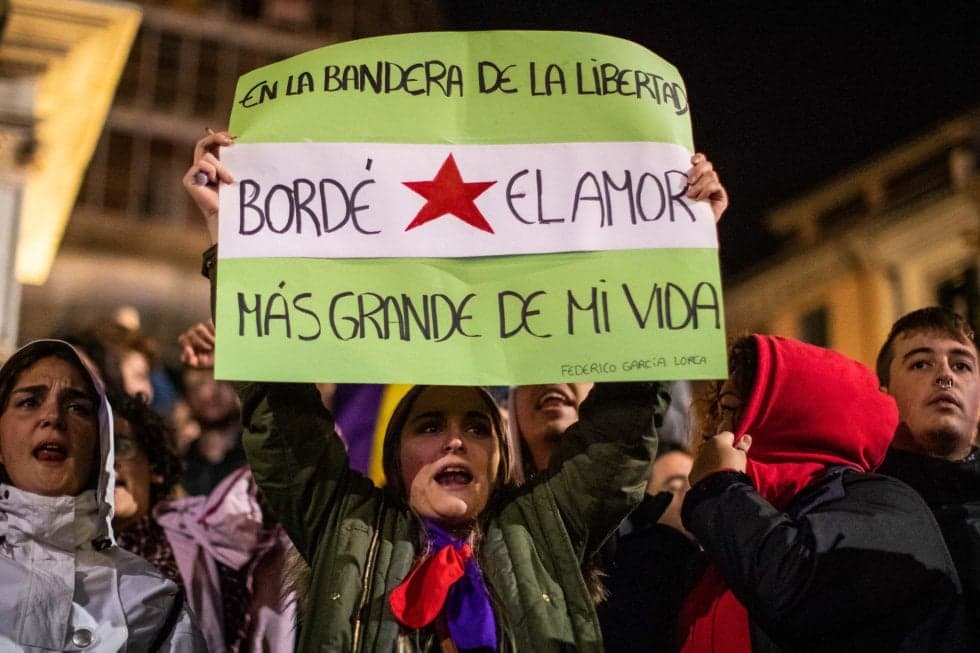
José Saramago, a Portuguese writer awarded in 1998 with the Nobel Prize of Literature, said: “We must recover, preserve and transmit historical memory, because when we start with oblivion, we end up with indifference”. I have been thinking about the way in which events in the political arena in my country, Spain, have been taking place in 2019 and that this political legislature may be the most polarized and angry in our recent democracy. Today, more than ever, we need to defend historical memory.

Sometimes we would like to believe that things are not as they are, to forget the harshness of an incredibly unbearable reality: we are taking steps backwards. I am writing now because I feel overcome by the harshness of this reality, because I see that we have wanted to take away the freedom to be brave and to be lucid, and therefore we want to be unable to move forward. I need to talk about the collapse of truth, the collapse of historical memory and, what is worse, the collapse of human rights that we are witnessing. It would be obvious and no less important to talk about how badly things work in the world, about the enormous inequalities that exist, about the abuses committed against women simply because they are women, about an immense poverty that we cannot or do not want to eradicate, about an enormous climate crisis that is no more than a secondary issue in our daily lives. However it is more useful to reflect by going back to the basics. That is why I will talk about how our societies have decided to turn their backs on the truth and what that entails, and in particular I will talk about a situation that I think I know well: the situation in Spain.

Between the two legislative elections held in Spain in 2019, the extreme right-wing party Vox progressed by 47% to win the vote of 15.1% of the electorate, that is, just over 3,600,000 voters. But what does Vox propose? To sum up, they want to dismantle the system of autonomies in Spain and return to a political centralism, expel immigrants en masse, repeal the Gender Violence Law, lower taxes for the richest classes, abolish the Historical Memory Law, greatly limit abortion, abolish the Climate Change Law…and more. How did we even get to this point?

In 1948 everything was clear ; humanity had gone through two bloody and atrocious World Wars, we had learned from our mistakes with pain and suffering, and hatred could not be a way to move our societies forward. In 1948, the Universal Declaration of Human Rights was written, and soon after, a large majority of countries ratified it. Humanity’s greatest historical milestone was achieved: to agree on a consensual and common basis of ethical and just values that we had an obligation to defend; it was the victory of a common human conscience freed from the burden of a history of violence and blood, from which lessons had been learned for the future.

Today, however, it seems that all that has been called into question in the minds of many people. What seemed to be evidence, today is no longer evident. What we had decided would be our common basis for building a decent and better world for all, is today called into question by more and more societies that vote with conviction for the extreme right.

It breaks my heart, when people vote for a party that wants to repeal a law that has allowed to protect women victims of gender violence in Spain and which has had a very positive effect on thousands and thousands of people. It breaks my heart when, in Andalusia, a party asks in an intimidating way for the names of the professionals who attend to the victims of gender violence. It breaks my heart, when people vote for a revisionist party that opposes the Historical Memory that, in Spain, must serve us to learn lessons from the past and to be able to avoid repeating the dark times of Franco’s repressive dictatorship and to help those families whose relatives, victims of repression, are today buried in ditches and have disappeared. It breaks my heart, when people vote for a party that shows no humanity by proposing to abandon Spain’s participation in the Convention on the Rights of the Child, the most consensual convention that has ever existed at an international level, with the aim of expelling unaccompanied immigrant minors from national territory. It breaks my heart, when people vote for a party that says that the biggest challenge of our era, climate change, does not exist and that it is a lie, and they mess with Greta Thunberg instead of tackling the real environmental problems.

But perhaps that is not the worst thing, because at the end of the day we are all free to vote for whomever we want and to think what we want. Yet, that freedom also demands a great deal of responsibility. The freedom to vote requires responsibility for the opinions, approaches and, above all, actions of the parties we vote for. Not exercising this responsibility means not being free in the practice of voting. If Vox is clearly a party that has approaches that are opposed to human rights, which can be verified objectively, how is it possible that there are people – and they are often people I know personally – who say that Vox is not opposed to human rights? If there are people who vote for Vox, they have to assume that this party has certain approaches that are opposed to human rights. You cannot vote for Vox and be a fervent defender of human rights at the same time if you want to be consistent. The problem that arises is therefore the following: either there are people who vote for Vox and lie, or there are people who vote for Vox who are blinded by excessive irrationality. The first case is reprehensible and unworthy for those of us who defend the truth, especially if we consider the philosopher William James’ theory of the usefulness and practical effectiveness of truth. The second case is worrying, because it teaches us that there are people who have not wanted to reason enough to arrive at an objective truth, and that these people are slaves of a blind faith that they profess towards the politicians of Vox. It is even more so when you demonstrate to Vox voters, and I suppose something similar will happen with many extreme right-wing voters in other countries, that the party they support has proposals that are incompatible with human rights – this is an objective truth – they are not capable of assuming it and with hesitation and resentment they say that this is not true but they are not able of demonstrating it rationally.

The problem we have with far-right parties is a problem of telling the truth. Of course, there are extreme right-wing voters who know very well what their parties are about, but I think there is a large majority who is persuaded by fallacies, lies and fake news, therefore believing such a party represents their ideals whereas actually not. And we are faced with a wall of inconsistency: we know that without the immigrant workers, the pensioners could not have had such high pensions in Spain during the Great Recession (according to data from the National Institute of Statistics, INE). Yet Vox says that we are facing an invasion and that immigrants cost Spaniards a lot. Then some of us are afraid and want to believe that Vox is right, even if we know that Vox has approaches that are contrary to Human Rights. However a high percentage of Vox voters may have have a high regard for Human Rights, then they say that Vox respects Human Rights because they could not bear emotionally that this was not the case. In the same vein, we know that climate change is real and a huge threat to life, since according to the European Environment Agency, in Europe alone, there are already 400000 deaths a year from pollution, but then Vox says that climate change does not exist and so its voters think that there are other issues that Vox defends that are more important than climate change. The problem of Vox and its voters is one of truth and consistency.

I appeal to anyone who reads this to consider who they are voting for and whether they really represent their ideals. To those who are Vox voters I say: if you vote for Vox, it is because you think there are other things more important than human rights; if you vote for Vox, you have to assume that there are things more important to you than climate change; if you vote for Vox, it is because there are things more important to you than saving lives, particularly the lives of migrants and refugees who die every year at sea trying to cross the Mediterranean. If you are prepared to face up to the reality of what Vox and the extreme right are, then you will be truly free to vote. But if, on the contrary, you defend the truth above all, if you defend above all that action must be taken to resolve climate change as shown by science, if you defend Human Rights above all, if you defend life unconditionally, and if you want to be coherent with what you defend ; then you cannot vote for Vox because, in that case, you would not be assuming your values coherently and you would be acting against your own ideals and yourself, slaves to an excessive feeling of hate, illusion or nostalgia that would not let you see what reality is like. Each of us also has that responsibility to argue to show the truth, because the truth should be the basis of any reasoning we do, especially knowing what politics is like in these times. How can we expect politics to be useful to everyone, if we are not able to understand reality?

To appeal to reflection, I would like to conclude with two famous quotes. The first one was written by a great thinker and a lucid mind whose 60th anniversary of death corresponds to this year, Albert Camus: “Il n’est pas une vérité qui ne porte avec elle son amertume”. The second one is from Gloria Steinem, mother of the second wave of feminism in the United States who had the courage to say “The truth will set you free, but first it will piss you off!”.

Joker – a review and a reflection

2 seperate pieces on Joker by Todd Phillips, written by Amir and Ji Sung, giving different takes and critiques of the film.

2 seperate pieces on Joker by Todd Phillips, written by Amir and Ji Sung, giving different takes and critiques of the film.


Part I – A Review – Ji Sung Park


Joker, released on October 4th, was highly anticipated, widely praised and greatly disappointing.


Do not misunderstand; it is a great movie in many aspects. The cinematography is superb; even with bright colors, the atmosphere feels darker than Sin City. The sound editing is pitch-perfect (Aha!); in the scene where Arthur dances his way down the stairs, the background music transitions quickly and appropriately from that reflecting the ostensibly comical image of the clown to that resounding his descent into madness – truly beautiful. The acting is Oscar-deserving. Joaquin Phoenix honors his last name with his flawless impersonation of the flawed character of Arthur Fleck, losing somewhere around 24 kilograms for the act.


But does the movie really deserve all the praise it is receiving? I have my doubts. Many audiences found it boring, not least because of the repeated and protracted laughter of the protagonist. But more importantly, it is a predictable story. Even Marvel zealots know who the Joker is. The downward path for Arthur was predetermined, and after watching the trailer a couple of times it will not be difficult for an indifferent granny to concoct half of the plot successfully. In that sense, the movie is a monotonous routine of disappointments and humiliation for Arthur. What is interesting is his growing versatility in murder. Given time, he might as well have killed someone magically with a pencil. May true DC (or movie) fans get my joke, and not be dazzled by the cheap Batman references in the movie.


However, the director does play a smart trick at the end of the movie. Instead of closing with Arthur dancing (that man just can’t stop dancing) on the hood of the police car, which would have been epic, the movie ends with Arthur having imagined a “joke” in Arkham State. This gives the audience a creative option for interpreting the movie; that the whole event was contrived as a mere “joke” by Arthur, in Inception-esque layers of imagination. Someone noticed that time does not change, or more precisely that all the clocks have the same arrangement in the movie, which seems to support the theory that the whole story was fabricated. Nevertheless, like Inception, there is no definitive explanation and there should not be one.


Now for the more serious talk. Some people suggest that Joker sheds light on the rejection and discrimination of mentally troubled people. Really, such awareness is not addressed in the film in any perceivable way, primarily because Arthur is not as insane as one may first suspect. By nature, he is not a psychopath, although he quickly turns into one. And with the exception of the hallucinations involving Sophie, he has a pretty strong grasp on reality. Enough so to deliver a fully-fledged, critical and apparently quite inspirational speech defending his murder. No, Arthur Fleck is neither as psycho as Norman Bates nor as sophisticated as Hannibal Lecter to entertain the audience by himself, ironically suiting the character.


Then, is Joker a critique on society and its inequality? The answer is: not really. The movie does illustrate how the rich upper class can be despicably apathetic and self-indulgent. But that alone does not justify murdering them. Thus, if the murders were committed by an unhappy social critic, it is an act of downright evil; if they were committed by a madman/psychopath, it is a series of unfortunate events (Aha!); for the victims, of course. In the end, what did Thomas Wayne ever do but punch an unreasonable man, reasonably, in the face? And what wrong did Murray Franklin commit to deserve a bullet to the head? It could be argued that they committed much more contemptful acts off-screen, but such accusation can be made of literally anyone. Therefore, the murder of Thomas and Murry cannot be more right than the murder of Christina Grimmie. Then, was the lower class so abused as to desire complete social upheaving? Sophie, who lives in the same miserable apartment as Arthur, doesn’t seem to think so. She has managed to put up with her harsh realities and establish a life for herself and her child. Moreover, Arthur murders Randall, a man in a similar socio-economic position as Arthur. The result of this action has obscured the conflict between the classes, and that between a troubled man and the world is highlighted. In fact, the story of the movie resembles the Taiping Revolution in many aspects; a gravely disappointed man-turned-mad unexpectedly leading the unsatisfied populace to a darker and more chaotic future. Only that it is set in a world far from realistic, unlike Parasite, or symbolic, unlike District 9, and only depicts a fictional inequality like in Elysium.


Then, perhaps the only valid message in the movie is the repercussions of lying, both to others and oneself. Penny Fleck, who is probably much more insane than Arthur, lies to her son about his origin. This inflames Arthur’s conception of being mistreated by society, exacerbating his mental state and for Penny, leads to her tragic death. Happy themes! Hopefully this movie did not inspire too many ideas apart from Halloween costumes.


******************************************************************

Part II -An Adventure of self reflection on social responsibility – Amir Harith


The reason I chose this title is that the film itself made me pull an all-nighter reflecting about my life and the society I’m currently living in. It provides me with a space, somewhere in my head, to recall the smallest cruel stuff and the selfish acts I’ve ever done that could hurt anybody in this world and also to put some thoughts on why I find familiarity in the despair experienced by Arthur Fleck, the Joker, played by Joaquin Phoenix.


Up to this point, the critiques that I’ve heard from my friends who dislike Joker is that the movie is just another lesson of: what are the consequences of social inequality, bad social integration or the problematic relationship between the governer and the governed. I think we should see beyond this obvious, simplistic causality of why the society in the film descent to societal insanity showed via the great buildup of the movie. We should be able to see the subtle messages and the complexity that Todd Phillips attempted to bring for the audience.


The conceptualization of the world around us through the eyes of the privileged


What I found was thought-provoking is the fact that the film gives us an alternative perspective about Thomas Wayne. It is not only that it changes the common way of seeing him as the hero for Gotham that seeks to cure and redress the injustice (from altruistic businessman to an abusive person), it also tells us, the audience, through what agency we have been absorbing or accepting ideas. It is through the lenses of somebody else: the media that is run and regulated by the captains of industry, the rich or politicians that have personal agenda. This was most evident when Arthur gives his indelible speech that says “ If it was me dying on the sidewalk, you’d walk right over me… but these guys (the three dead Wayne rich workers), because Thomas Wayne cries about them on TV…” which tells us that, even if we don’t notice it, we believe in things that somebody else wants us to believe. The things that come to my mind especially when thinking about the Malaysian context is how we perceive ethnic issues – when politicians play their racial-religious card and we become “enthusiastic” talking about it when we otherwise wouldn’t. Or how many Malaysians see immigrants in the media – the portrayal of the dangerous migrants and how it affects our perspective on them. It might appear that this news coverage is harmless, but this hatred and the normalization of this “us vs them” mentality has become so entrenched, fortified and almost irreversible within the system that we ourselves contributed to by supporting it or worse, says nothing about this evil process. As a consequence, eventually, this vicious view is translated into an inhumane policy.


Furthermore, I also think the movie delicately asks us to be skeptical about the philanthropic behavior by the upper class and to avoid taking things at a surface level. When we see a politician or a CEO of a company tries to fight for the poor or donates money to the underprivileged on newspapers, we think they know what they are doing, and they are doing something right. As much as I would love to celebrate this charitable ‘intention’ and demeanor, we always fail to recognize that this act is an indirect homogenization of the powerless, the poor by a person who has never lived this life. It removes the possibility of seeing the poor as having various identities and simultaneously silencing their different interests and point of views. This is extremely important because it affects the way we see the methods of correcting the system and helping people – not having a white savior complex. I also believe that it influences the way we see ourselves (coming from a different spectrum of the middle-class) who either think that we are working just for the sake of improving our own lives, or even if there is some form of awareness about the need to help the have-nots, we feel complacent with the amount of work we’ve done to help them. We follow a university trip or an NGO to a poor area for a month and teach impoverished kids English or Mathematics, we think we understand them already and have done enough to help them. I believe there is no such thing as peace or ‘sufficient contribution’ if there is one person out there who is struggling to survive in the system that we are complacent and privileged to live under.


We are all morally liable for the injustice that’s happening around us


I believe many people who managed to find the good within Arthur, are able to resonate a lot with the everyday cruelty suffered by him. Throughout the movie, Phoenix tries to be selfless and to do what is presumed right, at least in his small circle. He never misses to check the mailbox just in case there is a letter that his mum asks him about every day. Which means, he never forgets about the needs or interests of people around him. When he got beaten up by some naughty kids, we can see his hand reaching for the broken placard showing that he cares about his job and potentially, that is the only way to help his family survive. When he saw the woman and her child running for the elevator, he stopped the door from closing. It may seem like these are small nice random acts that most people do in daily life, but I believe they are the representation of Arthur trying to keep his sanity through doing what is deemed as correct behavior.

However, all of these moral acts are fundamentally betrayed by something bigger than himself, something he himself cannot control: the discriminative system he is working for, lies told by the same mother he devoted his life for, made fun of by his idolized comedian, rejected and ignored by the woman he has a crush on. It is the same for many of us who sometimes feel that we are doing something that is regarded as honorable or something generally nice but then ignored, forgotten and worse taken wrongly as having bad intentions. That is why it is easy for us to relate to Arthur’s journey from the film because we experience this feeling almost every day.


I think what is more important is to acknowledge is how mean and cruel people can be on a day-to-day basis irrespective of whether or not they are deliberate. We probably do not have the intentions to hurt people, but our objectives can sometimes clash with other people’s interests and that is totally normal. The question then becomes how you can think about it before you sleep – the opportunities that you might have taken away from someone else. It is important to self-reflect so that you remove the tendency for being individualistic in every single step that you take because it potentially affects others. Fundamentally, I think Phillips’ message in this movie is simple: the sufferings that people experience at a micro-level, whether being rejected from a job because of their ethnic identity or rejected from having a decent life because of not having access to good education, are all our fault. We cannot stay motionless and have to do something about it.


Ultimately, this movie is not only about top-down viciousness, but bottom-up complacency and ignorance about the world around us. Joker is an allegory about what happens in a society where cruelty is pandemic, and empathy is absent. It is a wake-up call that beseeches us to be kind to one another.


On being ok, mental health, and regrets.

For Alexis.

1. “Are you okay?”

I am often stumped by this question, despite the simplicity of its earnest demand – there are only so many responses to it. Yet it is precisely this simplicity that stumps me: I can only be either okay, or not okay. Oftentimes, I lie on a spectrum of okayness; there are shades of okays and not-okays. My often complicated situation, my complicated feelings towards it, and my inclination to honesty all makes it harder to respond to this question.

I might be inclined to respond with an affirmative – “yes, I am okay” – or negative – “no, I am not” – followed by a caveat – “but…”. I could tentatively reply with a prefix “maybe” to the typical response, already indicating the slippery feelings that escape the neatly defined responses. I could also opt for a more obstructionist response; I might defensively or aggressively demand why I was asked that way – “why do you ask me that?” – deflecting the question and the intention of the questioner, trivial though it might be. Etcetera, etcetera.

But what makes it even harder for me to answer it, beyond just a surface linguistic examination of the question, is that often, I am compelled to say that I am okay, while in fact, I am flat out not okay. Within the possible answers the question purports to have, there are certain expected answers. Imagine for once, the question was asked when I just stepped onto campus, or while waiting in line for my turn to the microwave, or as I was just seated for a lecture in the grand amphitheater. Given the fact that there is too little time for an elaboration of my feelings, and that everyone is around me, and maybe that I don’t quite know who the person asking is, it simply is more practical to answer yes, perhaps an indifferent “yea, I’m alright.” Even a “maybe” might be inviting too much attention; they might follow up with a “why?” and then there is no time nor space to properly address it. God forbids me saying “no”, then out of their assumed kindness and care for others, they might have to ask why, when they themselves most likely lack the time, nor the space, nor the real intention to care about it, given their busy lives. I would not want to bother anyone with that; you would not expect to listen to struggles from strangers, nor do you know whether you could do it effectively. So out of sheer practicality, or perhaps, more precisely, the pressure to be practical, I answer yes. And nothing happens; life continues, undisrupted.

But we can push this a bit more. Let’s assume, whatever the context is, no matter how impractical it could have been, I say no. And let’s assume also that they followed up with a why, expecting, genuinely, some concrete answer. Now, my answers to this might differ, depending on who I am talking to and the situation I am in. If, at the time, I am only facing something mildly annoying and short-term. the answer could be similarly short, followed by a brief and inconsequential exchange of dialogue. But if I am facing something more drastic, something – or multiple things – fundamentally problematic, that causes me significant distress, I am stumped again, because there is no time for a proper elaboration. The best compromise, one that conforms both to a need to express myself honestly and the lack of time and space, would be a truthful but short, reductive, and unsatisfying answer. A recent example of mine was “I’m depressed, and I can’t muster the effort to study or doing anything else” (some more unfortunate individuals encountered a “I’m suicidal”). Now it’s their turn to be stumped, probably uncomfortable; the effect only amplifies if the answer is longer, obliging them to listen for longer, straining their limited patience.

2. Mental health, but for whom?

The heart of the problem is that no one really expects to see others’ dysfunction in life, especially in the workplace or on campus. We carry on living with a facade of functionality: Here I am, punctually, I work, consistently and without problems, therefore I exist. We might care about others, genuinely or not, but in all cases, it is difficult to go out of our way to assist them. We have distanced ourselves from that task and rdelegated it to professionals, their improficiency notwithstanding. We actively distrust ourselves in the task of handling emotions, disbelieving in our capacity to listen, to empathize, to determine when and what to advise. There is a certain vicious, self-reinforcing, cycle to this logic: by believing that professionals handle it better than us, we avoid further engagement with others, and thus place more responsibilities to the professionals, encumbering them in the process. Paradoxically, this occurs alongside the very recognizable and palpable fact that all we do is emotionally intertwined; everywhere we walk, we speak, we work – there are emotions that trail behind. Yet we cannot act – or more precisely, we believe we cannot act – upon them, despite our own lived experience with our own problems. In a strict sense, everyone is lonely, everyone knows everyone can be lonely, but no one does anything about it, a fact admitted to me by someone to whom I once talked about my issues. A case in point is the fact that everyone has presumed the cause behind our recent tragedy, and acted upon it without a moment of hesitation or suspicion despite no explicit official confirmation, seemingly already knowing why and how it has happened.

Ironically, it is here that professionals might fall short of effective help: they might lack the critical insight on how we go about our daily lives. They suffer from the same fallacy as we do. There is nothing but formality in their offices, evident in their degree hung on the wall, formal attire, notes and pens in hand, despite the fact that to our logic, all emotions are is informality. I find it unhelpful to approach my problems through speaking about my dreams, like psychoanalysis compels the professional to ask of me to do. I find it frustratingly difficult to convey my issues, be they my studies, my finances, or my inability to find fulfilling social experiences, to this professional psychologist but absolute stranger whose relationship to me I have to start from scratch. The communicative labor falls not onto the professional, but rather on me who, already in distress and need of help, easily finds myself unwilling to exert much more effort.

This labor gets more difficult especially when there is a language barrier. I speak and express myself in English well, while the professional do so with only French. The linguistic barrier suggests a larger cultural problem: What if my ways of approaching mental health is different? What if I find more fulfillment in community engagement than individual exchange? What if I have never talked about dreams, ever, to express my problems? Professionalism operates well through processes of standardization, and standards perform poorly in intercultural conditions. But we can take it further: What if I cannot speak well? What if I stutter, or am mentally handicapped? Effective mental health assistance in both cases are then inaccessible to me; I cannot attain it unless I have acquired a certain language, and a certain way of speaking the language. I feel there is a certain exclusionary character of “mental health” as expounded in official discourse here on our campus: mental health is not only defined by your capacity to work well, but the paths towards it are limited by your ability to speak a certain language, in a certain standardized manner.

We often talk of inclusion and mental health, but to whom does this inclusion and mental health belong to?

3. Beyond a collection of individuals, towards a community

The writing here contains without doubt my very personal, emotional motives. I have felt too well my feelings of isolation and helplessness here on campus, and a lot of what I have written thus far seems like an indictment (I admit the process was very cathartic). Nonetheless, I would like to restrain myself for a moment, and say that I am not trying to accuse everyone of being callus (not entirely anyway, cheek-in-tongue-ly). In spite of my critical view, I know painfully well the fact that everyone has their own priorities in life – perhaps the rent is coming, the civic engagement project or presentations have been procrastinated too long, the papers are long overdue – and caring for others sometimes takes a backseat. To quote from my favorite writer in Vietnamese literature, Nam Cao, who luridly described the selfish nature of pained individuals during Vietnam’s colonial period: “A person with an aching foot could hardly ever forget about their aching foot to think of anything else? When one is in so much pain, one could no longer think about other people. Their kind-hearted nature is obscured by their selfish worries and pains…”

But I must remind you all that we do not live in the miserable hellscape of French-colonized Vietnam; our feet do not hurt as much, and our kind-hearted nature still shows and glistens at occasions, to friends more so than to acquaintances. We need not religiously follow the liberal, individualistic logic of caring for yourself first and having sole responsibility for your own problems – it is this logic that formed the baseline of the toxic internalization of my problems that drove me to destructive suicidal ideation multiple times before and during my studies. Such mentality prizes independence beyond all else, and, in the process, anathetimizes seeking help.

I find the mentality incredibly frustrating, toxic, and cumbersome, and we’d do better not to think of life that way. And indeed we say we do not for most of the time, but I could not help but feel that we do not do what we preach. At times, I feel myself dismissed by others when I express my emotions, superficially or deeply, either through a blunt dismissal or suspicion of my feelings, or through a blanket statement that I would be fine, more reassuring to the speaker rather than me. No, I am not fine, and neither are many others, I believe, who share my sentiment, at times or always. Perhaps the problem in those occasions is that, while they do want to listen and help, they simply do not know how to do so well. But my deeper concern resurfaces when I ask them to do better than that, to listen better, to empathize better. They would be likely to defensively respond by saying they do not have to, or that they could not, do that.

We would do best by recognizing problems as they are, seeing that we all have a stake in it and we have the capacity to address it as a community. This does not necessarily call for a rejection of professional assistance to mental health, but it does question an overreliance on such an approach. If we do treat mental health as seriously as we do with physical health, then we would not advocate for an overdependence on medicine. Treatments of both kinds should be reserved, applied when necessary, not whenever a sign manifests. More importantly, we should first look to a simple vigilance and attentiveness towards others, expressed through each person with a handful of genuine statements of care and wholehearted exchanges, and through the entire community, a network of active support and positive integration, beyond faux-functionality.

In striving beyond my casual cynicism towards a kernel of hope, I urge all of us to care more as a whole, truly, lest we find ourselves regretting what we did not do or pondering we could have done, a trope that should have been put to rest before we received our most recent tragedy.

Photos: author