An interview with David Lheureux
By Rita Zeefal
All photos credited to the author.
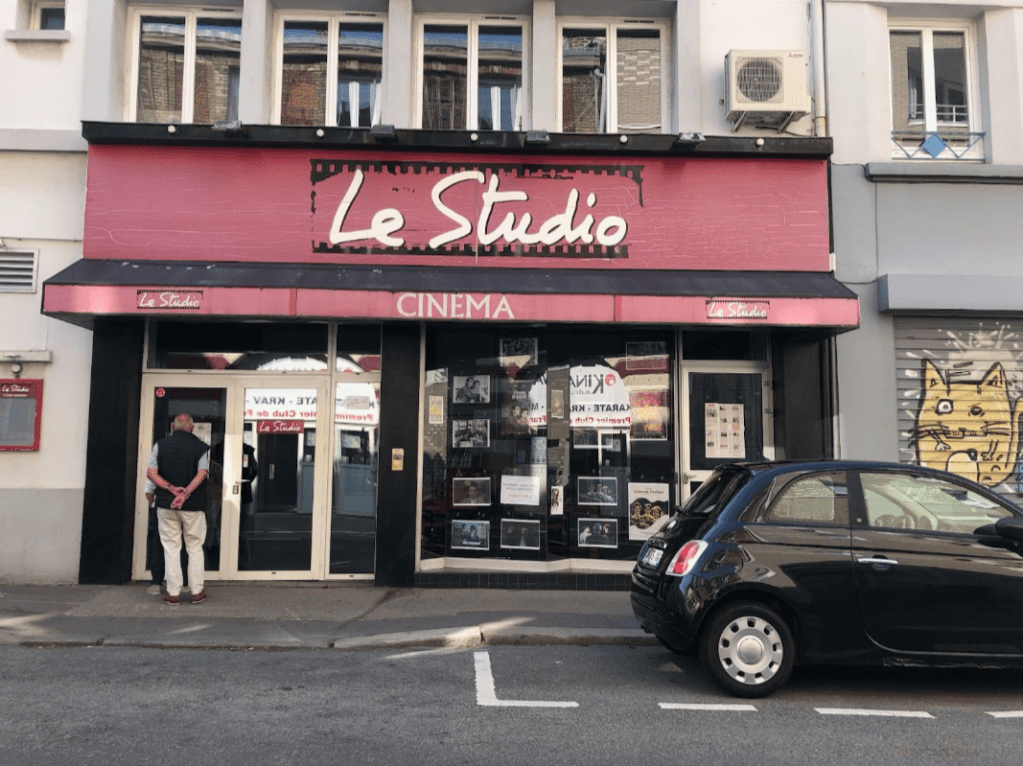
Above: a street view of Le Studio
While the beloved cinema d’art et d’essai’s future seemed precarious at the beginning of this year, it has managed an impressive rebound.
“Could you wait ten minutes until the screening is over?” says David Lheureux as we enter the foyer of Le Studio, Le Havre’s best and most beloved cinema d’art et d’essai. We sit down as David prepares to usher in an elderly couple to see Alfred Hitchcock’s The Lady Vanishes (1938). The foyer at Le Studio is immediately beguiling for an institution of its kind: the walls are papered with the printed cards that the enterprise gives to anyone who comes to a screening – with a still from the showcased film on one side and a description and history of the film on the other. One corner boasts a repository of such cards from screenings long past – which anyone can take free of charge. A large table occupies the centre of the room, on which are strewn pamphlets, brochures, and booklets on all things art and cinema at Le Studio and in the city of Le Havre.
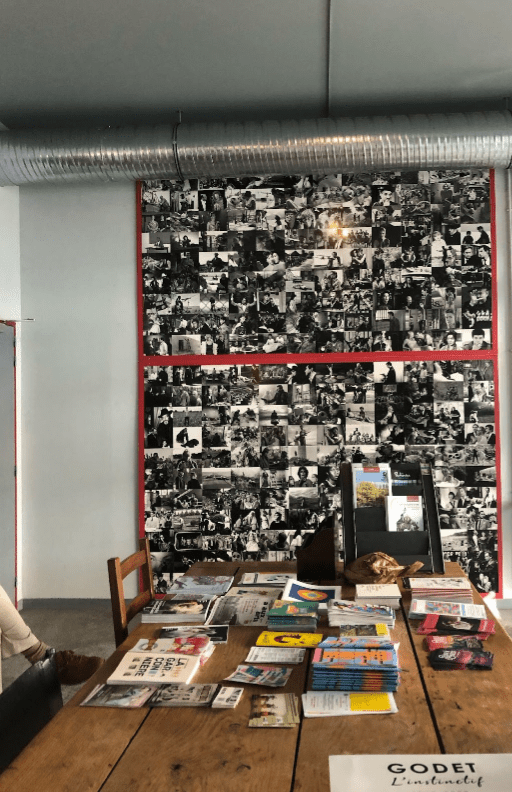
Above: a view of the interior of Le Studio’s lobby.
Fellow Le Dragon Déchaîné reporter Manon Patouillet and I begin our interview with David. His sharp, quizzical expression and steady blue eyes remain fixed on us.
RZ: Could you tell us a bit about the establishment of Le Studio? Who initiated the project and what was its initial objective?
DL: Well, Le Studio was established in 1999 by Christian Zarifian, a filmmaker, who wanted to establish cinema heritage – the aim was to be able to showcase cinema – the grandes classiques and the history of cinema, but also world cinema and what was not shown on television.
MP: And what is your role at the cinema? How many people work here?
DL: There are about six people who work here – for my part, I play a role in the curation of films, and I oversee the screenings, making sure that we have the rights to show certain films…
RZ: And for how long have you worked here?
DL: I’ve worked here since 2002.
RZ: Wow, so it’s been quite a while [all laugh].
MP: Could you tell us a bit about the legal issues Le Studio was facing earlier this year? We know that a petition was started by an old Sciences Po student from our campus to mobilise support for the cinema.
DL: Indeed, erm, a petition was started by a student from your campus, however we were still able to operate during that time.
RZ: But what was the trouble exactly?
At this point David’s answers become vague, and he shifts the focus to the role that a Sciences Po student, Elias Cantone, played in bringing attention to the conflict and mobilising local support for the institution to remain open.
From our point of view, the story is this: on the 6th of April, a petition created to ‘save’ Le Studio was shared with the students of Sciences Po’s Le Havre campus. “Sauvegarder Le Studio que nous aimons!” was its cry. The institution’s future looked precarious as two administrative factions fought over control of the cinema monosalle. A resolution of the conflict seemed elusive and the cinema appeared to be at risk of closing for good.
According to reporting done by Paris Normandie on the matter, two parties were at loggerheads over the question of control of Le Studio. One was led by the widow and daughter of the institution’s founder Christian Zarifian, and another led by individuals who have been administering the cinema since its conception, including president Patrick Gravé and treasurer André Fouché. By the time the story was reported on, the conflict had been raging for well over a year. By April 2024, a judicial tribunal was in the process of naming a provisory administrator while the two conflicting parties worked on finding a resolution internally. Once Le Studio reopened its doors on the 28th of August, Cécile Dür, an administrative official of the Association Les Films Seine Océan, had been named the provisory overseer of its affairs. The cinema reopened its doors to the public after a summer sabbatical on the 28th of August with a screening of Kozaburo Yoshimua’s Night River (1956).
For now all seems to be well. The optimism expressed by David for the cinema’s coming year is palpable. David proceeds to tell us of the curation of films at Le Studio, its choice to show what is dubbed ‘world cinema’. He casually includes his matured reflections on the value of such cinema in an artistic sense.
DL: We run a programme that we curate based on a theme, and our programmes run for the entire year, that is to say, from September to June. As you can see we are showcasing a lot of contemporary Asian cinema. We have Youri Deschamps who comes to present a film every month. We curate a programme for each month of the year. We try to show films by directors with a rather strong sense of aestheticism. Directors that are less known. Youri Deschamps has been doing presentations since 2002, so that’s 22 years. People come here to make discoveries, to see things that they aren’t able to see elsewhere.
MP: And why have you chosen to showcase Asian cinema in particular?
DL: Contemporary Asian cinema? Well… because of the amount of reflection that French films tend to have, we are really caught up with the spoken word, with language… I personally find that it’s sometimes a bit too literary, whereas with Asian cinema there is a sense of the aesthetic that doesn’t come second. It makes for a cinema that is – bolder, and harkens back to the true sense of cinema.
To many of us who are regulars at Le Studio, the cinema is more than just a patrimoine institution. The cinema is a portal to worlds far removed by space and time from anything many of us will ever get to know in our lifetimes. And for this fact alone, if not for any other, when we walk out of the inky black darkness of the screening room, we emerge as different people. The cinema is just as much a part of our education in this city as are our weekly seminars and 3-hour lectures. Our only hope is that this experience will be shared by many future generations of students in the city of Le Havre.
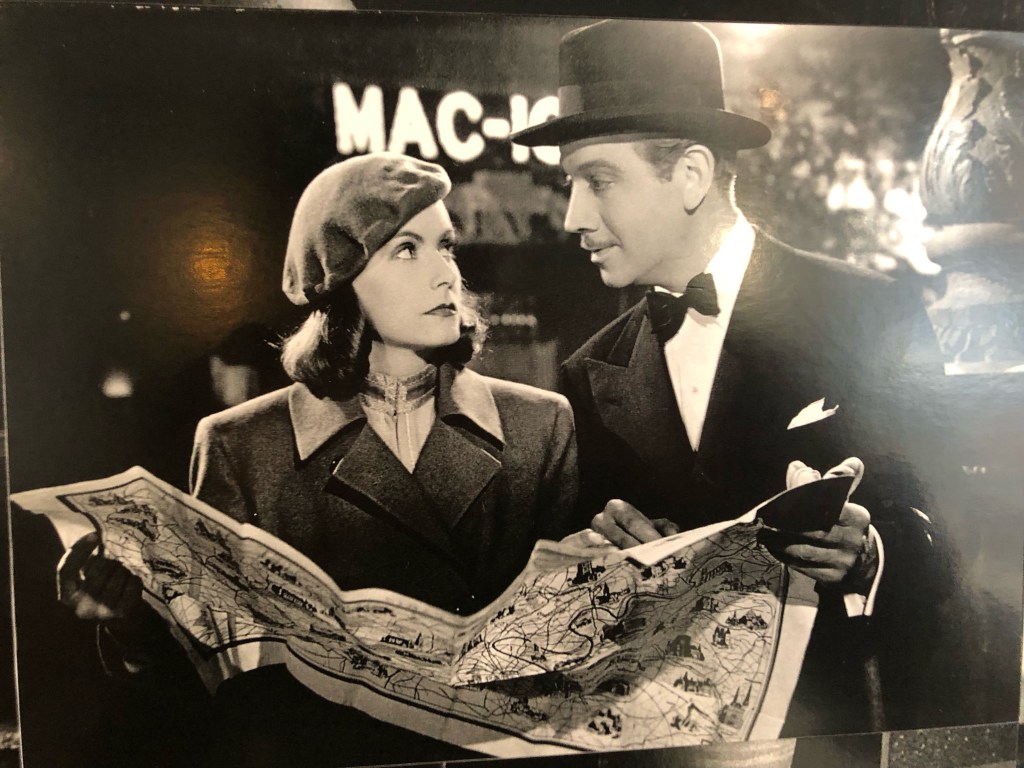
Above: an example of the printouts that are handed to every individual who pays to see a film at Le Studio. This film still shows Greta Garbo with John Gilbert.

 Le Dragon Déchaîné