From Slaughtered to Slaughtering: Asian Golden Triangle

by Giulia Porcu

Southeast Asia is known to be one of the main stages for transnational criminal activities, one so central for the development of this phenomenon over the course of the last decades that readings about its evolution do not surprise anymore. What must, or at least should, spark our interest is the relocation in the Golden Triangle of regional criminal gangs after being cracked down by the governments. Historically known to be a piece of the Mekong’s river bend converging Thailand, Laos and Myanmar, many researchers have recently started to consider an expansion of its borders, relocating its summits in Singapore, Hainan and Bangladesh. Such a subversion and the relocation of its western border in Singapore can be linked back to the development of money laundering hubs in the region, an occurrence which, despite being more prominent everyday, is still questionably marginal in international investigations. If the reader, following the same thought current of the international policies, fails to see the importance of such an event, I suggest thinking of the implementation of the “Corruption, Drug Trafficking and Other Serious Crimes Acts” in Singapore as a visible effect of such hubs where capital from illegal trafficking is directed.     

While Thailand remains the main transit and destination point, drugs are mostly produced in Myanmar as the progression of the civil war creates the perfect conditions for the development of illegal traffics and so-called ‘scam cities’. Scam cities, which started rising on South-East Asia borders before COVID 19, could originally be defined as ‘vices cities’, where casinos and gambling took place everyday despite being illegal in various South-East Asian states. The gradual shift of these cities into centers for online gaming after the pandemic lockdown is grafted on one of the great Asian passions: gambling. Certainly not a recent phenomenon, journalist Julia Wallace in 2011 reported Cambodian gambling even on rain for ‘the Atlantic’: “The rain-betting day is divided into three segments: 6 am to noon, noon to 2 pm, and 2 pm to 6 pm. A bet, starting at $2, yields a pay-out if it rains during the chosen time period. Betting on rain during the typically dry mornings is riskier, but offers a massive payoff. But it’s relatively safe to assume that it will rain before 6 pm at the height of the wet season, so winning bets on the third segment of the day bring in paltry returns”.  Online gaming subtly but surely set the stage for its replacement: extremely sophisticated scams attracting people, who are finally brought to give up all their having, through irrealistic promises which feed this phenomenon. The mini “Burmese Las Vegas” Shwe Kokko, a city of casinos located at the border between Thailand and Myanmar under control by local militias, has become sadly known as one of the essential centres for online gambling, scamming and human trafficking. Due to the tropical weather of the region, it is only logical to understand the attraction that sparkling cities, such as Bangkok, exerts on countless people who are first promised a stable workplace in these vibrant metropolis only to be forcefully but easily, thanks to the efficiency of the infrastructural network, transferred to scamming centers as to scam others. Interestingly, experts have recognized a variation in the behaviours of those subjected to this process: initially victims of human trafficking, after being paid conspicuous salaries and realizing that by being the scammer one has control over another’s life, victims undergo a psychological change which brings them to intentionally perpetuate scams and finally this system.   

Journalists Emanuele Giordana and Pietro Morello, authors of ‘Asia criminale. I nuovi triangoli d’oro tra scam city, armi, droga, pietre preziose ed esseri umani’ have identified three main reasons for the perpetuation of such phenomenon in respect to the general context of scam cities and illegal traffics: firstly the amount of capital employed in South-East Asia, also due to Chinese investments, and its consequent attraction for criminal activities, secondly the little to none space for civil society and open critic in the autocratic states involved and thirdly war, more specifically the Burmese one. The latter has brought several alliances between ethnic groups opposing the central government, leading to the constitution of narcostates fed by opium and methamphetamine production which shower not only South-East Asia but Bangladesh, India and the United States as well. The United Nations in 2025 reported a record amount of methamphetamine seizures in East and Southeast Asia, totaling 236 tons, marking a 24 per cent increase compared to 2023. “The 236 tons represent only the amount seized; much more methamphetamine is actually reaching the market,” said Benedikt Hofmann, UNODC Acting Regional Representative for Southeast Asia and the Pacific. “While these seizures reflect, in part, successful law enforcement efforts, we are clearly seeing unprecedented levels of methamphetamine production and trafficking from the Golden Triangle, in particular Shan State.”

It leads that an incredibly conspicuous capital is produced, eventually feeding scam cities, financial speculations and real-estate investments consequently freezing South-East Asia in a bubble of money’s recirclement and criminal activities’s superimposition. Overall, these three factors have come together during an extremely flourishing period for the region, creating the perfect ecosystem for the diffusion of criminality on a large scale.

Finally, the current importance of Southeast Asia, hence of the Golden Triangle, is strictly connected to its strategic location, which makes it a critical actor in international trades. Bridging major economies such as China, India, and Australia, the region is an indispensable hub for maritime activity. Several criminal activities are carried out and overlap in these waters just as they do on the mainland: piracy against ships carrying goods to Russia and Northern Korea to avoid sanctions, human trafficking and environmental crimes which generate a turnover of billions of dollars. Lastly the South China Sea, inside the Golden Triangle, is the focal point where a hypothetical third world war could occur. 

Recent failures in the dismantling of these networks highlight the long-lasting role that the Golden Triangle will most probably continue to play as a crucial hotspot in global drug production, trade and as a haven for transnational criminal organizations. Involving many different actors, legal, illegal and in-between ones, and given that often local players are seen as perfectly respectable businesspeople or government officials in their home countries, this transnational criminality needs to be treated as shared responsibility, with collaboration and cooperation between states. “The organized crime trafficking organizations look for chaos, the lack of governance, porous borders, and this they can find in parts of the Golden Triangle. So really, it’s an organized crime haven.” stated Jeremy Douglas, the Regional Representative of the UN Office on Drugs and Crime (UNODC) for Southeast Asia and the Pacific, on a mission to the border area. China and the US, among other states, ought to set aside their differences to support a regional initiative, and address what could be seen as a ‘non-traditional security issue’ ; were they refuse to do so, the flourishing of the Golden Asia Triangle would implicate global irreversible consequences.

The War in Ukraine: Ending the European Illusion of Peace

by Yeva Murova

In many European cities, the sound of a helicopter means little more than routine patrols or training flights. In Ukraine, helicopters only appear over cities after rocket strikes, often in operations to clear the city or search for people. These are two different realities. One is Europe, where people still keep talking about peace. The other is Ukraine, where they have learned the real price of losing it.

Following both the Second World War and the Cold War, many European leaders believed that a long-term international order would finally prevail. However, Russia’s full-scale invasion in 2022 shattered this assumption, forcing Europe to rethink its ability to defend itself. Today, it is almost impossible to believe that peace is the natural order of things. It now has to be maintained, defended  and, if necessary, fought for.

The new European defense agenda

The most evident changes within the European Union (EU) have been in security policy. After decades of underfunding, many EU countries have begun to strengthen their armed forces. The EU’s total military spending rose by close to 37 percent from 2021 through 2024. At the Versailles Summit in March 2022, EU leaders agreed to “spend more and better on defense”(Council on Foreign Relations). They later supported that idea with a new EU security roadmap, the Strategic Compass. Eventually, defense had become such a priority that by 2024, the EU appointed its first-ever commissioner for defense and enacted laws to boost ammunition production and joint procurement of weapons.

Speaking of collective security, the war also contributed to NATO’s consolidation. One of the most unexpected outcomes was the decision of Finland and Sweden to abandon neutrality, realizing that it no longer offered real protection. In Sweden, a solid majority in parliament supported a “NATO option” even before the invasion, and once the war began, both the public and the government united behind joining the alliance (Sagamore Institute). Europeans witnessed the Russian invasion and realized that they would be safer under NATO protection than outside it. NATO, which many once considered outdated, suddenly became politically relevant again. Poland, for example, increased its defense budget to 4 percent of its GDP, making it one of the highest in the alliance (Reuters). Even governments in Western Europe, which once viewed military power skeptically, began sending troops to NATO’s eastern flank and investing in advanced technologies. The old belief of diplomacy by itself holding back aggressors like Putin feels totally outdated these days. All of this shows that Europe is finally treating defense as a real part of its collective purpose.

From dependency to resilience

But military hardware is only part of the story. The understanding of security itself has expanded. Energy used to be seen primarily through the lens of climate targets and economic planning. Gas was just a resource, nothing more. Post-2022, any illusion that Russia was a “reliable partner” collapsed overnight. The real shock came when the Kremlin cut off the gas to make its point. That was the moment Europe realized that they cannot talk about peace if their energy lifeline is controlled by someone willing to weaponize it. The EU has made some pretty impressive energy changes in the past two years. Countries moved quickly to find new suppliers, reduce gas consumption and form strategic partnerships to ensure they are no longer as vulnerable as before.
Already in 2023, gas imports from Russia decreased significantly. By the third quarter of 2023, Russia’s share in EU oil imports had dropped to 3.9 percent and coal imports from it reached zero (EU Council). Overall, Europe supported the accelerated transition to green energy sources, and countries also turned to alternative suppliers including Norway, the United States and Azerbaijan. Critical infrastructure such as pipelines and networks is now considered a strategic asset.

Failing systems, new responsibilities

The war in Ukraine also exposed the deep dysfunction of international institutions that were once seen as guarantors of peace. The United Nations was established primarily to prevent wars from occurring. Yet it showed itself incapable of responding to Russia’s military moves. As a permanent member of the Security Council, Russia used its veto to block even the most modest resolutions (AP News). This failure shook Europe’s trust in the post-1945 collective security system and intensified calls for reform.

European Council President Charles Michel told the UN General Assembly in 2022 that the “use of the veto should be the exception, but it is becoming the rule. Reform is needed, as a matter of urgency.” He even proposed that if a permanent member of the Security Council unleashes an unprovoked war and is condemned by the UN General Assembly, they should be automatically suspended from the council itself. At first glance, this idea might seem quite radical. Nevertheless, given the current situation, it becomes difficult to overlook the reasoning that supports it. This points to the increasing frustration with institutions formed after the war. It also highlights that even peacekeeping systems can be stalled by the states they were built to keep in check.

These institutional failures reinforced another idea: Europe must be able to act independently when others cannot. NATO remains central, but so too does the development of a more cohesive and capable European security policy. The EU’s Strategic Compass, adopted in 2022, marked a shift from theory to planning, committing to the establishment of a rapid deployment capacity and greater defense coordination. A union like this one has long hesitated on anything too military-focused. The Compass signaled a deep adjustment in their overall stance.

Europe has, in a way, woken up. The war in Ukraine drove home the point that peace does not come on its own. It demands real effort from everyone involved. It means being alert, staying engaged and sometimes standing up directly to threats. Peacefulness is no longer seen as a distant ideal but as something that demands real responsibility and constant effort. What counts most is the resolve to defend what truly matters.

You can hear that change in the skies above Kyiv and maybe, faintly, across the rest of Europe too. Helicopters continue passing overhead in Kyiv, but their noise now carries a different weight. For people who endured the war, that sound will forever hold new layers of meaning. And for the rest of Europe, it is a quiet signal that peace and war are no longer separate stories — they are chapters of the same one.

Navigating Solidarity and Strategy: Daniel Peterson’s Lecture on Indonesia’s Support for Palestine

By Carmen Leong

Just over a year ago, nearly two million people gathered in the central Freedom Square of Jakarta, waving enormous flags in a spectacle of red and white, but also green and black. They were rallying to express solidarity with Palestine, in light of the war on Gaza that had devastated the state and slaughtered thousands. It was one of the most significant protests for Palestinian resistance in Southeast Asia, said regional law and politics scholar Daniel Peterson. Our campus had had the privilege of inviting him to give a lecture on Indonesia and the Palestinian cause at lunchtime on 28 January, in which he outlined the principles and narratives driving Indonesia’s support of this vastly distant state.

Indonesian support for Palestine stems from its own history of anti-colonial resistance and humanitarian principles – the latter of which is stated explicitly in its Pancasila state philosophy. But the massive scale of mobilisation for Palestine in the country can perhaps best be attributed to the sentiment of Islamic solidarity resonating among its people for their brothers and sisters across an ocean. The significance of this relationship can be traced back to the 1955 Bandung Conference; it not only secured Indonesia’s political presence on the international stage, but also marked the country’s diplomatic and moral pledge to Palestine. Although some dissent exists – for instance, a 2017 BBC World Service poll recorded that 9% of Indonesian survey respondents view Israel positively – most Indonesians take a pro-Palestinian stance, motivating the Indonesian government to do the same. For instance, Indonesia has refused to entertain Israel during international sporting events, most recently with Indonesia being stripped of its hosting duty for the FIFA Under-20 World Cup due to concerns over whether the Israeli team could compete there without disruption. Even so, some critics have argued that Indonesia can do more to ally itself with the Palestinian struggle; even if geographical distance and limited military power restricts its ability to intervene directly in the conflict, Indonesia can welcome Palestinian refugees. At this point, Peterson paused and directed the question at our audience: do we think Indonesia will welcome Palestinian refugees?

Image Credits: Melbourne Law School, Routledge Contemporary Southeast Asia Series

As LDD’s newspaper correspondent, I was lucky enough to catch him for an interview later that day, during which I asked his opinion on the very same question. His answer: it’s highly unlikely. There is firstly the argument that accepting Palestinian refugees is counterintuitive to the greater struggle; when refuting reports of Trump’s plan to relocate Palestinians in Gaza to Indonesia, the Indonesian Ministry of Foreign Affairs asserted that “any attempts to displace or remove Gaza’s residents is entirely unacceptable”, since “such efforts to depopulate Gaza would only serve to perpetuate the illegal Israeli occupation of Palestinian territory and align with broader strategies aimed at expelling Palestinians from Gaza.” Secondly, Indonesia has not had the best track record for taking in refugees, with Rohingya from Myanmar facing hostile pushback from local communities when arriving on Indonesian shores in recent years, due to fears of competition over scarce resources and an increase in crime and inter-ethnic conflicts. 

Evidently, the Indonesian government must carefully take into account its domestic situation prior to undertaking any intervention in the Israel-Palestinian conflict. This could explain its continued reluctance to use the word “genocide” to describe Israel’s actions against Palestine – a point that Peterson brought up in response to a student’s question during the Q&A segment of his lecture. Given Indonesia’s own violent history, such as the 1965-66 massacres of members of the Indonesian Communist Party (although the anti-Chinese sentiment behind this event has been refuted by some scholars as a myth), it may not be politically expedient to directly accuse Israel of “genocide”, since the definition of the word also varies and genocidal intentions are difficult to establish. That said, the Minister of Foreign Affairs has arguably asserted the same sentiment, by stating that “Israel’s ultimate goal [is] to wipe Palestine from the world map.”

In light of Indonesia’s steadfast, justice-oriented stance against Israel in the ongoing dispute, some may question why it has not adopted a similar position against China, especially considering the allegations against the latter of being complicit in the persecution of ethnic Uyghur minorities in Xinjiang. To this, Peterson points to Indonesia’s significant economic dependence on China. Just recently in November 2024, Indonesia signed $10 billion in deals with China; it is also the highest recipient of Official Development Assistance (ODA) and loans from China among Southeast Asian countries. In contrast to Israel, with whom Indonesia has minimal economic ties, China holds far greater influence over Indonesia’s economy, requiring the country to carefully balance its stance on human rights with the need to cultivate favorable relations for economic and development purposes.

Daniel Peterson’s lecture provided me – and, I’m sure, many other students – with a deeper understanding of how cross-border movements shape international relations. I now have a greater appreciation for how governments must carefully consider their own internal tensions and domestic situation before formulating foreign diplomatic strategies, particularly in the case of Indonesia’s approach to the Israel-Palestinian conflict. Our team at LDD would like to express our gratitude to Dr. Peterson for taking the time to participate in the interview, and we hope that this article offers valuable insights to those students who were unable to attend the lecture.

The Decline of Democracy in Korea: Judicialization of Politics

On November 2nd, the Democratic Party of Korea, the nation’s largest opposition group, held a massive protest at Gwanghwamun Square. They accused the current conservative administration of fueling a “crisis of democracy,” labeling it a “dictatorship.” However, this scene is not new: four years ago, in the same location, the People’s Power Party made the same accusation against the Democrat administration. Despite regime changes between left and right, the blame game continues, revealing that the decline of Korea’s democracy is not tied to any single party.

To know if democracy is truly in crisis, one must first define democracy. Contemporary constitutional doctrine distinguishes democracy from autocracy based on the autonomy of producing legal norms. In an autocracy, laws are imposed by an external sovereign, often a tyrant or oligarchy. In a democracy, however, the people are the sovereign with the autonomy to establish the constitution and laws through elections or direct participation. The executive and judicial branches derive power from this constitution and remain circumscribed by it. When these institutions impose laws on the people, sovereignty shifts away from them. Hence, democracy falters not from the rule of any particular party but when external institutions rob the autonomy of producing laws from the people.

In light of these elements, if either the Democratic or Conservative party in Korea seeks to safeguard democracy, they must denunciate the judicialization of politics. Over the past two decades, courts have increasingly been called upon to address public policy questions and social conflicts—such as capital relocation, adultery law, deployment to Iraq, the death penalty, the national security law, euthanasia, abortion, and conscientious objection. Initially, expanding the scope of the court’s role was aimed at ensuring individual rights and the legislation’s compatibility with the Constitution, preventing abuses of power seen under past authoritarian regimes. Yet, the danger emerged as judges began dictating what the law should look like rather than reviewing its adherence to the Constitution.

As stated by Montesquieu, judges must be no more than “the mouth that pronounces the words of the law.” This was challenged in 2012 when Justice Kim Neung-Hwan stated he felt he was “building a new state” when ruling that the 1965 treaty did not bar Korean citizens from filing a lawsuit against Japanese companies for wartime reparations. However, the role of judges is not to “build” or create something new. It is to interpret and apply the law or treaty as written,  referring to the original text and intent of its makers. Judges are not tasked with pursuing societal change or progress—that is not their mandate. They are the executors of the law, not social justice activists.

The essence of Justice Kim’s ruling does not lie in whether Korean citizens have the right to file a lawsuit against Japanese firms regarding reparation. His ruling demonstrated how the court applied domestic legal principles—principles without claim-preclusive effect in the international society—to a diplomatic matter involving complex inter-state interests. Interpreting an international treaty, which requires non-legal means like inter-state negotiations, should fall to the politically accountable executive branch. The judiciary, lacking such accountability, should have refrained from reviewing cases within the political realm. Justice Kim’s decision deviated from this principle of judicial restraint, initiating the long-standing diplomatic dispute between South Korea and Japan.

However, the problem extends beyond political questions and into social issues, with abortion being a prominent example. In 2019, the Constitutional Court ruled the abortion ban as violating the right to self-determination, overturning the 2012 ruling that upheld the ban as serving the public interest by protecting fetal life. The problem is not which ruling was correct; it is that a case raising fundamental questions about human life and existence was decided by judges who neither represent the nation nor have the authority to create answers outside the law. The Constitution does not clarify whether Article 10’s guarantee of human dignity encompasses protecting potential life or the extent of society’s obligation to it. Therefore, such questions should not have been decided by judges who do not have the legitimacy to define what life or human existence means for Korean society.

Moreover, the threat to democracy is evident when the court silences public debate on social issues, stopping individuals who could otherwise persuade one another and influence their elected representatives for changes. A system where fourteen unelected judges create and impose norms beyond the scope of the law on questions meant for the people to answer is clearly not a democracy. Allowing a small, unrepresentative group of privileged elites—mostly educated at Seoul National University, with only three women members—to make social changes that lack the representation of the people aligns more with an oligarchy. Accordingly, democracy fractures as the judiciary encroaches on the people’s role as the sovereign, stripping them of their autonomy to produce laws.

Ironically, both Democrats and Conservatives hold responsibility for this threat to democracy, even as they accuse each other of causing it. Fearing backlash from key support groups like Christians, they avoided debates like abortion and euthanasia, delegating the decisional power to the court. In doing so, Parliament has shrunk its autonomy, willingly surrendering its constituent power to the judiciary. These politicians claim to defend democracy yet actively contribute to its decline by avoiding their duty. They have protected neither democracy nor national sovereignty. It is time for the Korean people to see through their empty rhetoric and reclaim the power that belongs rightfully to them.

Belgrade’s Balancing Act

by Fyodor Dmitrenko

Andrej Isakovic/AFP via Getty Images, Politico.eu

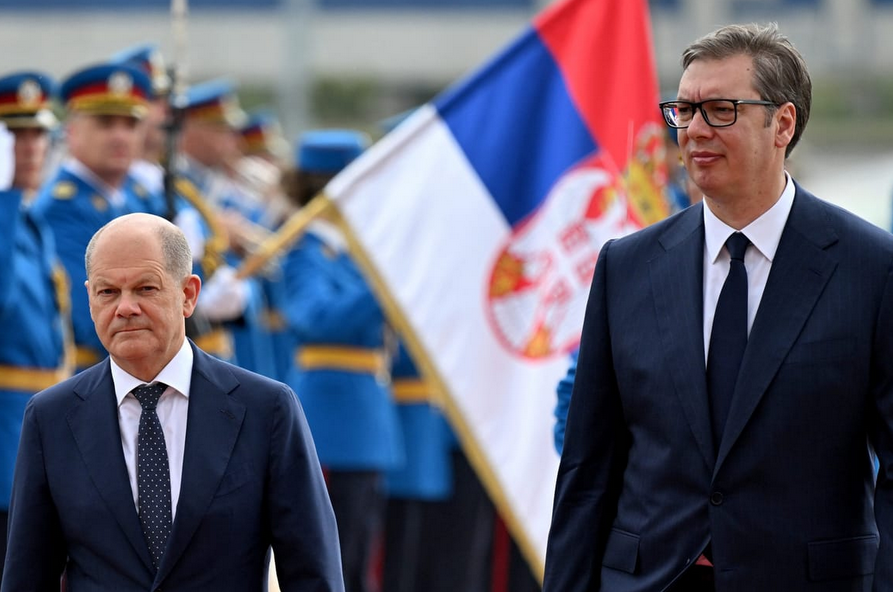
On my recent visit to Serbia in July of 2024, on the way from the airport to the centre of Belgrade alongside the stark Genex tower, I witnessed an interesting display. The highway to the centre was lined with small Serbian tricolour flags but also a stranger sight – that of a line of equally numerous blue flags with yellow stars. 

While seeing EU flags in Paris or Bucharest wouldn’t be that strange, their presence in Belgrade mere blocks from the location of the Yugoslav Ministry of Defence Building damaged in the NATO bombings of 1999 seemed bizarre, especially considering many Serbs still feel lukewarm at best towards EU member states like Germany, France, and Italy who participated in the air campaign against them – a sentiment illustrated clearly by the fact that EU accession is still seen more negatively in Serbia than in their Western Balkan neighbours according to IRI, with 44% of poll respondents stating they would vote in favour of joining, compared to 89% in Kosovo and 92% in Albania more than 2 decades after the event. So, what was going on? 

Unbeknownst to me, the flags had been put up for an interesting ‘trade summit’ on July 19th between German chancellor Olaf Scholz and Serbian President Aleksandar Vučić which led to the re-opening of the Jadar valley lithium mine project in Western Serbia by British-Australian mining and refining firm Rio Tinto. According to Reuters, this project could fulfill up to 90% of Europe’s current lithium needs, a material used in the manufacturing of lithium-ion batteries and thus critical to the Union’s aim of achieving net zero emissions by 2050. This also falls in line with other major EU objectives such as the current endeavour at securing more secure raw material procurement from partners – due to mistrust of Chinese suppliers and volatile supply chains owed to waning European influence in African nations like Niger – and playing catch-up to China and the US in high tech industries such as the manufacturing of electric vehicles. 

I found the reopening of the mine project especially interesting given that less than 2 years ago, Serbia had shut down the project after mass protests over environmental concerns. The complete U-turn in policy has unsurprisingly raised eyebrows yet also revealed an increasing trend in Serbian politics – a desire to mend ties with the EU. 

Despite the aforementioned mistrust towards the EU from the Serbian population (one further supported by a similar 2024 poll by Balkan Barometer), Vučić seems increasingly interested in developing ties, in large part due to the economic payoffs that these could yield. 

The most prominent manifestations of this interest are Serbia’s repeated attempts to join the Union itself, with its first formal request being submitted on the 22nd of December 2009. The EU granted Serbia official candidate status in 2012 following recommendations from both the European Commission and Council to do so. A further step towards closer integration has come in the form of the recently ratified Stabilisation and Association Agreement (SAA) establishing a framework to bring the country into closer political and economic relations with the bloc. 

The main drivers for this shift in policy appear to be the economic incentives offered by both membership of and outside forms of economic cooperation with the EU. For example, the EU has invested heavily in Serbia as part of official multilateral aid initiatives like the Instrument for Pre-Accession Assistance II (IPA II) – a financial policy tool used to support countries aspiring to join the union, with 1.5 billion Euros in grants being made available to the country between 2012 and 2022 according to the Delegation of the EU to Serbia, and significant private sector support for Serbia’s economy with the EU being Serbia’s largest trade partner with $4bn (13.2%) worth of its exports going to Germany alone in 2022 according to OECD data. Furthermore, without Serbia’s being a member of the Union, travel for Serbian nationals in the EU was made visa free from December 2009, with Serbia returning the favour shortly thereafter, making cross border exchanges significantly easier and thereby supporting labour migration and creating a system of remittances that have supported EU soft power in Serbia.

Another example of more symbolic political engagement with the EU has been Serbia’s toeing of the EU foreign policy line vis-à-vis the Russian war in Ukraine, a feat notable given Serbia’s initial support of the Russian annexation of Crimea in 2014. Serbia furthermore voted to suspend Russian membership of the UN human rights council in April 2022, a move which shows a general trend of Serbia’s distancing itself from Russia in favour of closer ties with the EU.

And yet cosying up to the EU doesn’t mean Serbia has abandoned ties with its traditional partners – if anything it has intensified them. This is especially true for relations with the People’s Republic of China (PRC). The root of the recent relationship stems from the 1990s when China supported SFR Yugoslavia which would later become Serbia against the NATO bombing campaign because, as Peking University and University of California San Diego graduate Dr. Suizheng Zhao points out, it saw the NATO-backed secession of Kosovo as a dangerous precedent that could inspire armed separatism in the provinces of Tibet and Xinjiang as well. The stance of China was further intensified by the destruction of the PRC embassy in Belgrade which killed 3 Chinese nationals, and injured a further 20 others. 

Since then the two have cemented their relationship through political efforts including the affirmation of a strategic partnership in 2009, which was subsequently upgraded to a ‘comprehensive strategic partnership’ in 2016. This relationship and its origins were showcased recently by Chairman Xi’s visit to Belgrade in May of 2024 to commemorate the anniversary of the aforementioned NATO bombings that he said China will “never forget.”

More importantly however, China has invested heavily into economic cooperation in an official capacity with over US$10.3 billion in bilateral aid being provided between 2009 and 2021 within the China-CEEC (Central and Eastern European Countries) program alone – a whopping 70% of all spending within that initiative, and Serbia being the first country to sign a free Trade Agreement with China in October 2023, with 90% of products traded between the two parties being exempted from tariffs, 60% of which would be exempted as soon as the agreement came into effect on July 1st 2024. 

In a more unofficial, private sector capacity, Chinese firms have also invested an estimated 5.6 billion euros into the country’s economy in the last decade according to an article by Forbes Serbia published in May 2024. The latter point is especially important given that according to the same report over 1,500 companies currently operating in Serbia are majority owned by Chinese stakeholders, with Chinese entrepreneurs being involved in numerous operations including mining (‘Zijin mining’ in Bor), heavy industry (‘Hesteel’ steel making plant in Smederevo) and automotive parts (Minth factories in Šabac and Loznica). 

This is all excludes the significant foreign direct investment in Serbian infrastructure including but not limited to sections of the A2 Miloš Veliki Highway linking Belgrade with the south of the country built by publicly owned Chinese construction giants like Shandong Hi-Speed Group and China Communications Construction Company (CCCC). Cumulatively these investments (both public and private) make China the single largest investor in Serbia according to China briefing, rendering it unsurprising that the two are such cordial partners. 

Interestingly, however, Serbia has not yet cut ties with its longtime ally Russia despite statements supporting Ukraine in 2023. While bilateral relations are less manifest in recent years than those with China and the EU (at least in economic terms), the two nations still share relatively cordial relations.

Perhaps the most significant reason for this enduring bond stems from a long history of shared interests and support, with the Russian empire being a firm supporter of Slavic and Orthodox nationalist movements in the Balkans against the Ottoman empire as early as the formation of Serbia and other Balkan nations under the 1878 treaty of Berlin. 

This support would be expanded in 1914 with Russia entering WW1 in defence of Serbia against Austrian aggression, a fact that Serbs have not forgotten with Czar Nicolas being revered in Serbia as a canonised saint. Monuments distilling the centrality of Russo-Serbian relations in Serbia’s national imagination are plentiful, especially in Belgrade, in which there lie the Church of Saint Sava and a bronze statue of the Czar unveiled in November 2014, less than 100 m away from Novi Dvor, the seat of the Serbian President) in the centre of Belgrade.

While there was a partial break in relations between the two during the cold war due to SFR Yugoslavia wishing to exert greater independence from its larger communist ally following major disagreements between Tito and Stalin in 1948, relations would improve following de-Stalinisation yet remain tepid as Yugoslavia pursued a policy of non-alignment in the cold war, staying out of Soviet organisations like the Warsaw Pact and maintaining relations with Soviet rivals like the USA.

Despite this, the modern Russo-Serbian relationship would be restored and cemented due to the collective hardship endured by the simultaneous collapse of both states in the 1990s, and the NATO bombing campaign against Serbia which Russian President Boris Yeltsin called “open aggression,” according to an article by the BBC. This contributed to the development of strong bilateral relations – a trend that Vučić has worked hard to maintain despite his increasing EU alignment.

However the current relationship between Serbia and Russia rests not only on historical, but also economic and military considerations. Russia still comprises an approximate 3.95% of Serbian exports and 7.18% of imports in 2022, with crude petroleum being Serbia’s primary import from Russia, aiding in the diversification of Serbian energy sources and thus reducing its reliance on coal and hydropower. Moreover, the Serbian Armed forces use primarily former Yugoslav and Soviet military equipment and still purchase numerous weapon systems from Russian manufacturers due to their perceived reliability and similarity to weapons already in service. In this vein, Russia has also gifted Serbia several vehicles including 30 modernised T72 tank variants, 30 upgraded BRDM-2 reconnaissance vehicles and 6 MIG 29 fighter jets to facilitate military cooperation, further underscoring Russia’s vested interest in maintaining strong bilateral relations with Serbia through their combined military ties.

Given all of this information, why the idiosyncrasy? More specifically, why is Serbia trying to have a foot in all camps, a strategy which seems at odds with its strategic interests? The simplest explanation to this seems to be that Vučić is increasingly trying to leverage Serbia’s historical connections and geographical position at the centre of the Western Balkans to make Serbia a ‘middle power’ – a sort of geopolitical conduit and client state between the EU, Russian, and Chinese blocs while asserting Serbia’s independence and deriving certain benefits, such as diversified sources of investment. 

Whether this will continue to work in the future is debatable, given the increasing polarisation of the world order into geostrategic blocs like those of the EU and China and its allies, each with their own (possibly competing) supranational structures. One day Serbia may be forced to choose a side, but for now it seems set to continue the balancing act, walking a tightrope between the national interests of Russia, China, and the EU. After all, why should a nation limit itself to one partner, when it can have its cake and eat it too?