China’s Victory Day Parade: a Geopolitical Signal

by Giulia Porcu

September is indeed an intense month for Asia, the 25th Shanghai Cooperation Organisation Summit along with the Victory Military Day Parade being a clear indicator of such. In Beijing’s Tiananmen Square on Sept. 3, China celebrated the 80th anniversary of ‘Chinese People’s War of Resistance Against Japanese Aggression and the World Anti-Fascist War’ with a 90 minute parade.

Along with the presence of many prominent leaders, it was the image of Vladimir Putin and Kim Jong Un, walking on the same level, slightly behind Xi Jin Ping, which sparked many debates. Worried about the growing relationship between the two leaders, Xi Jin Ping‘s establishment of a triangular relationship aims to avoid any bilateral alliance that  would push  China aside. 

Whereas nowadays Russia is undeniably inferior from an economic, demographic and military point of view, it remains a key factor in China’s expansion and growth. This will inevitably lead to future fractures, as Russia will have to re-equilibrate its strategic hopes as the angles of power in this triangular relationship will change. Interesting to highlight is the signature of the ‘Power of Siberia 2’ memorandum: pipelines represent a long term political engagement and should President Trump further develop his relationship with President Putin, Russia would still be committed to China.  

The parade was perceived by many analysts as a dare towards the excessively Euro-American centric narration of World War II, sending a clear message on what China and Russia’s role in international institutions and order, forged right after the end of the global conflict, should be. Challenging the Western narration of its predominant role in the shaping of the contemporary world order, Xi used the parade to amplify the role of China’s ruling Communist Party in fighting the war, reinforcing its grip on power with a bit of “revisionist history,” said Drew Thompson, a senior fellow at the S. Rajaratnam School of International Studies at Nanyang Technological University in Singapore.

Diverse historical interpretations of facts is essential to powers that thrive on redefining the past to use it strategically in order to legitimize present long-term goals. The Western minimization of China’s and the once USSR contribution in WWII is undeniable . The emblematic focus on the Western Front in popular WWII movies, ‘Saving Private Ryan’ among many others, leaves out crucial Eastern Front battles that were decisive in defeating Nazi Germany. Nevertheless, the gradual obliteration of the role of Chiang Kai-shek’s nationalists in the anti-Japanese struggle — purposely avoiding any mention to the joint military effort between US and China —  while exalting the People’s Liberation Army and its task to safeguard the country’s ‘sovereignty, unity and territorial integrity’ has been increasingly persistent on Chinese media. Such indirect references have raised serious concerns in Taiwan as they set the bases for the idea of a destined Chinese comeback to its ‘rightful place’ and ‘unified nation’. Furthermore, as reported by the Times, “Many of the weapons trundling through Tiananmen Square or flying in formation over it are ‘anti-access’ systems, intended to deny the United States navy and air force use of the waters and airspace around Taiwan, should the Trump administration or its successor consider contesting a Chinese invasion.”

Beyond the commemoration of the past, there is also a strong military message. “For China, the parade is a question of prestige.” said Jon Grevatt, Janes analyst, “It is an opportunity to demonstrate the growing power of its defense industry.” Aspiring a central role in Eurasia, as the pivot of the planet, with a sphere of influence radiating from its coastal seas to Oceania and Central Asia, China does not want to repeat the Qing dynasty’s mistakes that led to the collapse of the empire. As highlighted by Xi Jin Ping when he came to power in 2012, military and especially naval modernization are fundamental, now more than ever, as it is at sea that the challenge with the United States is being played out. 
“There is still someone” : The 2025 protests in Turkey

by Nil

One of the most popular songs this year on Turkish social media was “Birileri Var” by Şebnem Ferah. As she sings “there is still someone, who protects the breath of the innocent”, it was used on platforms such as TikTok in relation to the 2025 protests in Turkey. As the main figures of political opposition are being arrested, that “someone” is now the ordinary Turkish people; protestors, journalists, students. 

The mayor of Istanbul, Imamoglu was arrested on March 19. After his landslide victory in the election, his next goal was the presidency — making him a direct rival to Erdogan.  The charges against him were corruption and terrorism. Many of his supporters found the evidence lacking — most of the claims against him were based on a statement by an anonymous witness. Other than the lack of evidence, the timing also raised suspicion: on the 21st of February, Imamoglu applied to join the pre-election for presidential candidates. His arrest came just a month after.

After Imamoglu, local politicians from the Republican People’s Party (CHP) were taken into custody, along with their employees and even families. Around 500 people have since been arrested on charges similar to Imamoglu’s. Over the course of the investigation, Imamoglu’s lawyer was also taken into custody. Later, his lawyer’s lawyer also was. Imamoglu has consistently rejected all allegations against him, at court and in police statements, while his party has labeled these operations as a “civil coup”.

Following Imamoglu’s arrest, his party started holding meetings in the Saraçhane neighbourhood, in front of the Istanbul City Hall. Despite these meetings being legal political gatherings, attendees faced arrests and police violence. In the first six days of the protest 1418 people were taken into custody. Attendees were also met with tear gas, plastic bullets and physical force. The Ministry of Communication has denied these allegations, particularly saying that the police did not have plastic bullets. However, pictures of attendees injured by them have been shared on social media. 

As the weeks went on with no sign of the government backing down, the meetings turned into protests and spread out of Saraçhane. Starting from March 19, there have been countless protests in city centers, in front of municipal buildings, on the streets or in university campuses. They were joined by the sounds of pots and pans banging from apartments every evening, at 8pm. The safety of campus was not enough to protect students from violence as police entered campuses, normally closed to outsiders, with plastic bullets, tear gas and riot-control vehicles, called TOMA, that spread water in order to disperse crowds. Those who were not detained during protests were taken from their homes at night, during the so-called “dawn operations”.

And the repression continued online, as people were arrested because of their posts on social media platforms. The movement relied heavily on social media as a way to communicate and organize — it was used to spread information about protests, arrests, and mistreatments in the hands of the police. Another way the protests were reflected on social media was the boycott movement. Starting in March, lists of brands and establishments linked to the government and the Justice and Development Party (AKP), the ruling party, were shared along with captions inviting people to boycott them. A boycott calendar was established by universities’ student associations, and certain days of the month were chosen to be zero consumption days. These calls also led to restaurants, cafes and shops closing on these days to show solidarity. 

The government was not welcoming towards the boycott — social media users were once again taken into custody for their posts about the protests. Cem Yiğit Üzümoğlu, an actor known for the show Rise of the Empire: Ottoman among others, was among them and is still legally banned from leaving the country.

Even though protests started with the arrest of Imamoglu, and was highly reflected in the international media in that light, for some protestors it was an outcry against suppression and restriction. A similar wave of protests happened in 2013, starting as a resistance against the destruction of Gezi Park to construct a mall. What started as an objection to protect trees turned into a massive reaction against the restrictive policies of President Erdogan with protests taking place in almost every city in the country.

Within the current international context with protests going on around the world, the movement in Turkey can be seen as a small part of an ongoing global theme. However, for many citizens in Turkey it was a sign that enough is enough. As of September, Imamoglu has been arrested (on a charge unrelated to his arrest) and a state-appointed trustee has been appointed to his party. As the crackdown on opposition continues and universities are now reopening, whether the movement will continue is uncertain. 

Another question left unanswered is the ultimate goal. While there seems to be a consensus between protesters that they do not want Erdogan as a president, what comes next differs widely. The protestors encompass people ranging from  rightist nationalists to anarchists. As the chants of “Rights, law, justice” rise from crowds, everyone attaches a different meaning to these words. Perhaps that is why Ferah’s song resonated so much among protestors : “Be what you are, You, don’t give up, don’t be intimidated, don’t be weary”.

BBC Türkçe. (2025, March 20). Imamoglu’na ‘terör’ soruşturmasına gerekçe gösterilen ‘kent uzlaşısı’ nedir? BBC Türkçe. https://www.bbc.com/turkce/articles/c05my822qzqo

T24. (2025, March 20). Öğrenciler sokağı terk etmedi: Polis Beşiktaş Meydanı’nı abluka altına aldı, Ekrem dışarı, Tayyip içeri. T24. https://t24.com.tr/haber/ogrenciler-sokagi-terk-etmedi-polis-besiktas-meydani-ni-abluka-altina-aldi-ekrem-disari-tayyip-iceri-,1228179

Anadolu Ajansı. (2019, October 18). Gezi Parkı olaylarına ilişkin davada karar. Anadolu Ajansı. https://www.aa.com.tr/tr/turkiye/gezi-parki-olaylarina-iliskin-davada-karar/1737418

Deutsche Welle Türkçe. (2013, June 9). Erdogan eylemcilere sert çıktı. Deutsche Welle Türkçe. https://www.dw.com/tr/erdo%C4%9Fan-eylemcilere-sert-%C3%A7%C4%B1kt%C4%B1/a-16869254

BBC Türkçe. (2025, March 26). Imamoglu protestoları: İçişleri Bakanı Yerlikaya, eylemlerde 1.418 gözaltı. BBC Türkçe. https://www.bbc.com/turkce/articles/c70edn829z3o

Directorate of Communications, Republic of Türkiye. (2025, September). Statement on the allegation that police intervened against protesters with rubber bullets. Retrieved from https://www.iletisim.gov.tr/turkce/haberler/detay/polisin-gostericilere-plastik-mermi-ile-mudahale-ettigi-iddiasina-iliskin-aciklama

Anadolu Agency. (2024, June 19). What was asked to Ekrem Imamoglu during the corruption investigation? Retrieved from https://www.aa.com.tr/tr/gundem/yolsuzluk-sorusturmasinda-ekrem-Imamoglu-na-neler-soruldu/3517038

BBC News Türkçe. (n.d.). [Article on Turkish current affairs]. Retrieved from https://www.bbc.com/turkce/articles/crk66j0jl7xo

Hürriyet. (2024, June 20). The 4 secret witnesses in the file. Retrieved from https://www.hurriyet.com.tr/gundem/dosyadaki-4-gizli-tanik-42737634

South Korea Enraged as Over 300 Workers Detained in US Raid: Implications on US-South Korean Relations 

by Minyoung Song

Since the beginning of this year, the Trump administration has granted the US Immigration and Customs Enforcement (ICE) permission to execute raids, leaving immigrants detained and at times deported (American Immigration Council). Amid confusion and fear against stricter immigration control, a particular incident has sparked a catalyst among South Koreans to heavily criticize President Donald Trump’s immigration policies and the ICE’s response.

South Korean Workers Treated as “Prisoners of War” in US Raid

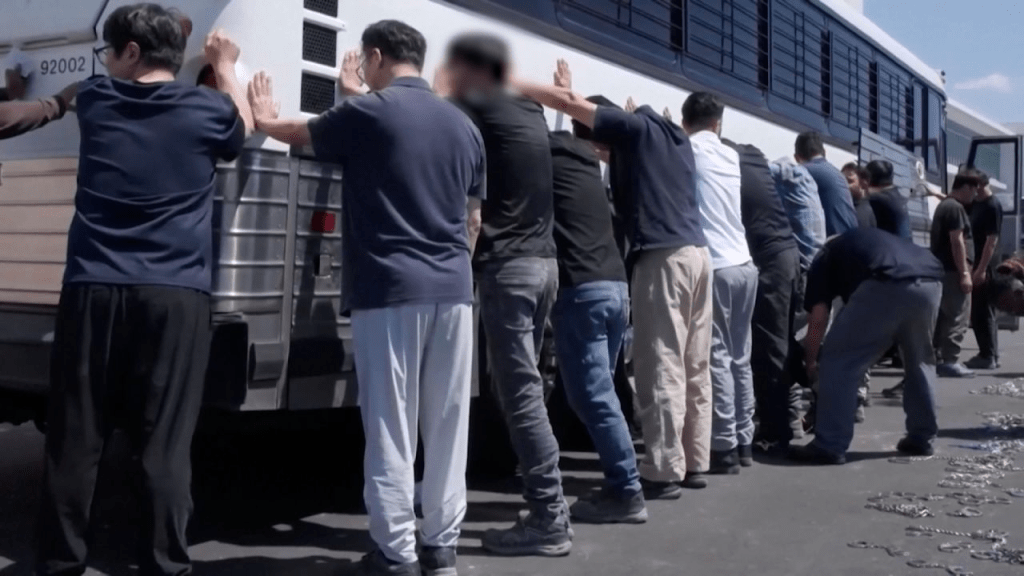
On Sept. 4, ICE revealed a video that displayed over 300 South Korean workers, along with 14 workers of other nationalities, being detained in shackles in the immigration raid in Georgia at an electric vehicle battery plant being built by a joint venture between Hyundai and LG Energy Solution.

The detention arose from the workers using B1 business visas and the 90-day visa waiver program, also known as the Electronic System for Travel Authorization Permits (ESTA). These are geared towards brief business visits rather than actual employment (Koreaherald). The immigration officials deemed these workers as illegal immigrants, requiring them to acquire the official H-1B work visas to acquire a legal status in the US. However, the said work visas “take months to obtain and South Korea lacks the dedicated quota allocations that other US trade partners enjoy” (The Guardian), as only 1 to 5% of the quota is allocated for South Koreans. Thus, Korean companies have long relied on this “gray zone” method, and previous US administrations have also turned a blind eye to this practice. As a result, the sudden crackdown on the Georgia plant was unprecedented and caught the South Korean workers by surprise.

The video of the workers being shackled and sent to detention centers was met with controversy within South Korean media. The abusive treatment and conditions that these workers faced for eight days before being released back to South Korea outraged the Korean public. According to the detained workers (from an interview after being released from detention), the ICE officials put them into shackles before instructing them to ride the bus and shared a room with 80 people (SBS). The lack of clarity and mistreatment, despite having a valid visa that had been permitted for decades, angered the Korean public. In fact, this crackdown on the Georgia plant was ICE’s largest workplace raid under President Trump’s campaign to “remove illegal immigrants and preserve jobs for American citizens” (The New York Times).

They were supposed to be holding souvenirs on their way back home, instead they had shackles on their arms with only a plastic bag for their available belongings. (SBS)

Footage of the South Korean workers getting arrested in the immigration raid on the Georgia plant (CNN)

The Aftermath andImplications to US-South Korean Relations

Since the absence of Korean workers from the factory, it has been reported that the construction and management have been temporarily halted, causing local workers to become unemployed as well. According to Money Today News, in an interview with Hugh Trip Tollision, who is the president of the Savannah Economic Development Authority (SEDA), he commented on the “talented South Koreans here installing battery equipment” and stressed their return.

While President Trump has requested allies such as South Korea and Japan to vastly expand their investments in the US to revitalize its manufacturing industry and create jobs, the raid in Georgia discouraged South Korean companies and workers from supporting US industries. Therefore, it is vital to find a negotiation in the midst of increased tension between allies, where the US could benefit from technological advancements with the help of foreign workers while having more clarity and transparency in its immigration policies and visa issuance.

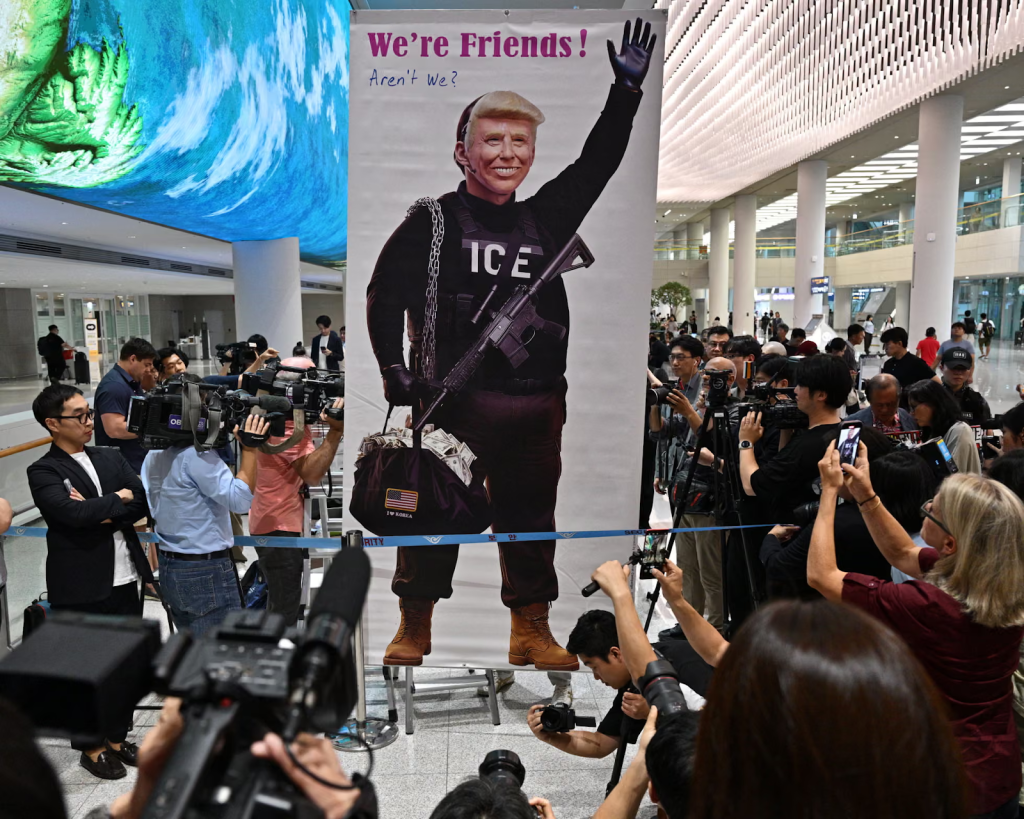
Protesters at Incheon airport with a banner questioning the US relationship with South Korea as 316 workers landed after their detention in an ICE raid. Photograph: Anthony Wallace/AFP/Getty (The Guardian)

Works Cited

Da-gyum, Ji. “Seoul to Probe Legality, Human Rights of Korean Workers’ Us Detentions.” The Korea Herald, The Korea Herald, 15 Sept. 2025, http://www.koreaherald.com/article/10576070. 

Freed South Korean Workers Return from the U.S. to Tearful Cheers – The New York Times, http://www.nytimes.com/2025/09/12/world/asia/korean-workers-georgia-arrest.html. Accessed 21 Sept. 2025. 

Jeong, Hyein. “‘조지아 구금 끔찍’ 미 의원, ‘韓 전문직 취업비자’ 법안 추가 발의.” 머니투데이, 머니투데이, 20 Sept. 2025, news.mt.co.kr/mtview.php?no=2025092014054657497. 

Kim, Hyemin. “‘한 방 70명에 화장실 오픈, 최악’…구금 생활 어땠길래.” SBS 8뉴스, YouTube, http://www.youtube.com/watch?v=d7vRECul5ww. Accessed 21 Sept. 2025. 

Park, Hanna, and Yoonjung Seo. “Workers Detained in Georgia Ice Raid to Be Sent Back to South Korea. Trump’s Border Czar Says More Such Raids Are Coming.” CNN, Cable News Network, 8 Sept. 2025, edition.cnn.com/2025/09/07/us/south-korean-detainees-negotiations-release-hnk. 

“South Korea Outraged at 300 Workers Treated as ‘prisoners of War’ in US Raid.” The Guardian, Guardian News and Media, 12 Sept. 2025, http://www.theguardian.com/global-development/2025/sep/12/south-korean-outrage-at-us-detention-ordeal-as-300-workers-return-home. “The End of Immigration Enforcement Priorities under the Trump Administration.” American Immigration Council, 27 Mar. 2025, http://www.americanimmigrationcouncil.org/fact-sheet/immigration-enforcement-priorities-under-trump-administration/. 

Machado, “Champion of Peace”?

by Nil Topcular

Maria Corina Machado is the laureate of the 2025 Nobel Peace Prize, awarded to her for her fight for democracy in her native Venezuela. The ceremony will take place on Dec. 10 in Oslo, but Machado is currently in hiding and has only made two public appearances since July 2024, making it uncertain whether she will be able to receive her prize in person.

Machado is the leader of the Unitary Platform, an alliance formed by multiple Venezuelan political parties that oppose the rule of Venezuela’s current president Nicolas Maduro. She has been living in hiding due to the threats that she has received by the government. The threats started after her accusation that the 2024 presidential elections were fraudulent. Following this election, the government-controlled National Electoral Council declared Maduro’s third term, despite evidence provided by national and international organizations that the elections were undemocratic.

According to an ELLE article, Machado was exposed to the socioeconomic inequalities during her studies at Andrés Bello Catholic University. when she also volunteered in the low income neighbourhood of La Paredas, in Venezuela’s capital Caracas. She decided to pursue politics after college, seeing her country becoming unstable under the previous president Hugo Chavez’s rule. She ran for congress in 2010, and became one of the 65 opposition members in the National Assembly. 

Machado won the Peace Prize for her work promoting democracy in Venezuela. Following her win, she dedicated her award to the U.S. President Donald Trump, a figure who for many represents discrimination and repression. Trump has made many racist and misogynist remarks, has multiple sexual assault allegations, and his term is currently marked by strict anti-immigration policies. In an interview with Bloomberg, she voiced support for U.S. military intervention in Venezuela, and has expressed that it is necessary for a democratic transition in Venezuela. As the committee’s announcement salutes her fight for a peaceful transition to democracy, Machado has called upon military intervention. Here lies another contradiction: She fights against the oppressive regime in her country, but calls for the help of another regime which for many is oppressive. 

Machado has expressed her support for Israel in the ongoing conflict. She called Netanyahu to congratulate “the decisions he took during the war”. More than 67 000 Palestinians were killed in Gaza by Israeli forces.  “Today, all of the U.S. who defend Western values ​​stand with the State of Israel, a genuine ally of freedom,” as she tweeted in 2021. 

Machado is not the only controversial Peace Prize awardee. Previous laureates of the prize have also been criticised for their actions that are not always reflective of the award’s’ values. Barack Obama, for example, was heavily criticized because of his involvement in the war in Iraq and Afghanistan. The U.S. was at war throughout all eight years of Obama’s presidency. Machado’s win, like Obama’s, led to individuals and the media questioning the legitimacy and the meaning of such a “peace prize” – if working for, or even supporting peace is not a prerequisite, what does the prize mean?

Despite her controversies, Machado’s win was not entirely contested – many also celebrated her compensation. Particularly, as a recognition of women in the political sphere, and of opposition to authoritarianism. As of 2025, only 6% of current Nobel holders are women. Machado’s win was therefore congratulated by many women’s organizations, and media outlets targeted towards women. Machado is also the sixth Latin American and the first Venezuelan to be awarded the peace prize.

Furthermore, Machado has support in Venezuela. The New York Times conducted three polls that showed she is the most popular politician in the country, with more people accepting her leadership than not. According to Amnesty International, Venezuela has been in a deep political crisis for 10 years. Opposition is repressed, as seen in Machado’s case. There are also 853 political prisoners in Venezuela as of July 2025. Human Rights Watch states that there are arbitrary arrests, torture and even murder of political dissidents. In such a political climate, she is the main figure of resistance.

Nevertheless, her being awarded the 2025 Nobel Peace Prize has led to a debate: Should Machado be compensated for her efforts, even though she voices views that are contradictory to the name of the prize itself? She is a figure of resistance and freedom in her country, but supports regimes that are similarly oppressive to the one she is against. 

In the art world, there is also a long-standing debate about separating the art from the artist. Can we appreciate the work of an artist, even if we do not agree with their views or acts? Similarly, the question surrounding Machado comes down to whether we can separate her stance in Venezuela from her international views.

The Paradox of Disappearing Nations: When Tides Rise High Enough to Swallow an Entire Nation, Does that Nation Cease to Exist?

by Margherita Greco

For Tuvalu, a Polynesian nation of nine coral atolls covering just 10 square miles, this is no longer a hypothetical or philosophical question — it has become a threatening reality. Tuvalu is facing what no modern nation has ever had to deal with: the complete disappearance of its territories within 50 to 100 years, due to the rising sea level. 

When the Foreign Minister Simon Kofe stood knee-deep in the Pacific Ocean during

the COP26 climate summit in November 2021, he was not only performing an effective political gesture: he was highlighting an unprecedented environmental crisis. Two years later, during COP27, he announced a groundbreaking statement that would lead to reconsidering the now-entrenched concept of State. Tuvalu will create a digital version of itself to ensure survival “regardless of what happens in the physical world,” Kofe said. This statement brings us to reflect on a pressing matter that philosophers have been debating for centuries, but not international jurists: can a nation exist without territory? 

When we think about nations, we instinctively associate them with a territory — the French with France, Italians with Italy, Brazilians with Brazil. The 1933 Montevideo Conference on the Rights and Duties of States translated this instinctive thought into international law, establishing four main criteria for recognizing statehood: a permanent population, a defined territory, a government and the capacity to enter into relations with other states — asserting a definite response to the philosophical debate concerning the necessity of land for a State’s recognition.

Yet this framework takes for granted something that climate change is now challenging: the endurance of the land itself. 

According to Locke’s “Two Treatises of Government,” the foundation of political legitimacy remains in property and place. Going further, Max Weber, in “Politics as a Vocation,” defines the concept of state as “a human community that successfully claims the monopoly of the legitimate use of physical force within a given territory.”  

So, does the social contract dissolve when the property disappears beneath the sea and the place becomes uninhabitable? And what happens to the state’s authority — does it sink as well? If we base our reasoning on these two major philosophers’ thesis, Tuvalu does not have a future: without a territory, it cannot exist.

A light of hope comes from Benedict Anderson, who proposes a brighter alternative. He argues, in “Imagined Communities,” that nations are imagined political communities united by shared values and narratives, rather than physical areas. Tuvalu’s national identity will not sink along with its territory, as it will persist through collective imagination.

  However, identity alone is not sufficient to legally recognize a state: even if a nation endures in memory, a state must exist according to international laws, making Anderson’s theory weak and legally unenforceable. For instance, the Kurdish people have preserved a strong national identity despite the lack of legal statehood, perfectly illustrating that cultural continuity is not synonymous with political sovereignty. 

Laws are made to be changed and to be updated to keep up with the modern, fast-paced, always-evolving society. Internalizing this concept, Tuvalu’s government is not surrendering to the evidence and the destiny of its territory. Indeed, it is negotiating a treaty with Australia to allow Tuvaluans to migrate with special status, while holding their Tuvaluan citizenship. Additionally, Tuvalu argues before the international forum that it should maintain its maritime boundaries and Exclusive Economic Zone (EEZ) even if the islands submerge. This claim generates an unprecedented situation: a state exercising power over ocean space without a habitable territory. This move aligns with Anderson’s view, challenging the status quo and current legal framework. 

With the idea of Tuvalu’s digital nation, a new dilemma arises. The international system, established at Westphalia in 1648, has no precedent for recognizing virtual sovereignty. Every existing treaty, norm and law assumes control over a physical territory — an actual territory in which power and laws can be enforced by authorities. Tuvalu’s project poses a greater question, which has never been investigated so far: can sovereignty exist even when it is detached from geography, and connected to the continuity of governance, citizenship and community will?

Tuvalu’s voice challenges this paradoxical condition. Its digital nation is the solution to an environmental issue, to which it has contributed only 0.001% of global carbon emissions. Yet, it is paying the highest price — the vanishing of its territories — among all the other states, many of which have been far more responsible for this unstoppable crisis. 

The digital dimension is a demand for recognition, declaring that national identity, governance and rights can transcend geography.  

Tuvalu’s submergence would embody not only an environmental failure but also a political one — the failure of international laws to accept the digital dimension as a form of national sovereignty, failing to expand its moral imagination faster than the seas are rising. 

Yet, recognizing digital sovereignty now would set the first step of “cyber international law” that welcomes new technologies to recognize new legal institutions, which from now on will impact the evolution of states and the future history of nations.