Don’t wait until we are in power.

A report and analytical defense of the global climate strike.

“Many social, technological, and nature-based solutions already exist. The young protesters rightfully demand that these solutions be used to achieve a sustainable society. Without bold and focused action, their future is in critical danger. There is no time to wait until they are in power.”

Science, 2019

The Climate Strike in LH

On Sept. 20th, 2019, young protesters gathered on the streets in every part of the world for a better future, fulfilling the responsibility of their generation.

As part of the series of climate strikes taking place worldwide on the same day, hundreds of students in Le Havre skipped schools to join the protest, including approximately over 30 Sciences Po students.
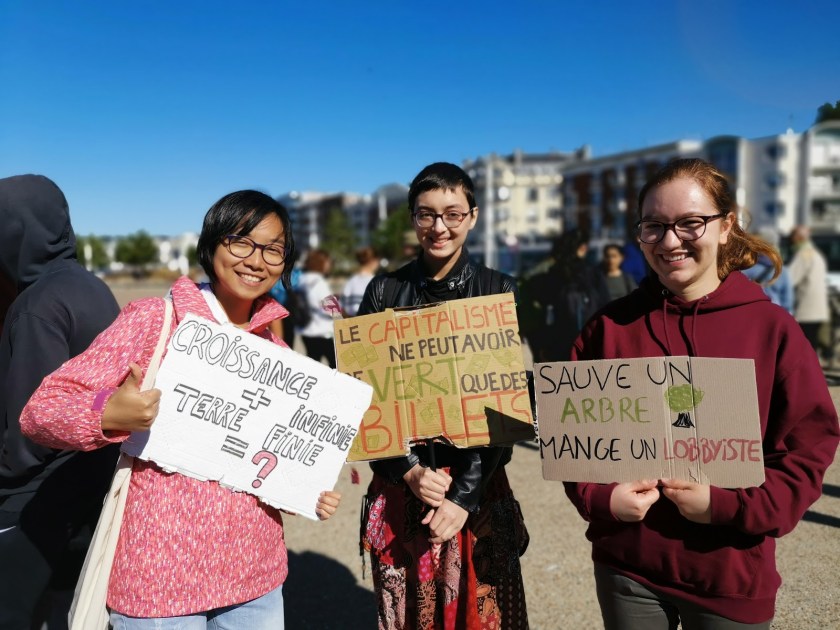
Days before the strike, Sciences Po students were informed that absences would still be counted during the strike. This did not extinguish the passion, nonetheless, of those who were firmly willing to participate. On the Le Havre campus, the preparation for the strike had started the day before, when active students met to prepare for the coming protest, writing slogans down on posters.
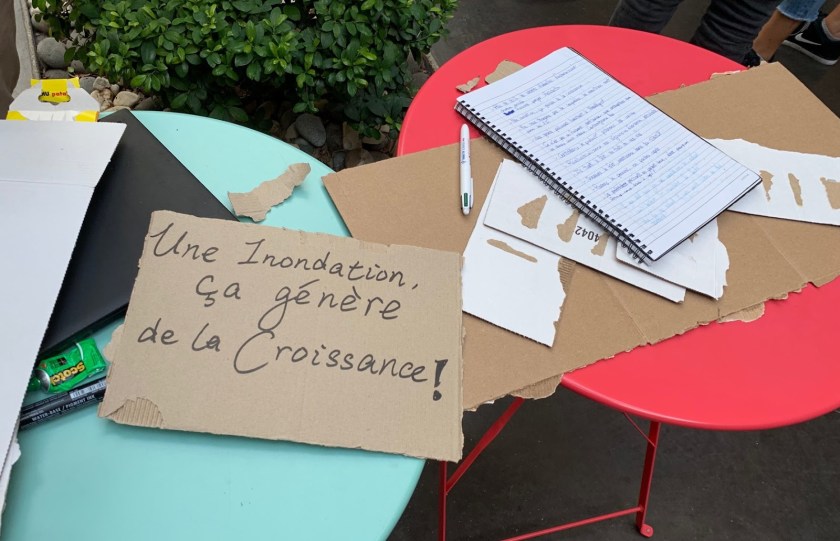
“A flood generates the growth!”

On Friday morning, students met in front of campus and headed to the University of Le Havre, where the strike would begin. At around 10:30 a.m., the protestors started to march through the city, with more joining the march later. A small proportion of the protestors, notably, were not students but non-student citizens of Le Havre. Some participants of the strikes were members of Mouvement Jeunes Communistes de France (JC) and several JC flags could be seen during the march. Confédération Générale du Travail (CGT) also participated.

The strikers marched through the city from the University of Le Havre to La Plage, carefully avoiding possible negative impact on neighborhoods and public transportation. At approximately 12:00 p.m., the strikers arrived at La Plage, gathered at a square. After the organizers of the strike delivered a speech on the emergency of climate issue, the strike ended.

Why is there a strike?

The climate strike on Friday in Le Havre was a part of the series of international strikes and protests, a.k.a. the “Global Climate Strike” or “Earth Strike.” The full week from Sept. 20 to 27, called the “Global Week for Future,” is a worldwide week-long strike. Inspired by Skolstrejk för klimatet (School strike for climate) initiated by Swedish young activist Greta Thunberg, the participants of the worldwide strikes are predominantly students. Since August 2018, Greta started to protest in front of the Swedish parliament and skipped school every Friday.

Youths have the responsibility to act and demand changes because their previous generation has failed to treat climate change as a crisis and actively respond to it, as the slogan “If you do your job, we would be at school now!” reveals.
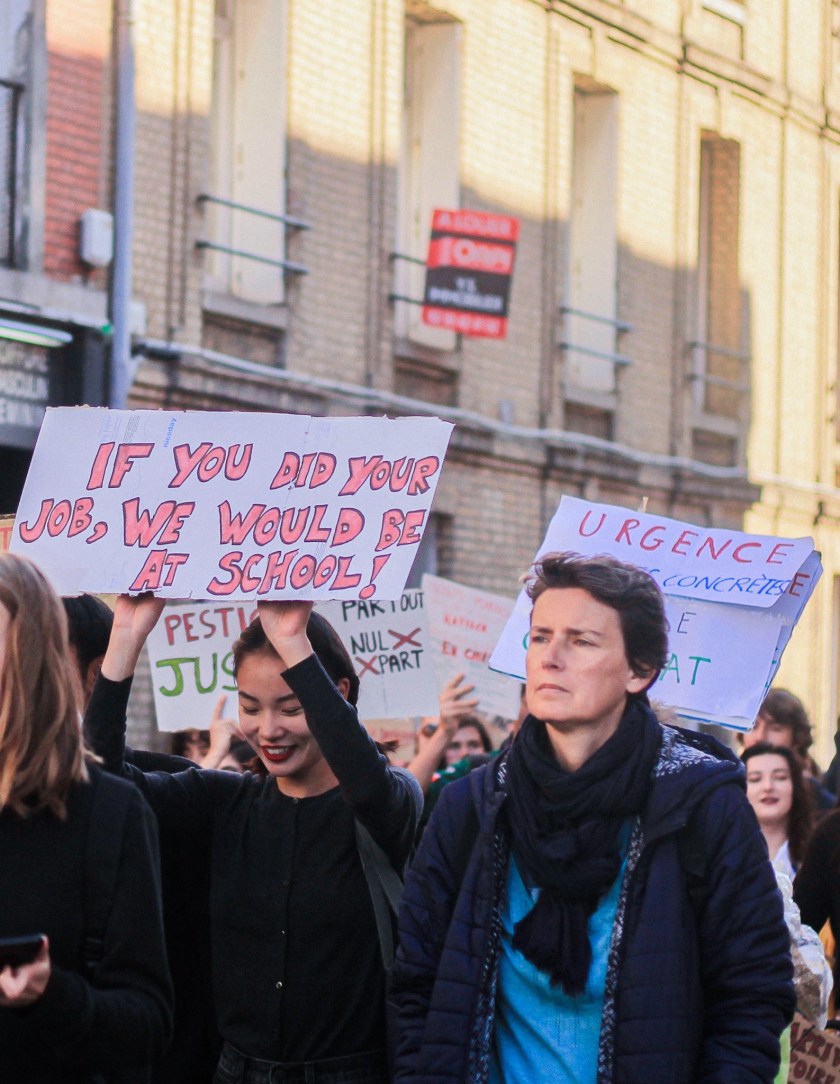
Greta’s action has become a global movement. The strike on Sept. 20, 2019 is the third global strike in this movement, with the previous two in March and May this year, which had smaller numbers of participants.

Although this movement is highly decentralized and grassroot, its mobilization has been a huge success. Over 4 million people around the world participated in the climate strikes on Sept. 20th. In France, it is reported that roughly 40,000 people participated, with the gilets jaunes (“yellow vests”) joining the climate protest on their 45th Saturday of action.

The UN Climate Action Summit will take place on Sept. 23, 2019, three days after the strike on Friday, in New York. [5] The strike on last Friday was timed to put pressure on the summit, demanding a realistic solution.

In Defence of the Strike

Unsurprisingly, the movement confronts criticisms from many perspectives. Some consider the young protesters truant, while some other claim that the movement is not practical. A widely supported argument opposing the strike, noticed on social media, is that the strike is not constructive since it cannot bring viable solutions and actual changes. According to this argument, these can only be achieved through the effort of scientists and policymakers, and thus the movement is a waste of time. The key issue is, therefore, in what way these strikes are able to achieve their goal.

Jürgen Habermas’s Public Sphere provides a direct approach to prove the constructiveness of the strikes: in such a discourse-based sphere, the active participation of the public is essentially a contribution to the advancement of the social agenda. Critically, the domination over discourse often aligns with the established frame and domination in policy-making, which makes breaking the bondage of disciplinary discourse a rebellion against the political establishment.

“Before most of the children who will be striking were born, scientists knew about climate change and how to respond to it,” says Kevin Anderson, a climate scientist. The scientists’ open letter in Science magazine also states that “many social, technological, and nature-based solutions” are already available. The scientific community recognizes the failure to respond to climate change a consequence of ineffective governance rather than a lack of alternative solutions.

It is not to blame politicians and governments for being blind, but it should be realized that in the legislation process, other considerations are taken prior than environmental concerns. In this manner, the popular discursive participation, through mobilizing the teenagers who are excluded from the political establishment, is fundamentally a contribution to the improvement of governance.

It doesn’t mean all the movements are constructive – only certain kinds of movements contribute discursively. Movements should not be person- or concept-oriented but agenda-oriented to challenge the domination over discourse. The significance of a popular movement opposing existing norms, like the climate one we are experiencing, is the popular participation for the purpose of advancing a certain agenda which would effectively undermine the establishment.

The political sociologist Anthony Orum also explains the indirect role of civil societies and movements in legislation; although the mobilized masses are not able to immediately propose alternatives, through linkage institutions, they are capable of advancing legislation by pressuring actual actors. In a parliamentary system, for instance, a popular movement would empower the opposition parties or MPs to find an alternative solution. Another possibility is that the ruling party or parliamentary majority would gradually embrace the movement’s demands to maintain its standing.

The case of Germany could prove the significance of public actions in the legislation process. Germany has a strong tradition of civil disobedience on environmental issues – in the Friday strikes, there were over 1.4 million protesters across Germany, comparing to the 40,000 in France. Consequently, the ruling parties have to constantly make compromises to the greens, on both national and local levels, due to the pressure from activists. The Social Democratic Party, before losing the 2005 election, even had to form a coalition with the greens (Alliance 90) to gain a parliamentary majority, which is a time witnessing a huge progress in environmental legislation. When Merkel’s grand coalition came to power in 2005, although it had a firm majority in parliament, Merkel’s cabinet had to occasionally accept environmental groups’ demands for fear of losing popularity among them, which would probably lead to a second SPD-greens coalition’s victory.

When I visited Germany in June, I saw a well-designed and -developed recycling system of cans and plastic bottles, as well as the celebrated efficient garbage classification, clearly a result of the effort of the past movements in Germany. The goal of strikes, thus, is to generate a flood that revolves the watermill of political machines, to produce a revolution of our time.

Photos by Emo Touré, Yufeng Liu, Zhenhao Li

Pleading Not Guilty

*From the April print edition* Our new Editor-in-chief Joyce Fang reflects on the existential guilt bourne from a privileged liberal existence.

If you were to ask me what I was proudest of, I would tell you it’s my empathy and compassion. If you asked what I was most ashamed of, it would be my failure to always act on it. Perhaps failure is a harsh word. But it is the word that describes the way I frequently think of when striving to align myself with values I hold.

In my applications to university, I wrote personal statements explaining my interest in the particular courses I had applied to. My answers often outlined a vague hero complex; that I was uncomfortable with inequalities and that “understanding economics and politics is the best way for me to affect large scale change” for all the issues I care about. Poverty. Gender inequality. The environment. However, as I acknowledge my actions or thoughts that are in conflict with what I say I’m passionate about, a creeping guilt crawls across my conscience. Too often, I am imprisoned by an overwhelming sense of disapproval that I am not doing enough to satisfy the expectations that I have placed on myself. How can I buy things that have been made by the exploited and impoverished? How can I simultaneously indulge in chivalry and call myself a feminist? How can I eat dairy or use a plastic bag and protest against climate change? It is as if I carry some sort of barometer that measures my level of “good” on any given day. Today I bought veg from the farmers’ market, gave money to the homeless guy on the street, and held the door open for a man- I’m fixing the environment/homelessness/gender stereotypes! On the other hand, a day of action that compromises my beliefs leaves me with the awful taste of guilt.

The kind of guilt I am privy to is one that has inevitably arisen from privilege. It is the byproduct of private school education, holiday homes and the bubble of an upper middle class. Having this life, alongside a certain degree of compassion and sense of injustice, means the guilt has steadily festered. With the cost of my university fees, I could probably feed a small village in a developing country for a considerable amount of time. Of course, I am constantly assured that my education is an investment in the future change I will work for. We all know that if we give a man the proverbial fish he’ll eat for a day, if we teach him to fish he’ll eat for a lifetime, and perhaps if we establish some policy that helps him get a job, he can eat something other than fish, and have a better life. Unfortunately, this pressure for me to use my degree for good will without a doubt coexist with guilt that I’m not doing everything I can.

Guilt has utility to a certain extent- many people make good choices from feeling bad about something. But I don’t want my actions to be viewed as a way to offset my guilt when they are born out of a real altruism. What’s more, is that guilt has become a hindrance. I fear being caught out- standing up for something and then being accused that I am not a true believer. Hypocrisy, the antithesis of being well informed, is a harrowing insult, and one I am terrified of. Thus, my confidence in my values is stemmed, and my likelihood of identifying with any movement or speaking out is less that it would be otherwise.

Frankly, I’ve come to the conclusion that having such a dogmatic attitude is ruinous. It may be powerful at times, but often it breeds a type of guilt that stagnates its bearer, and wastes the value of their initial motivation. By sapping the confidence of those who transgress, and instilling discomfort, it takes away the positive of any good action. Instead, it is important to acknowledge any hypocrisy or conflicting ideology, and accept that you may not always be congruent to your beliefs. To exist is to have a multifaceted assimilation of values and expectations of yourself that may sometimes be contradictory, but in which the recognition of these dualities motivates us rather than hinders. If we bolster even the least scrupulous, we give them an encouraging boost of confidence that they can have an impact.

Consistency in these things is an admirable goal, but it is one only attainable for those who are willing to sacrifice their whole lives for a greater good. This does not mean that anyone privileged who wants to contribute shouldn’t bother at all. I can’t separate my actions from my values, but I need to distance them a little and be confident in the fact that this will ultimately yield more beneficial action than what would be produced under the weight of guilt. There is infinitely more power in one who believes they can make change, than one who doesn’t think they can have any impact. It is exactly the latter mentality that stalls progress.

Finally, when speaking to others about this, I am often told things like: “at least you care” or “your guilt shows you’re a good person,” and “look at how many people in the world do nothing and don’t feel guilty.” If you too are aware of your privilege, and do not feel some drive to use it for good, then it is wasted. My call to arms is to ask that you start with something small. If we all envision an upward trajectory of hope, it will be a powerful force for meaningful change.

Edited by Pailey Wang.

The Production of Destruction

“If space-junk is the human debris that litters the universe, junk-space is the residue mankind leaves on the planet.”

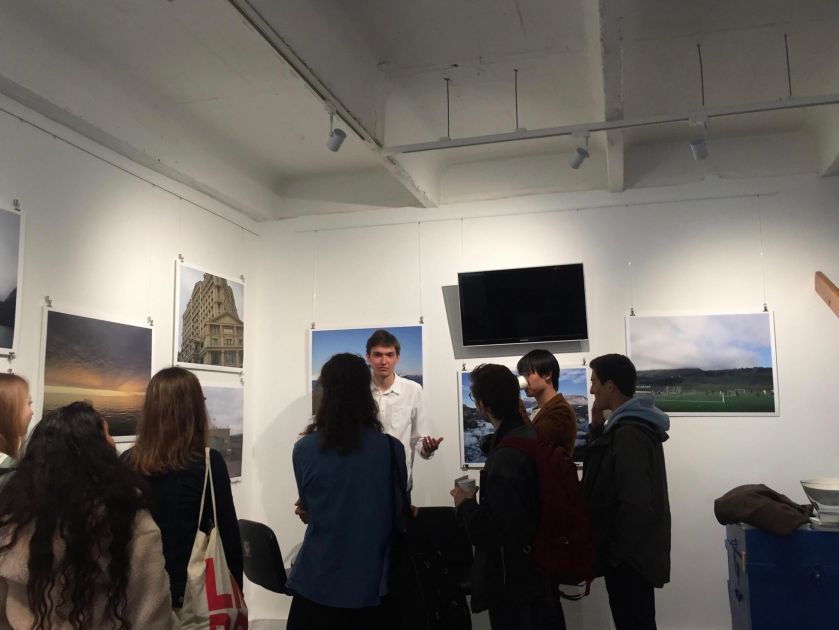
This quote by architect Rem Koolhas confronts you as you enter Jean Castorini and Vinzent Wesselman’s exhibition The Production of Destruction. The paradoxically titled exhibition attracted a steady stream of curious visitors to its opening on Monday evening. Clutching cups of cider and walking around the gallery in a low buzz of voices, groups took in the powerful assemblage of modernising urban scenes in South East Asia and glacial landscapes of the Arctic.

As a self described visual metaphor, the photos are curated to elicit a sense of dissonance between the two environments and spark conversation on the nature of modern industrial consumerism and the effect it has on the natural world. Framed in the heat of a political climate that remains deeply divided on climate change, the photos contribute to an ongoing discussion that questions the man-made construction of the urban environments we inhabit and the negative effects their creation has on natural spaces from which we are sheltered. The stark juxtaposition of the two settings immediately brings to attention their subtle symbiosis, as photos of rapidly retreating glaciers are placed next to those depicting rapid vertical urban expansion. The images present incredible glaciers that are formed over centuries, and highlight how they are now deteriorating simultaneously with the proliferation of new skyscrapers- an unlikely but powerful predator of these ancient ice forms.

The exhibition also acknowledges the people who inhabit these places. A photo of soccer pitch nestled between mountains and an ocean speckled with icebergs. A transitory looking church in a Inuit town. A discarded gold religious relic amongst a pile of rubbish. A handless statue of Madonna. Reflections off the ocean, and off shiny skyscrapers. Through the presence and lack thereof of modernisation, we are given a clear expression on mankind’s differences.

Castorini and Wesselmann’s exhibition brings a collision of two continents into a 30 square metre gallery in Le Havre, that forces us to confront the truism that our behaviour in urban settings has immense impacts at the poles of the Earth. The

Production of Destruction is a thoughtful collection of photos that give insight into a global concern. The gallery’s program for the coming fortnight is a promising lineup of debates with guest speakers and film screenings that will continue the discourse on the most significant issue of our generation.

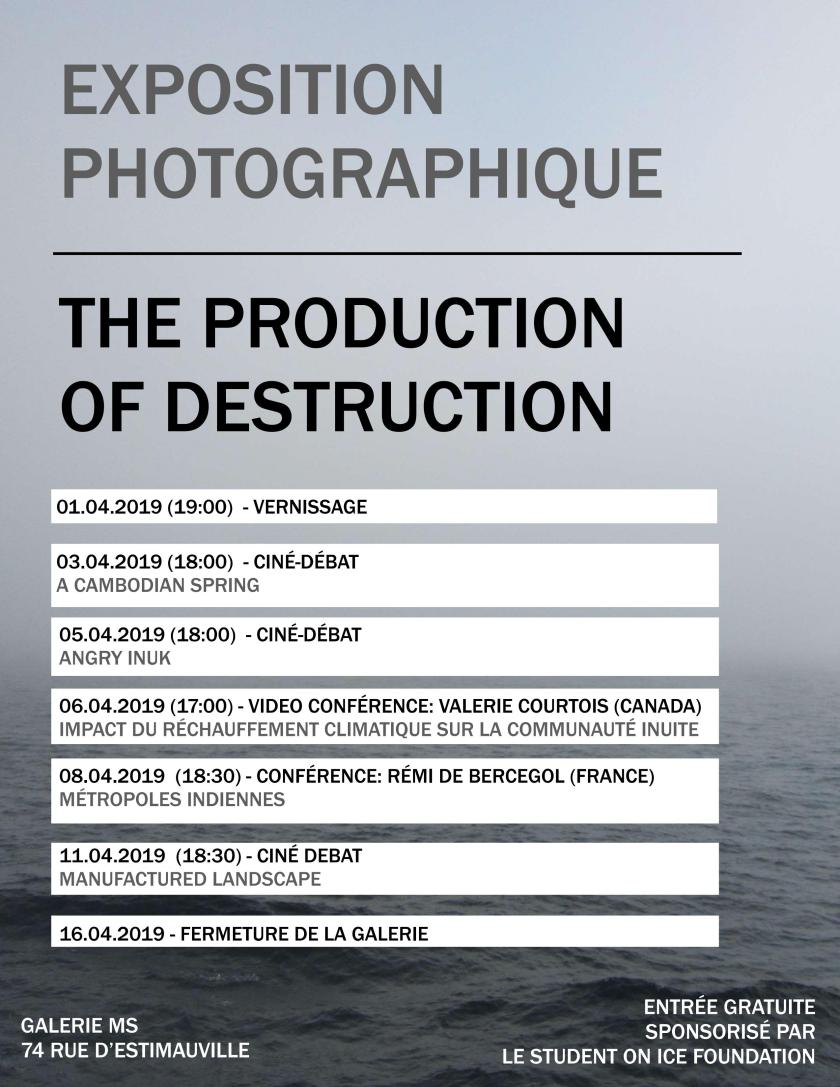
See below for a full schedule of the upcoming programming. The exposition closes on the 16th of April.

Joyce Fang is the Public Relations Manager of the Bureau des Arts and a reporter at Le Dragon. She is covering an exhibit by second-year students, Jean Castorini and Vinzent Wesselmann at Galerie MS.

To Speak or not to Speak

From asking a question to giving a presentation to Prix Richard Descoings, the fear of speaking never leaves. The finalist of Richard Descoings shares his fear of speaking and his speech about fearing.

I stood against the blinding darkness. My words precipitated at the tip of my tongue. All things froze for an instant before my speech as I took in the deafening silence.

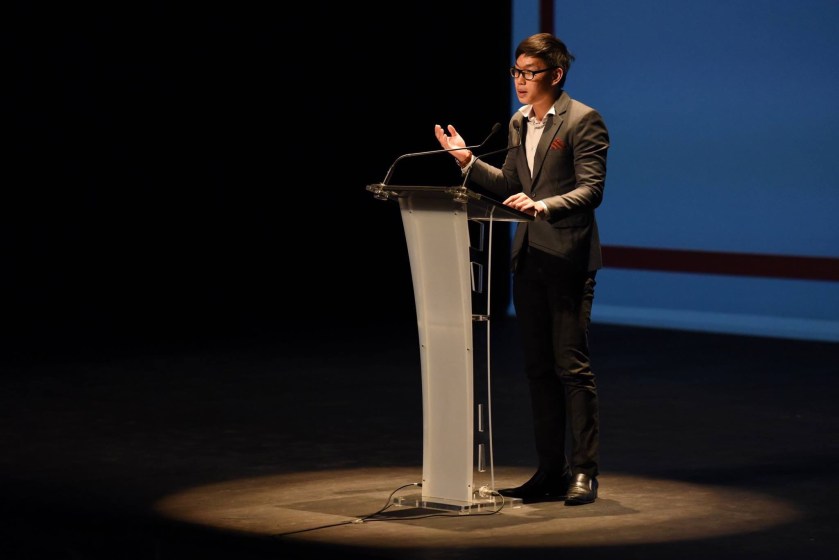
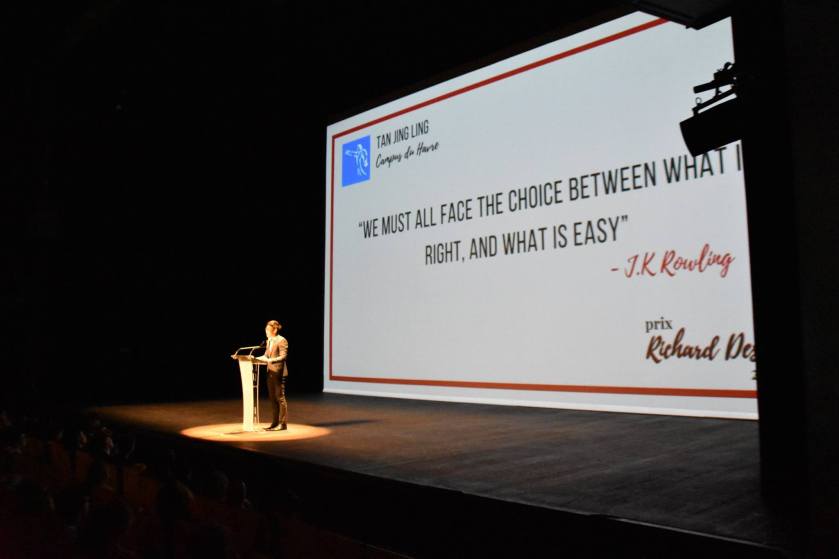
I was in the Theatre Auditorium de Poitiers, which sits 1000 people. It was the final round of the Prix Richard Descoings. I carried with my every word the reputation of Le Havre.

Every February, Sciences Po undergraduates gather together for the Prix Richard Descoings, an oratory competition to select the most eloquent English and French speaker from Sciences Po. I took part in the English category while Salomé Cassarino represented the French category.

Predictably, someone who made it past two rounds of a public speaking tournament would be perfectly comfortable on a stage and under the spotlight. I am not. The fear of speaking is perhaps the most understated fear in modern society.

This fear is silent: it is the unsaid words that built up in my lungs. It is the scrutinising eye contact of those looking, the prolonged silence before speaking, the deoxygenated air breathing. It was this fear that I carried from Le Havre to Poitiers – a fear that grew with the stakes.

In the waiting room on D-day, it was this fear that united the speakers from each campus – each clutching their script and pacing in quiet momentum. When asked, each would tell you that they are not nervous, and you would believe them. After all, they are representatives of eloquence. Yet, as the clock ticks and each speaker’s turn to speak approaches, you will see the little droplets of sweat forming at the fringe of their foreheads.

The fear of speaking is perfectly normal. Receiving the prompt: “we must all face the choice between what is right and what is easy,” a quote by J. K. Rowling in Harry Potter and the Goblet of Fire, I decided to speak about speaking itself. I decided that the steps that led me to Richard Descoings were all choices I made between what is right and what is easy. Here, I share that choice, that fear, and that speech:

[Start-of-speech]

“To speak, or not to speak, that is the question. When I open my mouth, and these words flow into your ears, in this particular order, every syllable, every movement of my lips, my tongue, every eye contact, every molecule in my body is making a choice.

You see, we are not just atoms. Words are not chemical reactions. Standing up here is not part of natural selection.

To speak is to put my life story up on the podium, where I can no longer control the reaction, the interpretation, the direction of where and how I want to hear – me. My story is my choice, but when I speak, I give this choice to you: to be silent, to clap, to laugh, to mock, to ridicule, to open your ears but not listen.

To speak is a choice. But, to speak is the 11-year-old me sitting in my class, with my teacher asking: “do you have any questions?”, and my thoughts formulating, my palms sweating, my arm not raising, my heart beat racing. I wanted to ask a simple question…but I could see the audience, the microphone that amplifies my imperfections, the spot-light of failures, the stage of my fear. All on me as I stood up and asked one…simple…question. And it was always this one…simple…question, that I rehearsed in my head, over and over again, and perfected in the exact same intonation that echoes but will never be heard. And the class is over. And I keep this question for tomorrow and tomorrow and tomorrow. Because speaking is a choice…but is it really for the ones who can’t be heard?

At 16 years old, I had to give my first class presentation. I knew I must face the choice between what is right and what is easy. At least now, questions could be whispered in tiny pockets of mid-air suspended confidence, before it deflates like a balloon, as my face reddens, when my teacher says: “wow, that is a stupid question.” How then am I supposed to hear nothing but the silence of my voice for 300 seconds? How am I supposed to hear myself when I can only hear you and your loud mental judgement as I stammer…as I stammer…as I stammer…as I stammer…as I stammer? How can you say speaking is a choice when I don’t have the choice to be heard?

At 21 years old, I made a choice between what is right and what is easy. I joined a competition and it is my first time speaking to more people than in a classroom. I listened to hours and hours of “I have a dream” and watched myself in the mirror, until fear was so used to being in my veins that when my mouth finally opened, fear flew out like a butterfly ready to escape from a cocoon. I am still the 11-year-old with my thoughts formulating, my palms sweating, my heart beat racing. I am still the 16-year-old with mid-air suspended confidence in a tiny pocket of 5 minutes, before it deflates like a balloon, again.

You see, when I open my mouth, and these words flow into your ears, in this particular order, from beginning to end, from end to beginning again, every syllable, every movement of my lips my tongue, every eye contact, every molecule in my body is making a choice that is anything but easy.

We must all face the choice between what is right and what is easy. And today, I choose, to speak.”

[End-of-speech]

To speak or not to speak? The answer is yours.

Edited by Philippe Bédos & Maya Shenoy

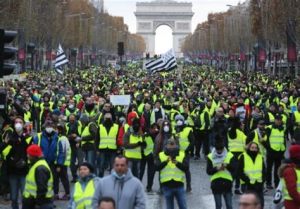
Gilets Jaunes: the fire that sparked a debate

Following the prolonged Gilets Jaunes protests, students of Sciences Po Campus du Havre weigh in on the legitimacy of the movement in a deeply divided debate.

With a burning fervour, the Gilets Jaunes protests scream not only along the streets of the Champ de Mars in Paris, but echo along the corridors of Sciences Po Campus du Havre, as students—French and international—exchange opinions on the subject between classes, sometimes amicably, sometimes assertively.

Initiated by student representatives, a debate was held on 4th December in the amphitheatre of Le Havre campus, following a weekend which saw the popularly backed protest spread its way down the streets of Le Havre in fire and fury.

The debate saw a full house of all nationalities of students, eager to put forth their thoughts on the hugely controversial issue that transpired right outside their residences, weighing in on the legitimacy and effectiveness of the movement.

In this article, Le Dragon Déchaîné summarises some of the key issues raised in the debate:


Proponents of the movement, vocally advanced by several French students, opinioned that the protests should not be evaluated solely on the basis of violence inflicted by protestors; rather, one should also consider the systemic violence inflicted on the protestors through systemic socio-economic alienation by president Emmanuel Macron’s “socially and verbally violent policies.” Implied here was that the damage caused by the protests—which is estimated to be €3-€4 million as of 1 December—was incomparable to the damage of systemic inequality.

On the other hand, opponents, largely led by international students, called out proponents with the logical fallacy of “whataboutism”: suggesting that the violence inflicted via unequal socio-economic policies in no way negates the violence inflicted during the protests. “Two wrongs don’t make a right,” said one student who counter-proposed that there are many feasible alternatives to violent protests, as seen in other democratic regimes like Germany.

To this end, proponents rebutted that it is the very violence of the protest that captured the attention of the media and of the government, pointing out how peaceful protests gain less attention in France. Perhaps then, prime minister Édouard Philippe’s concession—to suspend the fuel tax rise that sparked the protests—was a sign of the political might of the protest. However, most in the room were unanimous in condemning the violence of the protest.

Nonetheless, there is a long road ahead for both protestors and democratic discourse. Opponents emphasised on the glaring lack of representatives and leadership in the movement as well as the lack of clear, focused objectives. One student commented that there is no end in“protesting for the sake of protesting.”

As with the Gilets Jaunes, uncertainty hung in the air as the debate came to an end, but not to a close. On first principle, there was an irreconcilable difference between the rights-based proponents that focused on the right to violent protest in the face of injustice and an unresponsive government, in contrast to the opponents’ utilitarian argument that focused on the futility, lack of direction and extensive damage of the protests.


Despite the announcement to reverse the rise in fuel tax, protestors have vowed to maintain their movement. The flame lingers and the discursive scrutiny continues in what may be the most consequential lesson in politics yet.


This article does not necessarily represent the views of the editors or Sciences Po.