
Is the House Black or Our Lens? Empathy, Confusion and The Stretched Moral Knot

by Krishiv Agarwal

Watching “The House Is Black” makes you do something awkward: you feel empathy, then you check that feeling and come to wonder whether empathy is a moral failure. Faith sits beside this confusion, the ‘victims’ are not angry at God; they pray, thank, accept. This steadiness is not a religious resignation but a dig at us: why do we imagine suffering as an external problem for God to fix rather than a politics for us to change? And if you help, with what gaze, who is looking up and who is being looked down on, on the ladder named empathy? The film attempts to resolve these questions by refusing clear answers.

The House Is Black,” by Forugh Farrokhzad is a short documentary filmed in 1963 set in an Iranian leper colony. The film pairs stark images of daily life, children, rituals and chores with lyrical fragments that read like a diagnosis: the world looks away, and the ordinary lives of the afflicted become the measure of our moral imagination.

The film opens on a woman, hijab framing her face, staring into a mirror. The shot stays. That stare is the contract the film makes with the viewer: look with me, not at me. The mirror is literal and theological with the hijab suggesting God’s presence and concealment, as well as its inability to hide the fact of suffering. When the camera pushes in, the image is not sensationalized; you are made complicit in the act of seeing. Why does this matter? Think of global crises — refugee camps, bombed hospitals, pandemic wards — where televised images invite a burst of outrage that is soon recycled into a moral spectacle. Farrokhzad denies spectacle. The dry scene of a man walking along a wall towards us, then moving away as the audio fades in (Saturday, Sunday, Monday) is quietly savage. Time continues, the world rotates. That audio only fills the frame when distance returns. The ethical rhythm of modern life goes like: move closer, make it private; step back, give it a week; resume.

There is also an explicit moral address: “Oh Muslims, I am sad tonight” (lines from Forugh Farrokhzad’s own poetry), not just as a lament but as a commentary on faith itself. The sadness is not directed at God; it is about the unbearable strangeness of living in a world where suffering feels endless and the crescent moon hovers like a symbol of both fragility and endurance, reminding us that devotion can be inseparable from despair.


Artistically, the film is ruthless. The camera is often at household level — low angles, hands, utensils — leaving each one of us as an observer. Subtle editing stitches do not dramatize, it accumulates. When you place these formal choices parallel to current crises, some patterns emerge. First, the moral economy of pity can reproduce hierarchy. Pity often contains a quiet contempt, a desire to be relieved rather than to redistribute. Second, the film insists that structural questions like medicine, social exclusion, state neglect are not solved by feeling alone. The archives of war and pandemic now accumulate images to the point of numbness; Farrokhzad’s method counteracts this by reintroducing friction. No jingles intrude; no fundraising cutaway softens the image. Where TV would turn suffering into a charity proposition, Farrokhzad leaves you in a room with it. 

The Dove and The Politics of Hope

There is a voice in the film that wishes to become a dove, implicitly wondering whether an earth without suffering is conceivable. Distant things — moons, birds, future on Mars — become the only places where human hope can live, because they are tidy, one-dimensional and therefore palatable. When suffering is immediate and total, the mind prefers a far, digestible, horizon over an ugly, almost irresolvable, present. God, too, functions like that horizon for many: a promise so remote that injustice now feels slightly bearable.

But Farrokhzad complicates this consolation. The residents of the colony fold their suffering into ritual. They do not curse God in a way the privileged might expect. That is the moral sting: if those who suffer are not enraged, why are we? Are we compassionate because we imagine ourselves above them? Or because we are recognizing a shared humanity? 

The film refuses an easy ethic. In the end the film is deliberately, disturbingly unresolved. The director makes you sit with a confusion that feels almost criminal: you feel, you judge your feeling, you fail to act; you watch again and feel something else. That recursive discomfort is Farrokhzad’s point. Empathy here is not the end of ethics, it is the beginning of an interrogation. And that interrogation is, quietly, a little fucked up and gloriously necessary.

References and Time Stamps

The House is Black:

Time Stamps:

  • Hijab Scene: 00:45
  • Person walking along the wall: 02:49
  • ‘Oh Muslims I am sad today’ poem: 04:49
The Dual Nature of Reality

by Margherita Greco

We live in a world today that praises progress but trembles before crises. Heads of State invest in technological and scientific research but remain paralyzed when dealing with climate change, famine and genocide. Therefore, we should ask ourselves: “Is reality the story of human triumph or the story of our limits?”

This ambiguity in the perception of reality is not a new phenomenon. In the 19th century, two of the greatest philosophers of modern times offered two opposing  interpretations. On one hand, the German Georg Wilhelm Friedrich Hegel viewed reality as humanity’s steady progression toward freedom, civilization and ultimate triumph. On the other hand, Søren Kierkegaard underlined how reality was the place of despair, anxiety and impossibility, in which hollow men wander aimlessly in the shadow.

Even if these clashing interpretations were expressed two centuries ago, they remain more relevant than we could ever have imagined. Today, as opulent wealth and selfishness collide with hunger and poverty, we find ourselves living in both worlds at once. This dogmatic relationship with reality mirrors the uncertainty we live in today, caught between optimism about progress and despair at seemingly insurmountable crises. 

The Hegel’s optimism remains woven into modern narratives. His idea that history tends toward triumph has shaped both liberal democracy and Marxism and persists in today’s faith in human progress. This triumphalist spirit is reflected in higher forms of social unity, specifically in the technological realm as artificial intelligence, renewable energy sources and medical advancements are developed.

In the “Phenomenology of Spirit,” Hegel argues about “the fight for life and death,” which, in symbolic terms, should be interpreted as a conflict involving all humanity, in which those who have not been afraid to die win. In contrast, those who are afraid of dying  — those who have given up — succumb.

Through this conflict, men will obtain inner freedom and gain emancipation through work. This concept becomes apparent when applied to contemporary society: the desire to prevail over others is always more disruptive, reducing social relations to mere relations of necessity and power. 

But despite this hierarchy of strength, there is always a glimmer of positivity that is evident in the necessary interdependence of the strongest with the weakest, giving all the possibility to hold power. 

If Hegel interpreted reality as the place to advance towards the best, Kierkegaard, however, cuts against this triumphalism. For the Danish thinker, reality was not a matter of rational progress but a confrontation with despair. Anxiety, failure and faith were not detours on the road to victory: they were the essence of being human. Kierkegaard would likely be anguished by the growing climate crisis, global inequality and political polarization. How can we resolve these types of issues when we are only humans trying to make our lives a bit more bearable? Our limits, which we cannot overcome, ultimately render reality a place of impossibility, clashing completely with Hegel’s optimism and trust in progress.  

Living in our modern society requires us to be light-footed, jumping between optimism and despair with ease.  In our daily lives, we face the decision to feel like Hegelians, focused on development and innovation. However, we often find ourselves in a state of anxiety and paralysis, as Kierkegaard expounded, as we confront the digital world and the fragmentation of our identity, as well as wars and biodiversity loss.

To navigate this dilemma, we need to treasure both visions: cooperating and trusting the collective progress, while accepting certain limitations and having faith in the community to make our existence more tolerable. 

2025 is composed of two intertwined essences: progress and despair. We worry about climate change but, at the same time, fall into the blindest consumerism; we fight for individuality and freedom to express our thoughts, yet we criticize others online.

Perhaps, to live today is to accept this paradoxical nature of reality. Our world cannot afford blind trust in progress, nor can it survive steeped purely in despair. It is fundamental to realize optimism and doubt are companions, not opposites — both are necessary to navigate and improve this fractured world. 

We should collectively stand in the gap between Hegel’s and Kierkegaard’s theories, recognizing that reality has a dual nature that demands both faith and carelessness. 

By embracing this duality, it is possible to act wisely: advancing with hope, yet being aware of our boundaries. Only by assimilating this equilibrium can we dream of a future where human progress goes hand-in-hand with human vulnerability, in which we act consciously about our limits for the greater good.

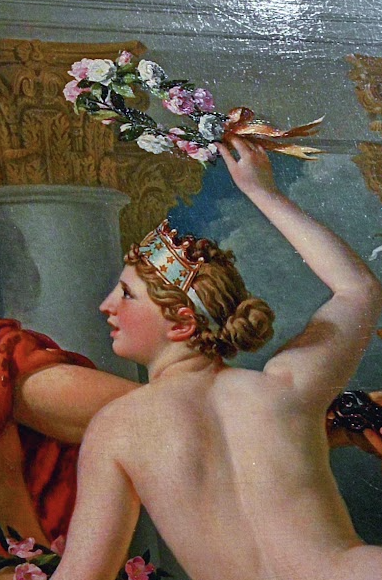
Jacques-Louis DAVID : When Eyes and Strokes Speak Better Than Words

by Nahia Onchalo-Meynard

Image Credit: Nahia Onchalo-Meynard

“One shouldn’t just look at the model, but should read it like a book.” This quote by the famous French painter Jacques-Louis David couldn’t be more opportune when it comes to characterize his own work. Indeed, a freshly set exposition at the Louvre, retracing his whole career as an artist and activist, is unveiling its captivating perspective on life and an undeniable talent, alongside a historical time-travel all the way to Antiquity where he drew his inspiration. However traditional, mainstream and excessively spoken of him and his work might appear, this exhibition did but prove this all wrong. The acknowledgment of him being a key figure in the French Revolution and a pre-romantic painter, as well as the popularity of very few of his compositions solely led to a well-known but unknown artist. Looking beyond the patriotic spirit that the Revolution and Napoleon stirred up in him, one can actually fully grasp the timeless aspect of his paintings. One discovers a touching sensitivity that resurfaces through the overwhelming gaze of Psyche and the teasing smirk of a cherub, or a die-hard humanity, be it in the dramatic astonishing fights between Romans and Sabins or the most discreet behaviors in the many portrayals he made. The latter brings a refreshing, lightening mood to the collection full of meaning. It does so by embellishing the most common day of one’s life, and picturing real, unfiltered and imperfect faces and realities, bringing not only a strangely comforting atmosphere to whoever looks at it, but also a deep realization of the very existence of these people, that once treaded upon the same ground.  Not only does he depict the “model,” but he indeed constantly strives for a deep understanding of it, well-conveyed to the observer, almost as a dialogue between people, eras, cultures and languages.This exchange, as one might call it, is in fact a leap backwards, a sneak peak into fascinating and foundational eras of history. Portraying myths and legends, representing real major events (or non-events), one does not only passively stare at the canvas, but actually learns alongside them. The observer knows from this point forward Brutus’ sons’ tragic fate, Romulus’ wife’s crucial role in the pacification of the Roman Empire, Socrates’ temper — and even reflects about dreaded dilemmas, such as the choice between the nation’s well-being or a close one’s life. These paintings appear indeed as heavily meaningful ornaments. Beauty is undoubtedly what comes to mind when contemplating most of the works. Nevertheless, it is merely a glimpse of what they contain. The eyes are pleased, but the soul is triggered, the heart flinching and the mind frozen. When picturing humanity with sensitivity, it also means picturing all of it: love, peace, courage, but also grief, terror, evil. It would be an understatement to say that it is hard not to shed a tear while looking at the portrait of a  13-year-old boy, dead because he enrolled in the revolutionary army to free people that never intended to do such for him. Its devastating impact on the spectator is enhanced by its unfinished state, highlighting a hardly sufferable violence, unrepresented,  maybe for the better. The death of Marat is not more comfortable to be around; made in three similar versions, they circle the visitor when he enters the dark room, conveying oppression, dread, horror and anxiety, underlining the price paid for peace.  So then, this exhibition did not allow only to readdress an influential yet unsung artist’s work, but also to dive back into an era, into feelings, into thoughts that one will probably judge as still relevant at any point of his life, be it academically, socially or personally. Even if the Crown jewels or the Joconde are worth your attention too, make the most of your passing at the Louvre to discover these gems and get a snippet of one unique mind in the revolutionary storm!

The Secrets of the Roots, and Other Stories from the Village

by Konstancija Kevisaite

Foreword from the Author:

Before you delve into the story of a life still set in dark, misty forests, surrounded by Lithuanian mythological creatures and supernatural mysticism, it is important to note that these stories are not entirely the fruits of imagination. Samogitia, a Lithuanian ethnic region, was the last place in Europe to be christianized in 1413, 200 years after the mainland. Even though many believe much of the water has flown under the bridge since then, ancient traditions were incorporated into the new religion, and old Baltic superstitions still thrive in countless households.

Many Lithuanian ethnologists and historians claim that the foundation of the nation lies in a tree cult culture and that a person’s entire life cycle depends on their relationship with a tree, from the kids’ toys to wooden kitchen utensils on the oak dinner table. There are not many private properties without a garden or some arable land, so while cities evolved, village life remains closely tied to the seasonal cycle.

These stories are distinctly Samogitian, born from its language, myths, and ethnic past. The following excerpts were written over six months during a challenging personal journey, driven by burnout and a longing for grounding.

Medė švabieja api Pondeivs žėna kū, no būktas api žmuonis. 

Trees are whispering about only God knows what, but probably about the people.

May your walk in the woods be peaceful.

THE SECRETS OF THE ROOTS, AND OTHER STORIES FROM THE VILLAGE

How do you fit together a city daughter, raised among grey, few-floor Soviet-like buildings, and a village granddaughter who was only allowed to cut her hair when the cherry trees started to bloom and the Moon was still young? How do you fit remnants of the long-gone past in the person that is so modern it barely has time to take a breath? How do you explain to the hectic world around you, that you start carrying a coin in the back of your pocket so you would not be condemned to eternal poverty when the first song of the cuckoo bird escapes its trembling, tiny body after a long, harsh winter? How do you say “no” to someone who wants to borrow your hairbrush or try on your ring when you were constantly reminded that this would result in soul exchange? How do you even ask these questions out loud? .. Do I seriously sound insane when I say I cannot sit on the ground? There has not been a thunderstorm yet.

A three-hour gap between classes turned into a drive to the nearest forest. The treetops intertwined into an incomprehensible labyrinth. The dense forest increasingly resembled a long-lost kingdom ruled by ancient tree spirits. The rustling leaves followed every step like a mysterious whisper. Moss hid its secrets, swamps of unfathomable depth, beckoned with the forest’s treasures. When animals noticed a wandering person there, they would remember one’s face, immediately smell one’s intentions, and eventually run away to complain to some deity about how someone would kick a mushroom, hit a tree branch, or scream at the top of their lungs. Mom used to say that only by merging into the flow of forest life could one escape from it. Nature does not satisfy human needs; it protects what should be eternally sacred. I stop at the winding path. In front of me, there are the remains of the stairs up to the castle mound. For a couple of centuries, an eternal fire burned here, golden threads of fate were woven, grass snakes slithered, and bees sought refuge. Now, only a lone oak tree remains in place of the altar, like a witness or warrior guarding a place of eternal peace, or so it still thinks…

Once the storm passes, I will harvest the fruits, and my mother will make my favourite jam.

I told my grandmother I was exhausted from all these current changes when we were sitting on the bench outside. Her limb fingers, suffering from arthritis, held a knife and skillfully wielded it to peel apples and later throw them in the bucket. The wind picked up, and I could hear faint raindrops falling on my dirty boots. The toughest woman I know glanced at me for a second and then her eyes returned to the falling peels of bright pink apples. The last thunder of the season shook the ground. I have just realised I do not remember a time when she addressed it by its common name, perkūnija, rather than the god Perkūnas, who is responsible for it. She always tells me that everything will pass in a matter of days, and if not, a few moons. I knew the remedies of the soul by heart – honey with milk before bed, lavender in the closet, small rituals in the morning, daily walks outside, preferably away from the city.

Hug the tree, borrow its strength. Will that get me through these upcoming weeks?

The Revival of Hanfu: Where Fashion Meets Cultural Renaissance

Welcome to the East Asia Club’s first-ever article! As captains of the East Asian Club, we are dedicated to raising interest in contemporary  East Asian cultures and practices. This prompts our emphasis on a movement reshaping modern China – the revival of the hanfu (漢服). 

A piece of traditional attire worn by the Han Chinese, hanfu has revived its adoptability as a vibrant national trend. But this movement is more than just fashion—it’s a celebration of China’s deep cultural roots, blending historical pride with modern identity.

The ancient style is now gaining huge popularity, particularly amongst younger generations. Between 2015 and 2021, sales of hanfu clothing surged from just 190 million yuan to a staggering 10 billion yuan (approximately USD $1.45 billion), with estimates projecting the market to reach 24.18 billion yuan by 2027​​. As of 2022, over 10.16 million people have embraced the art of wearing hanfu, a substantial increase from the 6 million of the previous year. 

The appeal of hanfu is multifaceted. For many, wearing hanfu symbolises a form of  reconnection with Chinese history and heritage. This is particularly relevant as China continues to modernise at a breakneck pace. The revival has sparked cultural pride among young people, who are increasingly drawn to hanfu for its historical significance and aesthetic beauty. According to a recent survey, nearly 70% of hanfu enthusiasts wear the garments as a means to promote traditional Chinese culture​.

Social media has played a significant role in the revival, with platforms like Weibo and Douyin (China’s version of TikTok) allowing hanfu enthusiasts to share their passion globally. Young influencers have showcased hanfu in everything from historical reenactments to modern street fashion, propelling it from a cultural niche into a mainstream phenomenon.  

Furthermore, the appeal of hanfu lies in its deep connection to Chinese history. In an era of rapid modernization, a relatively easy way to understand one’s heritage can be demonstrated through the simple act of wearing the piece of clothing. For instance, hanfu from the Tang Dynasty (618-907) is known for its elegant, flowing robes, a quality that directly reflects the period’s cosmopolitan nature. This draws a stark contrast to the hanfu from Ming (1368-1644), which represents a more conservative and structured style​. For many, wearing hanfu during festivals, cultural events, and even casual outings is a way to promote traditional Chinese values while asserting their national identity. The hanfu community is especially active during major cultural holidays such as the Mid-Autumn Festival, Chinese New Year, and traditional events like the Hanfu Festival, where enthusiasts gather to celebrate in full attire. Cities like Beijing, Shanghai, and Chengdu have become vibrant hubs where young people participate in hanfu flash mobs, photo sessions, and public performances​

It is interesting to note that the Chinese government has also been a key player in this cultural revival, as part of a broader push for “cultural confidence.” Promoting traditional elements such as hanfu aligns with China’s emphasis on preserving its rich cultural heritage while fostering national pride. This has provided hanfu with more visibility as a dynamic symbol of China’s cultural renaissance, gaining official support and encouragement​.

However, the movement isn’t without its challenges. Critics argue that many modern iterations of hanfu blend elements from different historical periods, straying from historical accuracy. While some purists seek to preserve the authenticity of hanfu design, others celebrate its creative evolution as a modern interpretation of traditional fashion. Zhao Bo, a curator who was once interviewed by the South China Morning Post, has reproduced ancient hanfu garments, highlights the importance of both approaches, noting that public interest is crucial in keeping this tradition alive.

In sum, the hanfu revival represents a unique blend of historical reverence and modern innovation. For young people, wearing hanfu isn’t just about fashion; it’s a personal statement that connects them with China’s rich cultural history while navigating the complexities of a globalised world. As this movement continues to grow, hanfu has emerged as a powerful symbol of China’s cultural resilience, proving that traditions can be both preserved and reimagined for a new era​.

Stay tuned for more exciting explorations of East Asia’s dynamic cultures from the East Asia Club!

Learn more about hanfu: 

https://multimedia.scmp.com/infographics/culture/article/3241304/hanfu-part-1/

https://www.scmp.com/news/people-culture/trending-china/article/3190171/cultural-power-not-suit-and-tie-hanfu