Echoes of 夏/ Été

by Elena Hayashi

Maybe it’s the cicadas

bustling in the air loudly, and proudly

presenting their voice, sparking curiosity.

Their melody—

not just a sign of the scorching summer sweat trickling down

my body—

but a reflection of the miscellaneous voices around me

that arise once the heat arrives.

Heat—Wind.

Cicadas—Seagulls.

Maybe it’s the seagulls

squawking by the docks loudly, and proudly

its cries carried by the restless wind.

Maybe it’s the cicadas, no—the seagulls

a new echo of curiosity,

adapting to the rhythm of this new life.

Ti’Péi, Gran Lamour

by Lu-Ann Pade

La nuit dernière tu m’es apparue en rêve.

Tenant dans tes mains l’étendard de la trêve,

Tu as signé l’armistice de cette guerre,

Triste reflet d’un combat solitaire. 

Comme une mère, tu m’as serrée dans tes bras,

Tel un linceul, marque de cette lutte qui s’effrite

Et qui meurt en même temps que mon embarras,

Marquant la fin de cet ère en laquelle tu étais proscrite.

D’où viens-je, qui suis-je?

Autant de questions ayant l’odeur du châtiment, 

Dressées sur un autel qui exige

De renoncer à son assentiment.

Alors laisse moi te vénérer.

Hurler en tous les mondes,

Plus acharnée, plus furibonde,

Que tu es celle qui porte mon passé, notre présent et leur futur.

Que le soleil qui se lève sur tes flancs,

Est celui qui m’a vu naître un matin.

Que ces peuples de l’Orient,

Que tu a accueillis sont les miens.

Fille du feu, des plaines et de la mer,

Fille de cette terre érigée d’un cratère,

Bénie par toutes les religions,

Péi de toutes mes passions.

This poem reflects on how I used to be ashamed of where I come from, how I used to discard it and paint my identity as having none. 

It is also about how I gave up on this act. 

A Sustainable Darkroom?

by Kristýna Poláchová

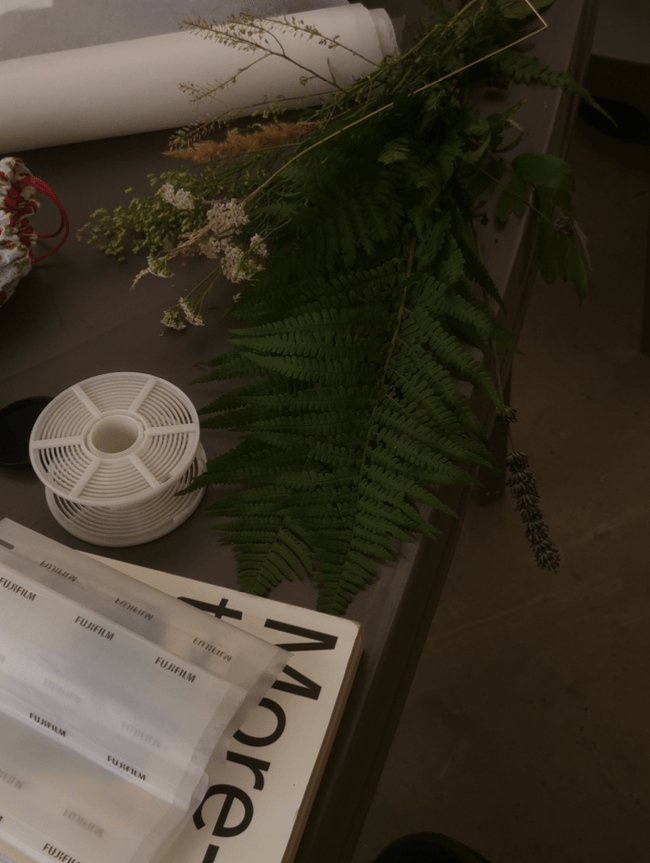
As a person interested in analogue photography but also caring for the environment, I often asked myself: can a darkroom ever be sustainable? Through these reflections, almost as if I manifested it, I had the opportunity to attend a workshop on this specific topic last summer. This article will thus be an hommage to this workshop and to all the inspiration I gained from it as well as a ‘cookbook’ which came together afterward. I am thankful to Michaela Davidová for sharing these moments of experimentation and discovery with us. 

Making the whole process of photographic development sustainable is not an easy task and the inclusion of a question mark in the title of this article serves partially to encourage reflection on the process as a whole. This question is not purely material or processual but also philosophical – do we perceive photographic material simply as a means for realisation of our ideas? Isn’t the darkroom itself an organism transforming and digesting materials? Let us ponder these questions further while we proceed to a practical application of this approach exploring ‘recipes’ for DIY film developers from less toxic materials. 

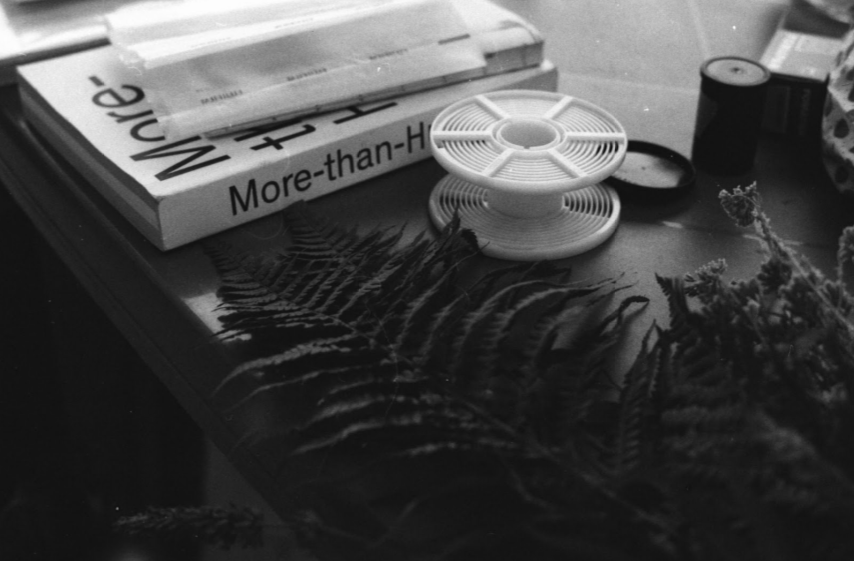
For black and white negative processing, one generally needs a developer, an acidic stop bath, and a fixer to transform the taken latent (invisible to the eye) image into a visible one. Commercial developers are generally based on organic compounds derived from benzene. For plant-based DIY developers, we need to use ingredients containing phenolic acids (phenolic compounds structured on a benzene ring). Those can include coffee, mint, wild thyme, or urine. Phenolic acids can be extracted from them by, for example, pouring hot water over them and letting them cool down, boiling the plants in hot water, or by cold extraction through maceration (storing in an air-tight container in a liquid made of water, oil and alcohol for 3 days). The second ingredient needed is alkali since the developing process can only occur in an environment with pH>7, and alkali helps to achieve higher contrast and more grain in the final image. The most commonly used option is water-free sodium carbonate (= washing soda). The following ingredient is ascorbic acid (vitamin C) which helps to reduce the developing time. By mixing vitamin C (pure ascorbic acid) with sodium carbonate, we get sodium ascorbate. The final ingredient needed for a DIY developer is water. 

The stop bath needs to be an acidic solution in order to interrupt the alkali-developing process. As a more accessible substitute for a commercial stop bath, we can mix water and white vinegar. Lastly, to make the image permanent, we need to bathe it in a fixer. There is not a perfect substitute for a conventional fixer (hypo or ammonium thiosulfate), but it is also possible to use salt-fix, although it serves more as a stabiliser and doesn’t have such long-term archival qualities. 

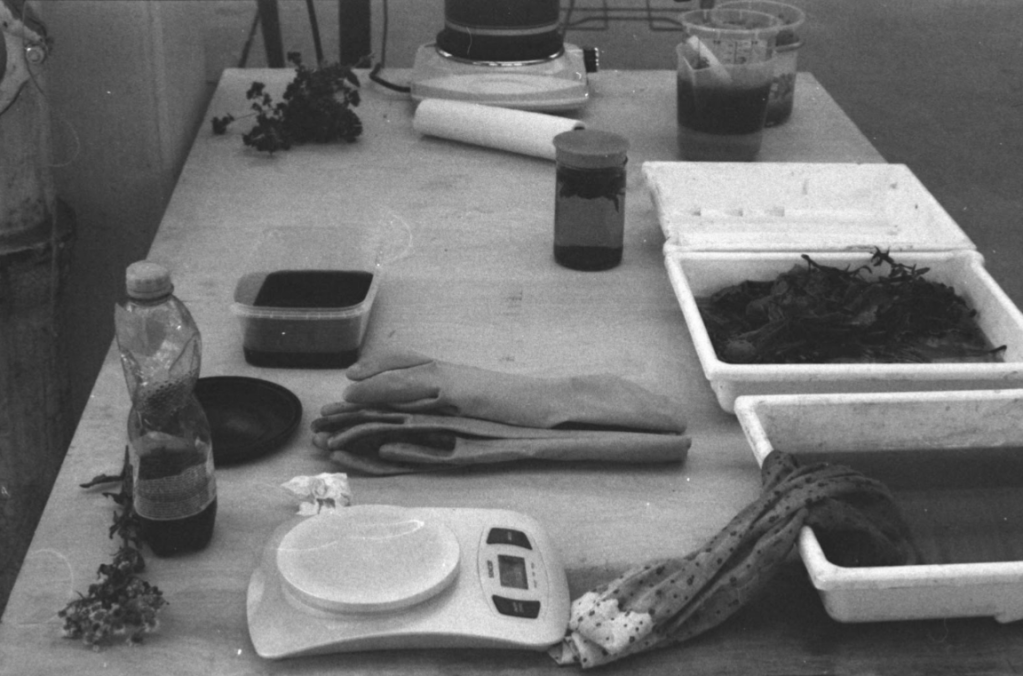
0,5L Caffenol-C (coffee-based ‘soup’) recipe:

Ingredients:

– 20g of water-free washing soda dissolved in 1/3 of 0,5L of water

– 5 g of vitamin C dissolved in 1/3 of 0,5L of water 

– 20g of instant coffee dissolved in 1/3 of 0,5L of hot water 

(source: Blog – Plant-based/DIY developers – michaela davidova)

Directions:

We start by mixing the ingredients in separate containers with water at 24°C. First, we mix the solution with soda, then the solution with vitamin C, and lastly the solution with coffee. 

We let the mix develop for 12 minutes, agitating during the first minute and then 10 times each following minute. 

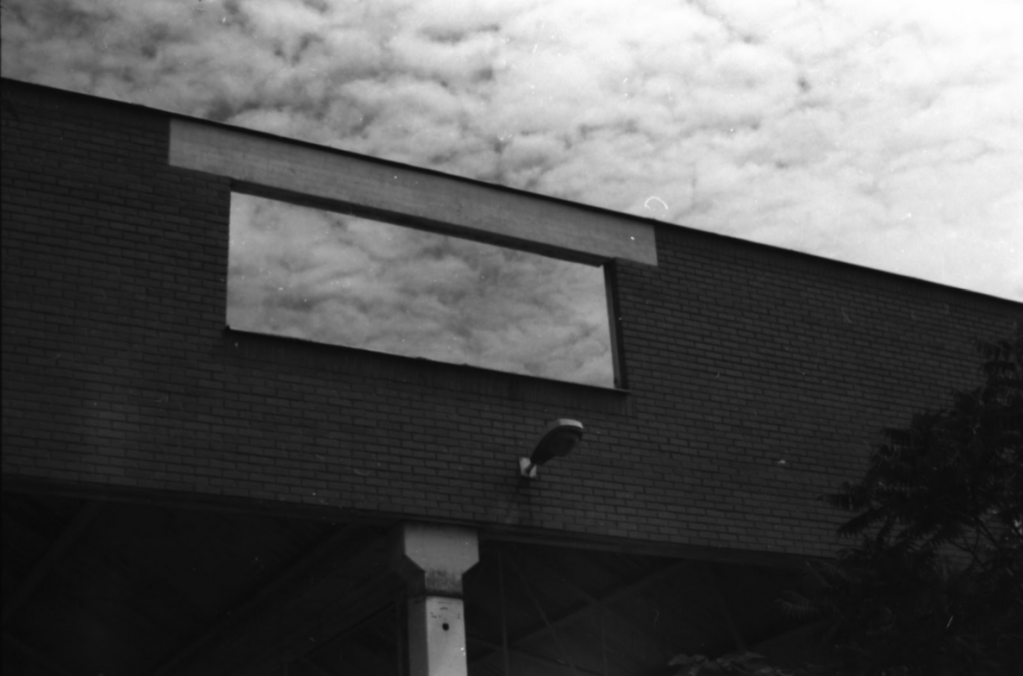
Film roll used: Fomapan ISO 100
Remarks: Pictures have quite high contrast, however the film is slightly over-developed. It is possible that 10 minutes of development would have been sufficient.

One-week-old Caffenol-C developer:

Oregano developer

For more information, visit: 

Exploring Ecofeminism 

Reflections from SciencesPo Le Havre students on Feminist Chapter and SciencesPo Environnement’s Ecofeminist Week from November 25 – 28, 2024

By Syontoni Hattori-Chatterjee 

I admit that even as an environmentalist and a feminist, I was unaware of ecofeminism, the movement linking the exploitation of women under patriarchy to the exploitation of the environment under capitalism and using this framework to dismantle both. It was through co-organizing Ecofeminist Week with fellow SPE members and our friends from FC that I learned about this political philosophy, whose foundations in Indigenous and local knowledge and nuanced criticism of technology-driven modernity spoke to me immensely. If you were able to participate in any of SPE and FC’s events from November 25th to 28th, I hope that some of the insights or key figures of ecofeminism that we presented interested you or made you see the world in a different light as well. What follows is a collection of photos, videos, and quotations from SciencesPistes that chronicle our all-too brief journey into discovering ecofeminism. 

Monday: Documentary Screening of “The Seeds of Vandana Shiva”

We at SPE and FC could think of no better way to introduce our campus to ecofeminism than with this documentary on the life of Vandana Shiva. Shiva, raised around the forests of Uttarakhand in the newly independent country of India, was initially avidly passionate about physics. By her 20s, she had earned her PhD in quantum physics from The University of Western Ontario in Canada. But the Chipko movement back home, during which local female agricultural workers put their bodies on the line against deforestation by hugging trees in order to prevent them from being chopped down, entirely changed her purpose in life and worldview. She then spent over fifty years and counting engaged in environmental justice activism. Vandana Shiva is most well-known for her fight against Monsanto’s genetically-modified cotton seeds and the impact of patented and privatized commercial agriculture on small-scale farmers and on the genetic biodiversity of seeds. 

A small but dedicated audience joined SPE and FC on Monday evening to watch “The Seeds of Vandana Shiva.” Participants came out of the screening reflective and inspired: 

Thomas: “The Vandana Shiva documentary was very informative for me as I never made the connection between feminism and ecology. It was very interesting and I caught myself being fully immersed in the documentary, learning about this woman’s journey and environmental mission.”

Juliet: “The documentary “The Seeds of Vandana Shiva” was truly eye-opening. I had little knowledge of how environmentalism and feminism intertwined, previously not seeing the connection, but the documentary opened the doors to understanding my role in environmentalism, not just as a person living in an ecologically declining world, but as a woman. Furthermore, it showed me that there are solutions to preserving the rights, lives, and environment of small farmers. Often, I find myself resorting to nihilism and a ‘there’s nothing I can do about it’ mentality but this documentary proved there’s hope. A great film about a great woman.”

Amelie: “I walked in the Grand Amphi expecting some vegan cookies and a way to escape PI revisions, and I was left speechless by the bravery and the wisdom of an Indian woman who was fighting a war I realised I knew so little about. The documentary was truly inspiring and very helpful to understand the stakes of our globalised food systems on the environment and local agrarian societies. This event not only provided (delicious) food for my stomach but also crucial food for my never ending Sciences Po activism thoughts. Thank you so much FC and SPE for this film session!!”

Tuesday: Hallway Jacket-Decorating Arts Workshop 

On Tuesday, we brought a blank lab coat and extensive collection of felt markers to the main hall and let all of you decorate our jacket with drawings related to ecofeminism. The resulting multicolored manteau definitely upholds our campus’ reputation as the most artistic of the SciencesPos, and perhaps also the most inventive (not sure what a woman surfing and EVs ~exactly~ have to do with ecofeminism, but I appreciate the spirit).

Wednesday: Lunch Conference with Professor Manisha Anantharaman 

In the middle of the week, we hosted a lunchtime talk with our very own Professor Manisha Anantharaman on some of the key figures and theoretical and praxis contributions of ecofeminism. Even though I had heard abundant praise from my SPE friends taking Dr. Anantharam’s Sociology Minor class, I was still awed by her engaging and clear presentation and regretted not choosing that minor, too (but it’s not too late for you, 1As!). I have high hopes that this feeling was shared by fellow SciencesPistes who continued to pour into and fill up the Grand Amphi. If you happened to miss this talk, however, read below for some of its key points as summarized by reflections from Sylvain, Ben, and myself. 

Firstly, Dr. Anantharaman explained how ecofeminism views the material exploitation of nature, or non-human life, and the social domination over women, thus the exploitation of human life, as thoroughly intertwined. This expands upon the blind spots of traditional Marxist materialism to include further social and non-material aspects of domination. For Anglophone audiences, Carolyn Merchant’s “The Death of Nature” is a key work elaborating ecofeminist thought. Merchant critically analyzes the scientific revolution as not just technological progress but a shift from the Greek pre-modern view of nature as uncontrollable, agentic, associated with womanhood, and requiring a reciprocal relationship to a mechanical view of nature, which could now be divided, quantified, and controlled in the same way as women’s bodies. Through this analysis, Merchant ‘denaturalizes’ the nature/culture divide: she exposes how the separation of nature as ‘out there’ and away from culture and society is not inherent and comes from intentional historical processes. Hearing about Merchant’s work through Dr. Anantharaman felt like uncovering a missing puzzle piece. It not only complemented what I had learned in previous 19th Century History and Ecological Literacies courses, but pushed my critical understanding of the scientific revolution further by seamlessly linking the enclosure movement efforts to capture and extract value from nature to those efforts that rigidly constrain women to the home and exploit their unpaid domestic labor. Coming out of Dr. Anantharaman’s talk, I found the strongest salience of ecofeminist thought to be in its capacity to help us depart from commodified thinking about women’s labor and bodies and the environment all at once. 

Thursday: Ecofeminist Roundtable with Local Associations at Le Hangar Zéro 

Finally, SPE and FC participated in a discussion and debate at Le Hangar Zéro about ecofeminism alongside local Le Havre associations such as NousToutes. I was so proud to hear Elsa present ecofeminist sociologist Ariel Salleh’s work and to hear Anouk share Wangari Maathai’s life of advocacy with attendees sitting around Hangar Zéro’s cozy bar. While I did further learn about and discover new ecofeminist figures from the other presenters, figures including Françoise d’Eaubonne and Fatima Ouassak, I found the ensuing general audience debate to be the most interesting part of the evening.  

We ended up talking about the involvement of local women in Le Havre against proposed industrial projects that would have harmful environmental impacts on the wider community. As the conversation moved forward, it was clear that the room was split between the perspectives advanced by two women there: one who declared that we should take advantage of higher gender equality between women and men and insert ourselves in male-dominated spaces such as public inquiries about these projects, and one who stated that we had the right to reject participation in spaces built on environmental and patriarchal domination that did not care about our voices to begin with. I perceived this divide as very representative of the perspectives of the different waves of feminism, applied to environmentalism, and appreciated the nuanced compromise offered by another attendee. She suggested that one of the major successes of feminist movements was creating a collective voice for women on intersectional gender-related issues, and therefore we no longer have to individually push our way into patriarchal, exploitative discussions, but can occupy space as a consolidated power, together. I appreciated the fact that this conversation at Hangar Zéro allowed participants to ardently disagree while still working together, something that I believe maintains an essential pluralism of ideas within and solidarity amongst social movements that reinforces our strength in numbers. I spent the whole walk home talking about ideas arising from this roundtable with a friend, and was reminded of why I came to SciencesPo in the first place. 

I hope that you’ll take the time over the remainder of this holiday break to further explore ecofeminism, and see how it might complement or challenge existing ideologies and social movement frameworks that you care about. On behalf of SPE and FC, we’ll see you at future individual and collaborative events! 

A Seagull’s Day in Le Havre

When I wake up, the sun is still hidden behind the buildings of the city, but the sky slowly turns to a pinkish hue as it lights up. It’s cold, but I’m protected from the harsh gusts of wind of the grey sea. It’s a rainy day. It feels like every Monday is a rainy day. But it won’t last, it never does here, as the wind pushes the heavy grey clouds away inland, and brings in a fresh blue sky. That’s Le Havre for you. Everyday there’s sun, every day there’s rain, but it never lasts for long. I heard in the tropics, far South, wet and dry weather alternate every six months. Here in Le Havre, rain and sun alternate every day, so the city is always wet. I like wet. I’m born to live out at sea, to have droplets of water caress my white and grey feathers, to have the marine air fill my beak. My ancestors fed on fish, but myself, I prefer feasting on a half-eaten kebab I find in a rubbish bin, or better, a full Burger King meal stolen from a group of young humans. I like staying around young adult humans, they always leave stuff behind: raw chicken breasts, kinder bueno wrappers, empty coffee cups, lots and lots of them. It’s funny how they scurry around that large blocky grey building. They arrive there every morning, and stay until the sun has set. I always follow them; they seem like funny little characters. 

When I arrive at the building, around 8 o’clock, some of the humans are already there. I say humans, but they’re not all fully grown. I know some are still finding out who they really are, just like I am. I can relate to them. My seagull friends are there too. Right in time for breakfast! A few coffee cups lay at the bottom of the rubbish bin, I pick them out with my shiny yellow beak. I always need a coffee to start the day, otherwise I can’t concentrate. I want to learn more about the humans, about why a flock of so many different ones stick together in this sad coastal city. They’re like a weird family, sometimes friendly, sometimes fighting, but always together. 

After breakfast, I peek around the windows on the right of the building. There, an older human is telling the others about stuff. I cannot comprehend everything; it seems jumbled up. One class is about the Silk Roads, a large route of trade and cultural exchanges, spanning half of the globe. I wish I could visit all these places that the wiser human is talking about. It seems beautiful out there in the world. Other times, it’s a different older human talking about a different thing. They talk about how groups of human’s rule over other groups of humans, and the rules around this governing. They  explain why and how groups of humans interact between themselves. It’s a peculiar sight to see all these young humans learning about things from their own world. But alas, I, humble seagull, am unable to fully comprehend the complexities of human society. Who could, really? 

When lunchtime arrives, I stand in front of the building and wait for a human or two to come back holding food in their hands. They rarely feed us. They don’t really like us, actually. Some say we’re scary, that we may hide secrets or govern the world. Hilarious, really, when you observe what humans do to our homes. Some don’t like us because we feed on rubbish. But we simply finish what they have left off. Some just don’t care about us. Why should they, they’ve already got so much on their minds. In any case, there’s always a sandwich or two left in the rubbish. We fight over it with my fellow seagulls, it’s food enough, but the best parts are highly convoluted. The humans watch us fight sometimes. They point at us, they laugh. But when lunch is over, they all return back in for a next round of classes. Sometimes, some leave early, their day probably finished, but most stay late at night in a strange two-levelled room. Often, the central hall is decorated, and the humans stay there, talking, and sometimes, not a sound is made in the whole building. 

In the afternoon, I fly up to the green rooftop to observe the humans working in small groups. They look different up there, more attainable. Most of the time, when I peek in the rooms, there are only a handful of humans, typing on computers, shouting at each other, or repeating what another older human is telling them, in sounds that I do not comprehend. I watch as my seagull friends fight or have sex on the rooftop, and how the humans look at them, fascinated, disgusted, or laughing. How peculiar is it that I could be observing the humans observing my own species. Maybe they are like me, perplexed at the way of life of other species, wondering to what extent we resemble each other, or not. Some days I fly to the other side of the building. There, they also work in small groups often with an older human looking over them. It seems like they talk about the same topics as in the big hall, only more confused, and noisy. How strange they are, with their computers, and phones, watching a screen display. Doesn’t the life of a seagull seem more attractive? Just chilling and feeding all day, hanging out with friends. It sure seems more appealing to me than being locked up in a room in a sad grey building all day to learn seemingly useless mountains of information I have trouble seeing the usefulness of. But they are humans. Humans are weird. 

Over the seasons, I’ve noticed a pattern. Every 2 cycles of seasons, half of the group of humans leave and a new flock arrives. I don’t know where they go or where they come from. From what I could gather, they all go their own way, to places far away. Some never come back, and some do, but I never see them again. One day, maybe I’ll understand, but for now, I’ll continue to wonder why a small group of humans choose to stay together for two season cycles only to split at the end. It’ll remain a mystery. 

As night starts to fall, I peek through the blinds of the book-room where only a few humans remain. All concentrated on their computers, some with empty coffee cups lying next to them, face between their hands, hand on their foreheads. They seem tired. They seem overwhelmed. I’d love to help them, but how could I? I’m just a simple seagull. What do I know of human society? I do wonder if the humans themselves know, or if they are as perplexed as I am. But for now, I simply wait for the few humans dressed in black to push the young humans out at nine o’clock. I’m just a seagull, sure, but I’ve witnessed those humans work all day, climb up to the fourth floor worried or annoyed, to speak with older humans. I’ve seen them sing, dance, and act together. I’ve seen them cry and laugh, shout and whisper. I’ve gotten to know them, and one day they’ll leave, and I’ll never see them again. Never. I hope one day it’ll be my turn to see the world, to follow the humans to the ends of the Earth. Maybe that day, I’ll finally understand what human society is all about.

Read more: A Seagull’s Day in Le Havre

Romain YBORRA, 3a is nostalgic and shares here his fond memories of LH and the campus by putting himself in the shoes of the seagull.