La Rentrée Solennelle: A Conversation with Dean Jeanne Lazarus

by Carmen Leong

Source: Tyler Jaewon Kim

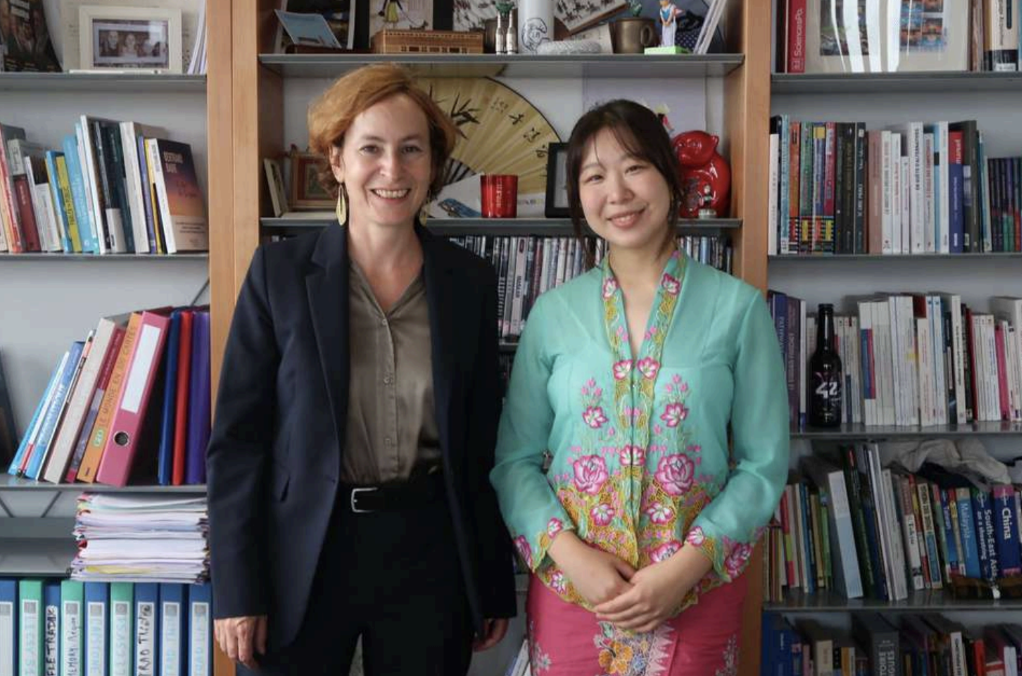
The campus is waiting when I arrive that morning on my bike, daylight streaming through its glass walls into the quiet hallway. It’s a rare sight to see at ten A.M., but today is a special day — the Rentrée Solenelle, official welcoming ceremony for the incoming and returning students. Soon, they will arrive in batches from the different directions of the nearby dormitories, some dressed in colourful traditional clothing and others in suits and formal dresses. The familiar buzz of conversation will fill the air as they settle into the Grand Amphi to listen to guest speakers and performances; but for now, I enter the doors, go up the lift and head to the office at the very end of the hallway to meet one of the speakers before her speech. 

Professor Hauchecorne is there already, settling himself down after a staff briefing. I’m slightly on edge, not having done a proper interview in a few months. But then my interviewee walks in, and she pats her hair down, rearranging her well-tailored suit. Jeanne Lazarus greets me with a smile, and I feel at ease immediately. We shake hands and I lead her to her seat so that we can begin the interview. 

It is not her first time in Le Havre, of course. Since becoming Dean two years ago, Madame Lazarus has come here twice a year as part of her duties to coordinate the campuses and organise the curriculum. It is common to hear complaints in Le Havre directed particularly at the bleak weather and even bleaker architecture, so I am pleasantly surprised when she compliments the modern look of our campus, and its position overlooking the sea. 

“Also, I’m quite interested in the topic of the campus because I used to learn Chinese when I was in high school,” she adds. “And I did an internship in Taiwan for six months when I was twenty. So I used to speak Chinese, but unfortunately, I didn’t pursue it, and I wouldn’t dare to speak [it] now; but I’m still very attached to that region, to Asian Studies.”

In addition to her role as a leading administrator, Madame Lazarus has also been a sociology professor in Sciences Po for thirteen years; seven years of which she was in charge of the Introduction to Sociology course at the Nancy campus. Over the course of her career, she became the director of the Department of Sociology at Sciences Po and simultaneously an elected member — then president — of the conseil de l’Institut. 

“And after all that, at one point, I thought that I really wanted to be more involved in the administration of Sciences Po, because I was involved in many ways, but more — I would say, on the side — as someone who could give some ideas or comments, but I really wanted to be in charge more. So that’s why I applied to become the Dean of the undergraduate college.”

So, why Sciences Po? I ask her. What makes our education stand out in the French and global landscape?

Madame Lazarus smiles and takes a breath. She must get this question a lot, I think. 

“First, what is distinctive is the plural disciplinarity of Sciences Po — the fact that you don’t

choose too early to specialise on one topic. And that is a very strong choice, for the students as well, because it means that — compared to students who go to the university to study economics or law — you won’t have the same density in one topic. But what we think is that you will have, instead, an openness that will allow you to do whatever you want after having these first three years of general education.

“The second thing is the international view of Sciences Po,” she continues. “Sciences Po is one of the first French universities to [open itself up] to international students and international programs. The fact is that, in the bibliography of the courses you have here, you will read research from everywhere in the world. Also, of course, we have the third year abroad that opens students to other educational systems. We really cherish this international part of Sciences Po.

“And the third distinctive thing in Sciences Po is the fact that it is open to public life. Of course, with the parcous civique, but also with the fact that we have conferences open to the public, that our students are involved in many, many associations, initiatives… We want students to be, firstly, very good [in their] academics, but also to use their skills for the community — for others, at whatever level. It can be at a very local level, in associations; and also at national level, maybe.”

At this point, Madame Lazarus takes a pause, trying to find the words to convey her thoughts.

“I know we used to say that we are here [to teach] the students to become leaders. But I don’t really like that word, because I think that if you say that to people, then you will tell them that [being a leader] is for themselves, like you will be someone different from others. And I prefer to think that the students are going to be part of communities — maybe they will distinguish themselves, maybe they will lead some projects — but the idea that you are a leader…” 

“Seperates them from the community?” I offer.

“Yes, and you have to, I think, be a little slower. To just think, first, that you will bring things to others,” she agrees. “You can also have a very good life not being a leader, but [just] being a part of something. It’s not only being a leader that is interesting.”

It is interesting to hear this from her when most top universities explicitly state otherwise — I recall writing numerous applications just over a year ago, trying my best to portray myself as a budding leader to gain better chances of admission. But Madame Lazarus has been involved in student life at Sciences Po to know enough about students and their ability to succeed beyond leadership. In fact, in 2001, she graduated as a Master’s student at the Paris campus. Back then, she tells me, the ‘internationalisation’ of Sciences Po had only just begun. Only the Paris campus existed, researchers numbered less than 50, and they had only just introduced the Conventions Éducation Prioritaire (CEP) programme. 

“It’s much more aligned with the world now, I would say,” she concludes. I ask her if there’s any advice she may have for the incoming first-years. 

“Well,” she begins, “really take what we as professors and administrators give you — which is a lot of knowledge, a lot of good research that is brought into the classroom; I think that it’s very important for the students to work on top of it, to make that knowledge their own.

“We know the abilities you have, so trust us, and work as much as you can to reach what we await from you. Sciences Po is more and more renowned in the world, and I think it opens many possibilities for us, of partnership and also research. 

“We were asking ourselves before, are we a university, a school, an institute? We are sure today that we are a university, and we still attract students from everywhere. And that is very special in France, especially at the bachelor level, because it means that students at seventeen, eighteen years old, decided to cross the world to come here.

“We are in a very uncertain world today, so we need to reinvent ourselves. We have very good basics, and we can build on that, but we also need to think about what we have in front of us, which is a very difficult world to understand. But we have the resources for that. We have the students.”

Author’s Note: I would like to thank Madame Lazarus for taking the time to speak with me during the interview, and to congratulate her on the thoughtful speech she gave later on that day in the Grand Amphi.
Between Adaptation, Persecution and Modernity: Christianity in East Asia in the 18th and 19th century

by Giulia PORCU and Anish PARCHA

Intro: The afternoon turned thoughtful on 16 September, as students trickled into the Petit Amphitheatre with notebooks in hand and quiet curiosity in the air. Professor Pierre Emmanuel Roux, Co-editor-in-chief of the magazine Extrême-Orient Extrême-Occident and senior lecturer of history at Universitè Paris Citè,  took the floor for a talk titled “Between Adaptation, Persecution and Modernity in East Asia in the 18th and 19th Centuries.” Minds eager to learn and pens ready to chase his words set the stage for an engaging session. The session was brief yet intuitive, insightful and packed with value. What was the discussion about? What were the most significant insights and how do they correlate to our 21st century understanding of the modern world?
A brief breakdown of the lecture and the subsequent interview is as follows:
A recap of the lecture: Accepting the unacceptable 

Covering the history of Christianity in East Asia through the 18th and 19th century, professor Roux gave us essential historical context starting from the 16th century. Further highlighted the importance of three key terms when analyzing local context: proscription, adaptation and modernity. Starting with the idea of persecution between the 16th and 18th centuries,, he stated that local Christian communities had to deal with constant repressions and tensions caused by the contrapposition of Christian preaching and Confucianism order. These were, for example, revealed by debates over practices like ancestor worship. Despite being a minority, Christians sustained their faith through a lineage of personal connections, preexisting networks and local religious figures. These local challenges reveal that Christianity’s survival relied as much on East Asian networks as on Western missionaries. This challenges the common assumption that East Asian conversions were based on the mere arrival of missionaries in local territories, hence the traditional vision which attributes great importance to the West in the making of Christianity in Asia. 

Upon this, the focus of this lecture was on the recent reverse theory in academia: ‘‘Are we ready to accept the unacceptable by fully recognizing Asia’s role in the making of world Christianity?’’. As a starting point “Inculturation” is the term used by many historians to describe Matteo’s Ricci ambitious but failing project. He was the first to realize the importance of finding shared knowledge between the two civilizations, using Chinese concepts adaptable to Christianity, specifically the Confucianist ambition to a virtuous society and inner self, so as to allow reciprocal comprehension and common grounds. Despite the failure of his project, as demonstrated by the 1724 expulsion of Christian missionaries, the greatness of Ricci’s work lies in highlighting how impossible it would have been for the West to be the only factor in the spread of Christianity in the East.

As stated by Nazarudin in ‘Bijdragen tot de taal-, land- en volkenkunde’: 

‘When something is transmitted, it is received in the mode of the receiver rather than the transmitter. Thus, what has been transmitted as Western Christianity has been received as Asian Christianity. Therefore the ownership of the Christian tradition — both for East and Southeast Asian people — grows stronger when it’s passed on intergenerationally’.

After the address by Professor Roux, we had the opportunity to speak with him via a Zoom interview.  This was done not only to build a deeper understanding of his work but also to cultivate a new sense of curiosity around Christianity’s central role in shaping Asian societies. The interview was carried out through three main questions, the first one being:

  1. As you presented during the lecture, many Western books acted as the major means of spreading Christianity among the elites in China, Vietnam and Japan. Considering the fact that they were based on European ideas of utopia, how were they received  by their audience?

It is important to keep in mind that there were different categories of books, specifically scientific and religious. In the Jesuits missions, especially, both were used. Given the importance of Jesuits in Beijing and their knowledge, it is only natural to conclude that Asian scholars were curious to meet them and grateful to receive their books. 

Missionaries were scarce in East Asia, so it was religious and catechetical books that were diffused among the faithful. Qing China is emblematic in this matter: in the early 19th there were 100 missionaries spread among the territory, while in the early 18th century only 20-30. Missionaries and local priests visited the main local villages once a year, hence the importance of books for conversion, maintenance of faith and continuity of prayers. “In many places it still works like this,” commented Professor Roux. “You can’t imagine the number of Bibles I received in Chinese and Korean because of this strong desire to spread faith!”

(2) What events led to the ban on Christianity in East Asia?

Fundamentally, the main common denominator for the ban of Christianity in East Asia was political.

Korea, Japan and Vietnam were small countries that embodied the idea of protonations state. Hence, when Christianity arrived as a new phenomenon, it was perceived as a possible threat to the social order. Obviously, this was not the case in China as it was a huge multiethnic empire, so the spreading of new ideas and beliefs was slow and further minimized by the ridiculously low number of missionaries in loco. 

(3) “The elaboration of this ‘European Utopia’ first took form in Matteo Ricci’s world map. Given the diverse perceptions around his work and that of other figures, how far did they actually influence the perception that the West had of the East and vice versa?”

There certainly were missionaries who had influence in China mainly at the national or regional level, but the majority of them had a local impact.

For example, Francis Xavier, who travelled all around Asia, is remembered as a great missionary, but there are some inaccurate narratives regarding the extent of his influence on conversions. Rather than influencing the East, his influence was far more prominent among young Jesuits who now dreamt of going to East Asia. Matteo Ricci, on the other hand, did have quite an influence in the 17th century, even though not as much as Francis Xavier did. That being said, it is important to note that Matteo Ricci’s influence was profound in East Asia itself, shaping local knowledge, religious practice, and cross-cultural exchange across China, Korea, Japan, and Vietnam. Unlike missionaries whose impact was measured by conversions abroad, Ricci’s legacy lies in his intellectual and cultural contributions within East Asia, from maps to catechisms. Since his catechism, books and map were dissaminated in Korea, Japan, Vietnam and China, he came to be known everywhere in East Asia. His map became the first world map shown in China, which continues to be used to this day. Institutes built in his honour are located all over the world (Paris, Boston, Taipei), proving the growth of his prestige after the major clash between Beijing and the Vatican. By nominating new Chinese saints in the early 2000s, the Vatican underscored Ricci’s enduring influence, indicating that his contributions continued to be respected despite historical tensions with Beijing.

The Asia-Pacific campus of Sciences Po Paris was arguably the most fitting venue for such a lecture. With its focus on the region, the campus offered not just an audience but a context where the intersections of faith, power, and society in East Asia and South Asia could be understood in a more nuanced way, where students could link theological insights to their cultural exposure. Sciences Po’s diversity is exemplified by lectures like these, where students from all around the globe seek genuine knowledge about the world that surrounds them — about the rise of religions, institutions and environments that shape modern history. As the lecture drew to a close, what lingered was not just a story of persecution and resilience, but also a reminder of how ideas travel, change, and survive across borders. Christianity in East Asia, as professor Roux emphasized, was never a simple tale of importation from the West — it was a dialogue shaped by local traditions, state power, and the challenges of modernity.

Navigating Solidarity and Strategy: Daniel Peterson’s Lecture on Indonesia’s Support for Palestine

By Carmen Leong

Just over a year ago, nearly two million people gathered in the central Freedom Square of Jakarta, waving enormous flags in a spectacle of red and white, but also green and black. They were rallying to express solidarity with Palestine, in light of the war on Gaza that had devastated the state and slaughtered thousands. It was one of the most significant protests for Palestinian resistance in Southeast Asia, said regional law and politics scholar Daniel Peterson. Our campus had had the privilege of inviting him to give a lecture on Indonesia and the Palestinian cause at lunchtime on 28 January, in which he outlined the principles and narratives driving Indonesia’s support of this vastly distant state.

Indonesian support for Palestine stems from its own history of anti-colonial resistance and humanitarian principles – the latter of which is stated explicitly in its Pancasila state philosophy. But the massive scale of mobilisation for Palestine in the country can perhaps best be attributed to the sentiment of Islamic solidarity resonating among its people for their brothers and sisters across an ocean. The significance of this relationship can be traced back to the 1955 Bandung Conference; it not only secured Indonesia’s political presence on the international stage, but also marked the country’s diplomatic and moral pledge to Palestine. Although some dissent exists – for instance, a 2017 BBC World Service poll recorded that 9% of Indonesian survey respondents view Israel positively – most Indonesians take a pro-Palestinian stance, motivating the Indonesian government to do the same. For instance, Indonesia has refused to entertain Israel during international sporting events, most recently with Indonesia being stripped of its hosting duty for the FIFA Under-20 World Cup due to concerns over whether the Israeli team could compete there without disruption. Even so, some critics have argued that Indonesia can do more to ally itself with the Palestinian struggle; even if geographical distance and limited military power restricts its ability to intervene directly in the conflict, Indonesia can welcome Palestinian refugees. At this point, Peterson paused and directed the question at our audience: do we think Indonesia will welcome Palestinian refugees?

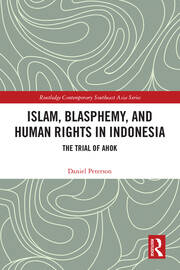
Image Credits: Melbourne Law School, Routledge Contemporary Southeast Asia Series

As LDD’s newspaper correspondent, I was lucky enough to catch him for an interview later that day, during which I asked his opinion on the very same question. His answer: it’s highly unlikely. There is firstly the argument that accepting Palestinian refugees is counterintuitive to the greater struggle; when refuting reports of Trump’s plan to relocate Palestinians in Gaza to Indonesia, the Indonesian Ministry of Foreign Affairs asserted that “any attempts to displace or remove Gaza’s residents is entirely unacceptable”, since “such efforts to depopulate Gaza would only serve to perpetuate the illegal Israeli occupation of Palestinian territory and align with broader strategies aimed at expelling Palestinians from Gaza.” Secondly, Indonesia has not had the best track record for taking in refugees, with Rohingya from Myanmar facing hostile pushback from local communities when arriving on Indonesian shores in recent years, due to fears of competition over scarce resources and an increase in crime and inter-ethnic conflicts. 

Evidently, the Indonesian government must carefully take into account its domestic situation prior to undertaking any intervention in the Israel-Palestinian conflict. This could explain its continued reluctance to use the word “genocide” to describe Israel’s actions against Palestine – a point that Peterson brought up in response to a student’s question during the Q&A segment of his lecture. Given Indonesia’s own violent history, such as the 1965-66 massacres of members of the Indonesian Communist Party (although the anti-Chinese sentiment behind this event has been refuted by some scholars as a myth), it may not be politically expedient to directly accuse Israel of “genocide”, since the definition of the word also varies and genocidal intentions are difficult to establish. That said, the Minister of Foreign Affairs has arguably asserted the same sentiment, by stating that “Israel’s ultimate goal [is] to wipe Palestine from the world map.”

In light of Indonesia’s steadfast, justice-oriented stance against Israel in the ongoing dispute, some may question why it has not adopted a similar position against China, especially considering the allegations against the latter of being complicit in the persecution of ethnic Uyghur minorities in Xinjiang. To this, Peterson points to Indonesia’s significant economic dependence on China. Just recently in November 2024, Indonesia signed $10 billion in deals with China; it is also the highest recipient of Official Development Assistance (ODA) and loans from China among Southeast Asian countries. In contrast to Israel, with whom Indonesia has minimal economic ties, China holds far greater influence over Indonesia’s economy, requiring the country to carefully balance its stance on human rights with the need to cultivate favorable relations for economic and development purposes.

Daniel Peterson’s lecture provided me – and, I’m sure, many other students – with a deeper understanding of how cross-border movements shape international relations. I now have a greater appreciation for how governments must carefully consider their own internal tensions and domestic situation before formulating foreign diplomatic strategies, particularly in the case of Indonesia’s approach to the Israel-Palestinian conflict. Our team at LDD would like to express our gratitude to Dr. Peterson for taking the time to participate in the interview, and we hope that this article offers valuable insights to those students who were unable to attend the lecture.

Something to Put on Your LinkedIn: SciencesPo’s First Intercampus GRC Conference

By Syontoni Hattori-Chatterjee 

All photos credited to The Sundial Press, SciencesPo Reims’ campus newspaper.

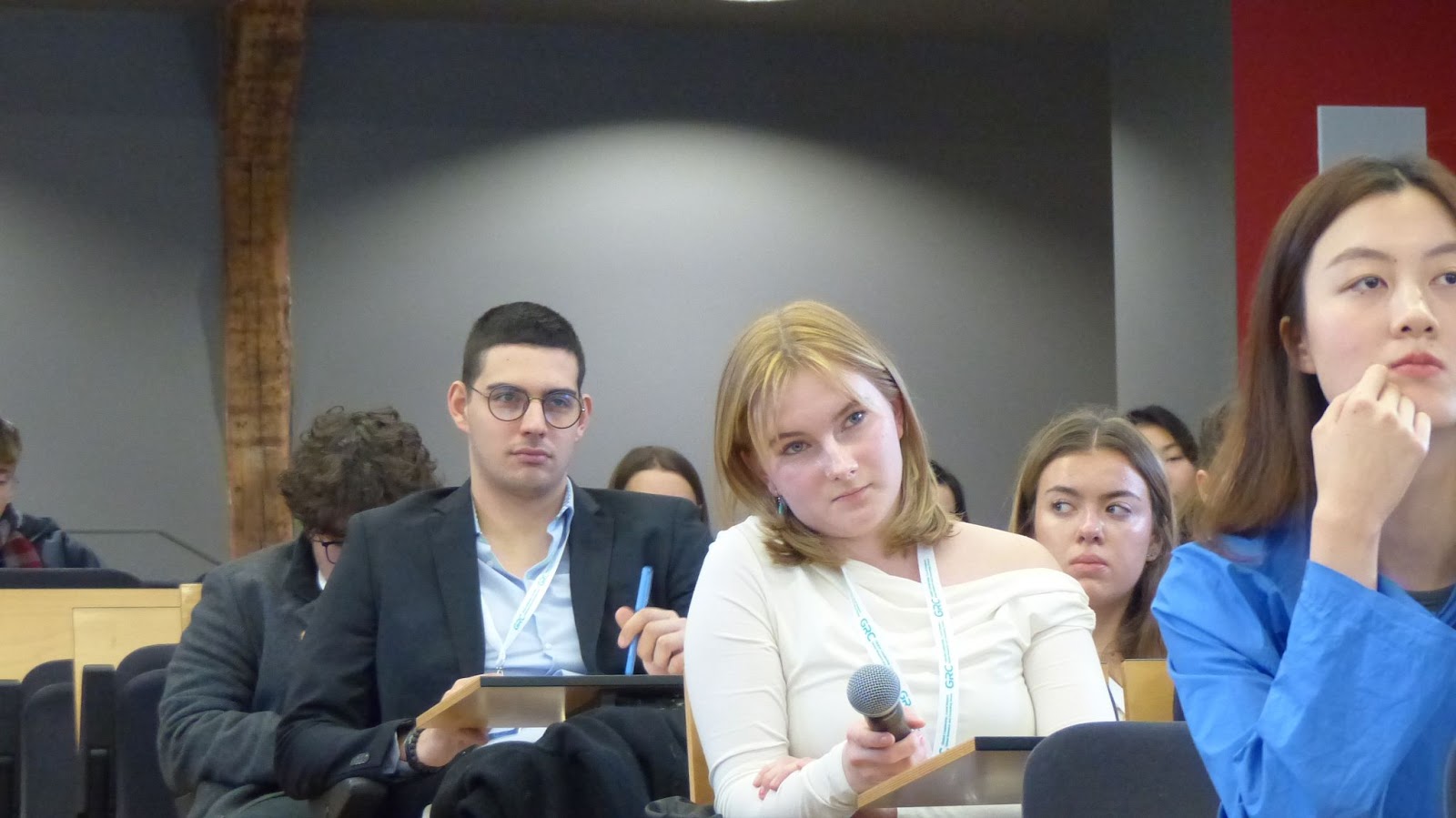
SciencesPo Le Havre GRC Branch President, Aaryani Sahay, with conference speaker Álvaro Martín Sánchez, Associate at Boston Consulting Group.

From February 8th to 9th, I had the special opportunity to attend SciencesPo’s first intercampus Global Research and Consulting (GRC) conference. Fellow associates from the Le Havre, Menton, and Reims branches congregated in SciencesPo’s largest regional campus for a weekend of speakers, workshops, cases, exploring Reims, and, of course, networking. While I had some previous experience in education and nonprofit consulting, I was relatively unfamiliar with the wider field of social impact consulting before getting involved with GRC this year. Being immersed in this burgeoning consulting niche over the conference weekend helped me solidify my future career aspirations, a sentiment shared by other attendees from across the three campuses.

Viren Gemini, also a GRC Le Havre associate, commented that The conference was quite intriguing because the guest speakers were very articulate and provided relevant and interesting insights on consulting and finance. The opportunity to ask the speakers questions and interact with them in person was very cool, and I felt like I gained a deeper understanding of consulting as a field and the lifestyle, skills and thought process of a consultant. I am excited to explore opportunities in this realm in the future!” 

Indeed, Álvaro Martín Sánchez from Boston Consulting Group (BCG), Mariette Munier from McKinsey and EDF, and Bassem Snaije from Cosmos Advisors and SciencesPo each provided distinct, interesting perspectives on their work as consultants. I was surprised not just by the diversity of projects they were each able to take on, but also by their reflections on their responsibilities and purpose which showcased different mindsets and strategic thinking approaches. 

Viren remarked that Bassem Snaije’s data-centric approach was truly fascinating, as his show-don’t-tell approach revealed the importance of finance in the modern world and introduced a lot of new key terms that I was not familiar with. I also found Professor Snaije’s technique of leading with the numbers and then explaining their importance quite engaging. 

Mariette Munier had me hooked from the beginning of her talk when she boldly announced that she had just quit McKinsey the day before the conference. I agree with Viren that her emphasis on honesty, authenticity and being open to feedback and learning as key attributes of all good consultants and her passion for promoting economic inclusion of consultants from different income backgrounds was refreshing. 

What I appreciated the most, however, was the chance to talk to Ms. Munier in between speaker sessions. As a SciencesPo Nancy campus alumna herself, she had a warm and nostalgic familiarity towards my and my friends’ experiences that made her advice on pathways beyond SciencesPo all the more salient. I was very interested in the HEC-SciencesPo dual Masters program that she pursued after obtaining her Bachelor’s degree. This was in particular because she remarked that HEC had an entirely different university culture to SciencesPo and focused more on professional development. Nevertheless, I also valued her perspective on career opportunities gained through SciencesPo’s greatest strength: our peers and friends, who form not just our emotional but also professional support network. 

Lastly, Viren and I both took away the same key insight from Álvaro Martín Sánchez’ talk: non-social consulting can also have a social goal. Mr. Martín illustrated this by discussing his first project as a full time consultant at BCG during which he helped expand legal banking operations and access to credit cards on behalf of a bank in Venezuela, Panama, and the Dominican Republic. While the project’s intended outcomes were profit-focused and aimed principally to extend the reach of the bank’s activities, the project also  had positive externalities on the local and national level. Strategizing effective ways to encourage citizens to keep their money in banks enabled said citizens to develop a credit history that they could use for loans, and also lowered the influence of the mafia and underground economy while promoting tax collection for public services. It was encouraging to hear that more consulting work is slowly but surely moving into this higher degree of interconnection between profit-based and social outcomes. Additionally, Mr. Martín’s fun story about a colleague who had to literally get into a pig sty for a consulting project amusingly showed attendees that consulting provides the unique opportunity to have a career where you get your hands into a bit of everything. 

Viren Gemini (left) and Carmen Leong (right), SciencesPo Le Havre GRC Branch Associates. 

The collected composure of the SciencesPo GRC team throughout the weekend masked how much effort went into making this conference a success. I talked to Aaryani Sahay, the president of our SciencesPo Le Havre GRC branch, about the preparation involved in organizing the first event of this kind between the SciencesPo campuses. She shared that the initiative for this conference began between the three presidents of the Le Havre, Menton, and Reims GRC branches all the way back in September, and the full executive boards of each campus’ branches were working on this from late October onwards. We all started having calls on Sundays. For like three or four hours, because I had to be on every call, I would be on calls and everyone else on the [Le Havre] executive board so Noelani, Armand, Elise would also join their teams and we’ve all been working on this for three months before the conference happened.

I was moved by Aaryani’s dedication, passion, and commitment to making the idea of an intercampus consulting conference a reality. Over winter break, in order to secure conference panelists, she stayed up until two a.m. most nights emailing, just cold emailing, speakers and navigated scheduling changes, cancellations, and more logistical challenges. She admitted that at some points it did feel like, you know, I was a bit overwhelmed. But I think I just had faith: I knew that this could be a good event and I just had to keep at it. Aaryani exhibited some of this faith by putting herself out there and messaging consultants such as Mariette Munier, with whom she had no prior connections, on LinkedIn asking if they were interested in speaking to SciencesPo students. Indeed, during a quick chat before her panel, Ms. Munier herself encouraged me and fellow attendees to boldly make the first professional move and take chances utilizing our extended networks. 

Nevertheless, this GRC conference was also a success because it built on previously forged professional relationships. Álvaro Martín mentored Aaryani and other first-year GRC Le Havre associates last year during their first consulting project at SciencesPo. When Aaryani reached out to him asking if he had any connections in the Paris area that might be available for the conference date, he offered himself to come speak, despite living and working in Madrid. Aaryani and the GRC executive boards had to figure out and fund logistics, but ultimately Mr. Martín was able to fly into Paris from Madrid and go back on the same day just to talk with us. Following the conference, case competition winners earned a private mentoring session with him and another consultant, and Mr. Martín will be back as a GRC mentor this year. 

Georgia Langworthy (center), SciencesPo Le Havre GRC Insights Team Head

Speaking of the case competition, Fifi Zhao, a GRC SciencesPo Reims branch associate and member of the winning team, and our own Viren from the runner-up team generously shared their reflections on trying out this new activity. 

Fifi: It was my first time doing anything like it, and I really went in with zero expectations and just the desire of getting some firsthand experience on the entire process of analyzing the prompt, conducting research, and presenting findings. I remember agreeing with my teammates that we wouldn’t cry of happiness if we won, but we wouldn’t cry if we lost either. It was a bit daunting because none of us had previous experience, so we tried interpreting the criteria to the best of our abilities. Winning was definitely unexpected but I’m so glad our hard work paid off! It did add some confidence that I can succeed in consulting, and the BCG session was a cherry on top. I’m thinking of using it to ask about skills I can develop to be more competitive in applications, as well as potential career paths and exit opportunities if I decide to change careers.

Viren: We started preparing for the case competition around six a.m. (two or three hours before the competition) as we had gone for dinner and then to the bar the previous night to celebrate my birthday. It was quite a productive session as we were able to work together remotely and split the work efficiently (I guess pressure can really make people thrive!). We were the second group to present, and after the first group it was clear to us that our approach was a bit unique and placed special emphasis on assessing the pre-existing conditions of fire-response in California. Fortunately, the judges took a liking to this approach and we came second! The feedback we received was that we fell short because we exceeded the given time and this was due to the last minute preparation, but overall we enjoyed the exposure and we were able to get a good experience out of the competition.

“But I think I just had faith: I knew that this could be a good event and I just had to keep at it.” 

The GRC summit was also an occasion for some to return to once-beloved activities and gain a renewed sense of purpose. As I watched Aaryani on stage in conversation with Álvaro Martín, asking thoughtful questions and cultivating an effortlessly dynamic discussion, I truly felt like this was where she was meant to be. I was a public speaker in high school: I spoke at the UN and I spoke at the Graduate School of Education at the University of Pennsylvania. I feel like going to conferences was a huge part of me and I genuinely enjoyed it […] I hadn’t done public speaking for almost three years by this conference so I was really nervous. Two days before the conference, I was telling my parents that maybe I should ask someone else to [moderate the discussion] with Álvaro because what if I lost it, you know? But my parents were like ‘You just take a risk and see how it goes.’ And it just felt like coming home. Aaryani also mused warmly on the impact of having her personal and professional support network there to help her: Tamae was there, Armand was super helpful throughout the whole thing, he helped me make the speaker questions. So I think just having everyone there, having my friends there, and being able to do something that I love, I think it’s an experience that I’m really going to cherish. 

Last but certainly not least, my favorite part of the conference was getting to know my peers from other SciencesPo campuses, something we still have too few opportunities to do. My coloc hosts were so generous and kind, and as Aaryani revealed the GRC Reims executive board worked tirelessly to ensure that us guests had a warm welcome to the city. Eleni from Reims worked so, so hard to secure the accommodation […] Every day I would text her with two new people and she would be like, ‘Let me try to make it work.’ I would just like to say that she really played a role in accommodation and making sure that people from Le Havre could come. As a 2A in a dual degree, I also welcomed the opportunity to meet people I would see again in the fall at Berkeley, a sentiment echoed by Fifi. I was really happy to meet LH and Menton students, especially those also in the Columbia Dual degree! It was like a little preview of what’s to come next year :).

I would like to end this article with Viren’s comments about celebrating his birthday during the conference weekend (the grind truly never stops): 

It was a great birthday! I got to discover a new city in France (4th French city I have been to yet) and I got to hang out with a group of friends that I truly value! They surprised me with 2 cakes that were from my family back in India and a cookie cake from them, and we went for dinner to a great Thai restaurant. Afterwards, we went for the bar night and I had some really good conversations. Later, my amazing coloc host Simona cooked pasta for us as a late night supper. Overall, an amazing day!

A big thank you to everyone involved: the Reims, Menton, and Le Havre GRC presidents and executive boards, all of the conference speakers, the Reims students who hosted us and showed us around the city, and fellow GRC and non-GRC members who attended the summit. Here’s to the next one!

Motion to Introduce Your New MUNSHU

Interview conducted by Tyler Jaewon Kim

Q: Could you please introduce yourselves?

Chiara: Hello my name is Chiara and I’m running for secretary general of MUNSHU.

Clem: Hi. My name is Clem – Clemire. My legal name, but most people call me Clem. And I’m writing for vice secretary general.

Q: Why did you decide to run for your positions?

Chiara: So I guess I’ll start. Being involved in MUNSHU made me realize just how passionate I am about MUN and about bringing it to this campus specifically. Especially since this association is kind of in its infancy. So I really want to help bring it into a new era. Well, maybe we can have more collaborations with other campuses or just in general, make it more fun for everyone.

Clem: Yeah. And for me personally, I was already involved in MUN ever since high school. And, I really liked participating in MUN organization this year, and I was already thinking of, like, being more involved and, about being more knowledgeable with, like, all different types of skills you could get from in an MUN organization. And, when Chiara asked, since we’re making a very good team and I felt like she was the right person to run for, I just decided to go for it.

Q: How did you choose your duo? 

Chiara: I think that we just had very good chemistry when working together. It helps that as we’re not just coworkers, but also friends, so we’re able to carry that dynamic on to the association and help make it, more vibrant and more accessible for everyone.

Clem: Yeah. For me, it’s also about running with someone that, you know, I can work with on, like, serious things and not just having a friendship and getting along. It was really felt like I valued her skills, and I felt like my skills could help hers. And that way we would really, like, complement each other on that part.

Q: What are your top three priorities for next year?

Chiara: For me, it would be definitely collaborating more with the other campuses. Yeah. MUN Poitiers and Reims and Menton. But since we’re so young as an association, we haven’t really established those links. That’s definitely one of my priorities. And also just making MUN more accessible to the others, because I know it’s not as popular here compared to, for example, like Asia. So just really bringing that more into our region.

Clem: Yeah. And I think that one of our key priorities also is to, introduce diplomacy. to others in other form. so we were thinking of developing, like other types of games and clubs that could allow, people to understand what diplomacy and MUN kind of is without necessarily just having to, like, join MUN conferences in, like, more casual, like clubs or activities.

Q: What is one takeaway you want readers to have from this interview?

Chiara: I think just maybe making MUN more accessible.

Clem: Yeah. And that to us, diplomacy is like our love story.