My Case Against Using Generative AI

by Siri Manneri


In a world with more political polarization than ever, one of my current most controversial beliefs has to do with my position on generative AI. For the past two or three years, I’ve continually observed more and more students around me using forms of generative AI in academic spaces, as well as in daily life. I’m specifically making a distinction here between Generative AI and other forms of AI, since I’m solely going to be critiquing the former category. Generative AI, in a general sense, refers to Large Language Models such as ChatGPT or Claude. Today, I’m arguing my case against using Generative AI mainly due to sustainability concerns, as well as general ones regarding how these types of AI actually work. 

To start off, Generative AI is known to be incredibly harmful to the environment due to how much water is used in the huge data centers required to power these Generative AI chatbots. According to Adam Zewe, a writer in MIT News, data centers have the aforementioned impacts relating to water usage while also endangering the surrounding communities of data centers, which are often also communities of color. In our current world, where, according to a study by the Global Carbon Project science team, we now only have five years to stop climate change, we must try to do everything we can to be as environmentally conscious as possible. This may mean limiting at least the most unnecessary AI usage in one’s life. 

When it comes to the companies behind prominent Generative AI tools, there is often also a darker corporate side to the chatbots we know and love. To give an example, OpenAI, and specifically its CEO Sam Altman, have notably been embroiled in different scandals. One of them includes Sundar Pichai, an OpenAI whistleblower who was recently found dead in his apartment prior to an important hearing in his OpenAI whistleblower case, according to The Guardian. If you are willing to divest from any corporate entities that have committed wrongdoing, I then urge you to consider divesting from this one as well. 

Generative AI, as a whole, also doesn’t particularly work in the ways that many think it does. While Gemini may seem like it has knowledge, these types of AI platforms don’t strictly know anything at all. Large Language Models, as a rule, are simply just regurgitating what may sound right based on patterns that have been picked up by the data and language that has been previously scraped by the AI company behind each specific tool. Arguably, the most compelling reason to disavow AI might be how blatantly incorrect it often is. AI “hallucinations,” as they’re often called, are fairly common and often hard to spot for those using each AI chatbot. A notable example of this type of hallucination involves the famous cases of lawyers using ChatGPT in court cases, before being fed precedent and case law that didn’t actually exist. 

In conclusion, my brief argument attempts to shed light on some of the rationale behind my conviction to personally never use any form of Generative AI in my own life. In this piece, I hope to encourage you to potentially reconsider your own AI usage, if only to limit your usage whenever deemed possible in order to help fight against climate change, corporate ills, and to ultimately help your own success overall. 

Anchored in Solidarity: The Seamen’s Club of Le Havre

by Naran-Ochir Khulan

Nestled in downtown Le Havre, the Seamen’s Club of Le Havre welcomes seafarers from around the world. The warmth of old friends replaces the chill of the sea, bridging language and culture, kindling a home far from home.

Image Credit: Hervé Tainturier

No man is an island, entire of itself. Nowhere is this truer than at sea, where trust, cooperation and solidarity is offered without hesitation. Maritime solidarity calls for seafarers, states and international actors to share legal and moral obligations to protect human life, secure trade routes and safeguard marine environments. This notion has deep historical roots, as far back as in the Book of Jonah, where sailors cooperate to calm the seas and protect their crew despite differences in faith. Maritime solidarity ensures that seafarers’ safety is an international responsibility and operates on different levels to support seafarers and other stakeholders involved. In Le Havre, one of Europe’s busiest maritime crossroads, this spirit of solidarity is carried from the docks to the Seamen’s Club by a community of hands and hearts ensuring that seafarers are not faced with the loneliness of a foreign port. 

The atmosphere at the club is shaped by whoever is managing the team on a given day. When Camel Brik is working, the whole room pulses with  Daft Punk’s rhythms on the TV. Christophe Thoraval loves order and precision; offering clear guidance and a serene environment for the seafarers. Bruno Machet greets seafarers in their native languages; and perhaps the visitors’ favourite, Didier. A thrives on joking with sailors, sparking conversations and promising easy companionship. These daily shifts make each visiting experience unique — yet the underlying warmth and accommodation remains constant, making every seafarer feel at home, no matter the day. 

The Seamen’s Club plays a practical role that extends beyond its walls. Each year, thousands of ships, carrying millions of tonnes of goods, call at Le Havre. Every ship consists of a crew of individuals who spend months at sea, working long hours under strict regulations, far from their families. Their objective is to ensure the well-being of seafarers by providing them with free shuttle service between the ship and the club, practical information and assistance such as free bike rentals; along with a bar and a shop that offers drinks, snacks and other necessities. Within the context of these services, the club receives up to ten thousand seafarers annually, hailing primarily from South East Asia and Eastern Europe. The club’s impact is part of a wider system of maritime solidarity by supporting individual seafarers: perhaps less visible, but no less essential. It reminds us that maritime activity is not sustained by machinery alone, but by the humanity of those who operate them.

The mutual strength and solidity of men at sea takes root ashore. Here in Le Havre, it starts with a ride into town, a warm welcome, and a feeling of belonging.

Connecting Solidarity and Sailing: the Transat Café L’Or

by Hannah Schepers

Image Credit: Hannah Schepers

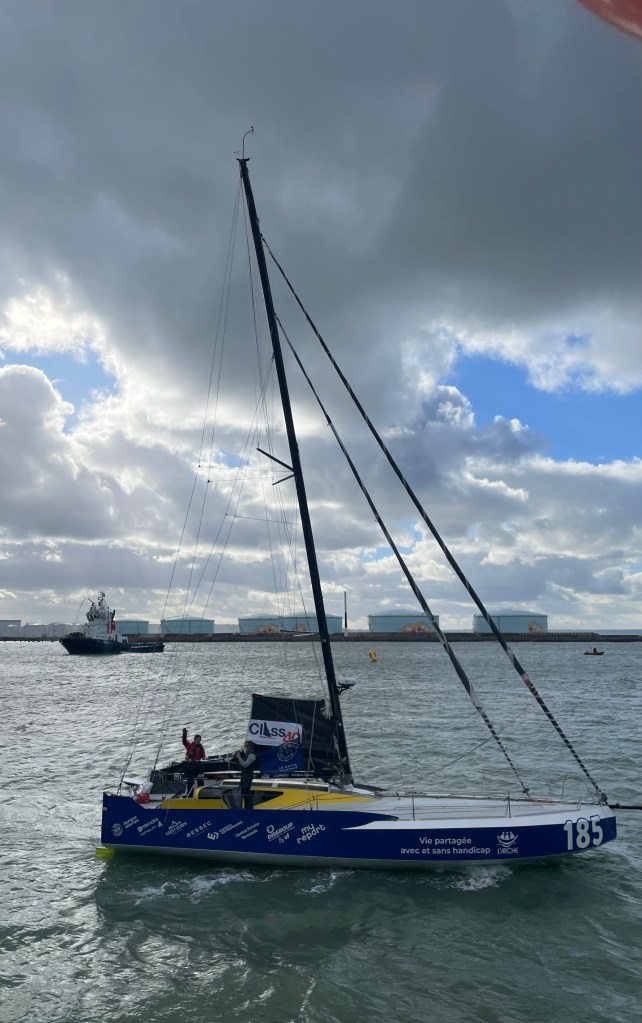
Under stormy blue skies and cheered on by the public, the sailors participating in the Transat Café L‘Or have left the port of Le Havre on Sunday, Oct. 26. The boats will head across the Atlantic Ocean, towards the goal of this year‘s regatta in Martinique.

The city of Le Havre has hosted this race for the 17th time this year. The regatta was created in 1993 and retraces the route of trading ships transporting coffee from South America to Le Havre, the biggest port to import coffee in France. The sailors compete in teams of two to be the first to reach their goal in South or Central America, which is newly picked for every race. 

With the race village set up right in front of campus, it has been quite hard for Sciences Po students to miss this event. During 10 days before the departure, the public was able to participate in several activities, learn about the regatta and admire the boats resting in the Bassin Paul Vatine. 

Embarking on a journey of solidarity

Among the many competitors is the team of skipper Sophie Faguet (38) and navigator Nicholas Jossier (49) who are participating in the regatta for the second and third time, respectively. This year, they are sailing in cooperation with the social organisations L‘Arche en France and Ellye.

For this article, I had the opportunity to accompany Faguet and Jossier when entering the Bassin Paul Vatine on their boat, together with a group of residents of the newly founded community of L’Arche au Havre.

With a rumbling motor the boat leaves the port of Le Havre, for the short distance the sail will stay rolled up in its cover. We are not far out at sea but we are still met with a strong wind. I can only imagine how strong it will be on the open Atlantic. 

While organising ropes on deck, Faguet tells me about her history in sailing. 

She grew up in Normandy, close to the sea, and started sailing when she was still in primary school. What she likes most about this sport is the connection to nature and the feeling of true freedom: “You can go wherever you want.” Looking out on the open water lit up by the setting sun, I think I grasp the idea. 

She participated in various sailing competitions for over ten years, becoming a full-time professional in 2019. Her next goal is to participate in the transatlantic regatta Route du Rhum in 2026. 

When asked about challenges she faced, Faguet mentions the search for financial support from sponsors. In this race she and her teammate Nicholas Jossier are sailing in cooperation with Ellye, a non-profit organisation that is engaged in educating people on cancer affecting the lymphatic system; as well as L‘Arche en France, an organisation that works with people with a mental disability, to create more visibility and solidarity for these topics. 

On the way to the Bassin Paul Vatine, she discusses the programme of the next days before the departure with the residents of L‘Arche au Havre. This cooperation started in 2024 when L‘Arche au Havre was still in development and Faguet participated in the Tour Voile, a regatta around the coasts of France, from the English Channel to the Mediterranean. In October this year L’Arche has celebrated its official inauguration, only a few weeks before the Transat Café L‘Or. The community consists of people with and without a mental disability who live together in a shared house, supporting each other in their daily lives. 

We have nearly reached our destination when we pass in front of the Sciences Po Campus and enter the basin through the open bridge. Students leaving campus now will have to make a detour.

“[The hardest part is] making the right meteorological decisions for taking the fastest route,” Faguet explains. The sailing boats in the regatta are dependent on wind and taking the wrong route can cost their team precious time. 

Especially this year, with storm Benjamin hitting France right in the week before the departure, the weather is not to be underestimated. The strong winds have overturned three trimarans in the English Channel that had already left on Saturday night, a few hours before the official departure. All of the sailors have been rescued, but they will not be able to continue the race. 

Nonetheless, both Faguet and Jossier are optimistic: “[…] I am sailing with someone I trust completely,” Jossier states in an interview with Le Figaro Nautisme. “Our strength will come from our ability to remain united and stand by our choices,” Faguet underlines in the same interview.

The boat with the number 185 comes to a halt at the very end of the basin and our small group leaves the deck. 

In the next days, Sophie Faguet and Nicholas Jossier will make their last preparations before leaving Le Havre to cross the Atlantic Ocean. 

Interview with Laurent Gayer: The Violent Fabric of a Megacity

by Le Xuan Yeo

A megacity is like a pressure-cooker — every building, every street, every piece of infrastructure has a part to play in intensifying the heat, both literally and metaphorically. Although megacities around the world are often lauded for their innovation and opportunity, beneath the glossy surface lies a far more sinister truth: a violent undercurrent that shapes the daily lives of millions of people. Therefore, what does it mean to live in a city where violence is built into the system, from its infrastructure to its economy?

This is one of many questions that Dr. Laurent Gayer’s lecture on Oct. 6, titled “The Violent Fabric of a Megacity”, sought to shed light upon. The lecture focused on his 25-year research in Karachi, and in particular, the city’s resilience amidst violence and economic turmoil. He explored how Karachi maintains a form of democratic order and economic prosperity. Beyond his findings, Dr. Gayer also shared about his research process and experiences living in Karachi. Here are some key insights from his lecture: 

The Research Process

All research must begin from somewhere, and for Dr. Gayer, this started from an enigma — something which goes against common sense, that surprises you and motivates you to delve deeper into the topic. If one is unable to solve the enigma, he suggests an attempt to strive towards an explanation of the enigma. For Dr. Gayer, the enigma he constantly returns to is how a city of 25 million people, which seems to be permanently on the brink of civil war and collapse, could nonetheless not only survive the decades of militancy, terrorism, sectarian warfare, gang warfare, but to some extent, also continue to thrive and actually found also resources for prosperity and democracy? 

He then conceived his work in the form of a trilogy. The first volume in 2014 discussed the disorder and the struggle for the city, specifically the political component that despite high levels of confrontation, a certain form of democratic order continued to reproduce itself and was never entirely at threat over these years. The second volume confronts the common assumption that capitalism requires stability and predictability to thrive, following the Weberian legal rational hypothesis. Dr. Gayer is currently working on his third volume, with his main informant being his co-author. This serves to acknowledge and put at the forefront the people he works with, as well as aiming to promote a more equalitarian kind of research when researching on the global side. 

On Scenes & Narratives

“Sometimes, what is the most striking, the most fertile is not necessarily something you see, something that you experiment, or in the way journalists work, a spectacular scene that would be interesting.”

Dr. Gayer highlights how he does not have personal anecdotes, instead, he works with ethnographic sources. Scenes in his work are not the product of one spectacular moment, but the outcome of familiarity he has developed over the years. From a conversation with his main informant over lunch that allowed Dr. Gayer to visualise so perfectly what transpired three years ago to his informant, to walking around Karachi, he has developed a much deeper knowledge of Karachi due to his extensive period working in the city. 

An important distinction Dr. Gayer makes would be between journalists and his work as a scholar. While journalists may work in the heat of the action to get their news scoop, Dr. Gayer was not there to expose himself. Beyond taking precautions in his fieldwork, he mainly worked through relations of friendship and confidence, working with people, as well as sought to revisit the stories of informants’ families as he believes in collaborative effort. 

Karachi and the Global Order

The built environment of Karachi bears the imprint of that violent city of various forms of violence. Violence intermeshes and materialises in industrial architecture, such as the textile factories that are reminiscent of prisons: they become death traps in fire accidents, the walls surveil the workers themselves, so that security architecture is as much inward as it is outwards, and thus it also shows this form of brutal accumulation through shared exploitation.  

What is most fascinating is how the guard belongs to a private security force managed by an official federal security force led by the army. We observe how capital and the violent brands of capitalism redesign the city with semi-official contracted partnerships with official security forces. This hence represents a deeply complicated, productive and repressive configuration.

Nonetheless, this circumstance is not specific to Pakistan. While Pakistan radicalises this form of gunpoint capitalism, it is only  a lens to look at the broader global phenomenon. This is also the story of global capitalism — the coercion we see today, like the US and its transnational predatory extensions right now is very emblematic. Looking into France where we are situated, the construction of the highly controversial Highway A69 is showing very similar trends to Pakistan. There is collusion between the kiafab, the largest pharmaceutical group in the region, which is the contractor behind that infamous highway project, suggesting how economic groups may control politics. 

Conclusion

Is there hope even with violence? Dr. Gayer has certainly heard many stories about Karachi. Some stories may be distressing, but others showcase moments of solidarity, of trust, bonding and generosity across boundaries, in ways that are more intense and unpredictable than ordinary situations. 

In our current world where the Global North is regarded as the paradigm of stability, success and development; perhaps what we need is to look at the South, to understand the forms of deviance from the paradigm. Symbolic violence still manifests in the Global North, be it internalised racism where minority groups are symbolically represented as inferior, less capable and even “dangerous,” or historical amnesia where nations downplay and forget the darker parts of their history, to reinforce a dominant national identity that avoids confronting historical injustices. To truly reimagine urban spaces all across the world would necessitate a comparative critique of the current global systems, that prioritise profit over human welfare, and a commitment to reshaping global inequalities. 

Defining the Sciences Po community: A note on Diwali and Halloween

by Anish Parcha

Image Credit: Emilie Leclerq

As a freshman at Sciences Po, during my first few weeks, I always wondered: what ties the 2As together? What makes them such a cohesive group, with every conversation among them reflecting positivity, engagement and curiosity. I looked from afar and analysed — maybe it’s the lectures, the collective struggle to get good grades or maybe the lack of space on campus, so as to keep seeing each other no matter where you are. This rudimentary analysis led me to constantly question: What defines the Sciences Po community? How is this vibrant, diverse, inclusive and deeply dynamic culture fostered and transmitted? And how can I perhaps be a part of this culture and reflect it, in my own way? 

My quest to find the answer ended when I witnessed it in its purest form, an experience of both immersion and realization. Through the course of celebrating Diwali and Halloween I understood what makes Sciences Po Le Havre a place like no other.

Starting the journey, an early spark: The night of Oct. 22 was perhaps an early initiation for me to find my answer. This time the hallways of Sciences Po echoed with sounds of awe as people described their elaborately constructed outfits; these overlapping conversations set the tone of creativity, cohesion and, most importantly, inclusion. I walked in a bit late when a few incredibly talented musicians from sciences po le havre’s classical music band LHarmony were performing ‘Danse Macabre’. I quickly found my seat and took a quick glance around the amphi to realise the sheer perfection to which everyone had crafted their outfits. To my left stood a spot-on Buzz Lightyear  from Toy Story, and to my right, a vampire with fake blood and fangs that looked alarmingly real. Strangely enough, through impersonation and fear emerged an unexpected compassion that united the entire student body.

The event was organised by numerous associations —  they curated a perfect student experience by embodying the spirit of Halloween, right from the incredibly petrifying haunted house to the blended decorations around campus. The famous sculpture “La Victoire de Samothrace” marking the entrance to Sciences Po was decked with cobwebs, symbolising the dynamism that runs through campus life — a community where birds gather not merely to rest, but to prepare for flight together through integration. Holistically, I finally found the first part of my answer! The fact that the community at Sciences Po is built through collaboration, curiosity and laughter—all of which were inculcated in the essence of Halloween.

Sustaining the community, a late surprise: Diwali, known to be one of the largest campus festivals, was celebrated in an incredibly decorated “Salles des Fêtes Franklin”. The Indian origin festival bloomed in an international setting. The atmosphere surrounding the event was brilliant, as I walked into the auditorium I felt a sense of cultural expression engulf me, every corner of the auditorium was reverberating with effort, grace and honest participation, all the students performing were frantically finalising their performance before getting onto the big stage. The Bureau des Arts set the tone for the event by defining the essence of Diwali through their perfect organisation, coordination, weeks of planning and seamless execution. The Bureau des Arts practically removed all organisational obstacles and made way for celebration contributing to a central theme of diwali being a culmination of happiness. I quickly headed upstairs to find my seat, with the words “Happy Diwali!” echoing through the auditorium. Over the course of the next hour, I witnessed sheer talent and creativity which left me in utter admiration for the cultural brilliance that I witnessed—from the rhythmic energy of the Bollywood dance to the poised grace of the Chinese dance performance, and the playful optimism of the musical theatre club. It’s rare to imagine such a harmony of styles and spirits in one evening within an auditorium in Le Havre. This is what makes Le Havre special, it’s not simply a city in northern France but within it lies a community that embraces global identity, harnesses diverse culture and celebrates life with friends who eventually become family. The progression of Diwali was a perfect representation of the bright lamps that were placed along the auditorium, representing light, happiness and vibrance. Every performance was followed by loud cheers and a strong wave of adrenaline flowing through the auditorium, so as to portray a constant wave of support the student body has for each other, when expression is complemented by belonging.

Finally, as the upbeat drums of ‘Uptown Funk’ played by the incredible band Mushulicious lit up the auditorium, I found my answer in its entirety with total conviction that the Sciences Po culture of building community centres on support, expression and energy, the kind that lights you up every time you see a familiar face on campus.