The Main Hall, Where East Meets West: “Formes” by Yiming Min

Photo by Nolwenn Voléon

“Formes” the sculpture by Chinese artist Mr. Yiming Min may combine the artistic heritages of East and West, however, it profoundly divides student opinion.

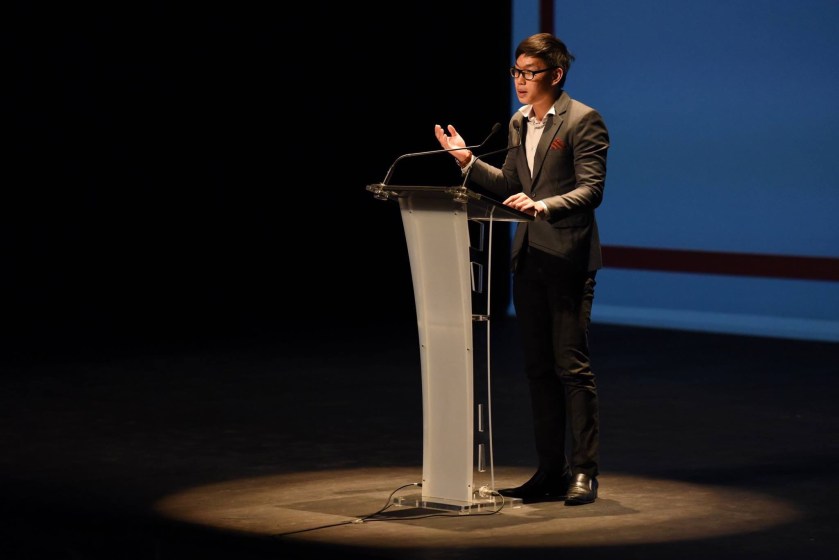
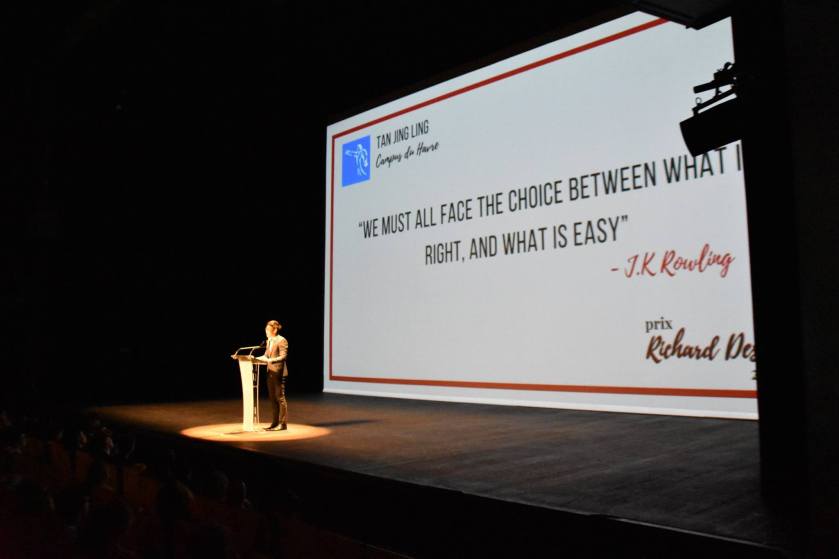
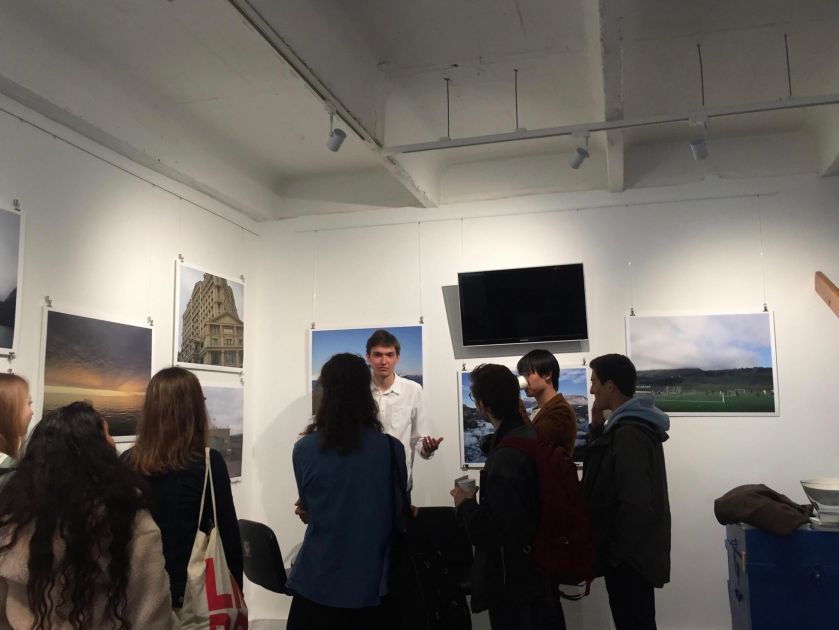
Mr. Yiming Min – the Chinese visual artist behind the sculpture that was installed in the main hall on February 8th, “Formes” – has displayed some of his artwork in London and Paris, and has also worked on an architectural project in Germany. In 2004 however, he shifted towards more contemporary art, seeking to deconstruct shapes and predefined perceptions, to allow us to interpret his work more freely. Formes first arrived in France in 2014 and was exhibited in Paris. It is heavily inspired by the Louvre’s Hellenistic sculpture of Nike, “The Winged Victory of Samothrace” this time, with an Oriental twist: pagoda roof-looking tiles fused with the feathers, on which porcelain doves give a military salute. After the inauguration of the sculpture, musical performance by students Mark Ma and Ziyu Deng took place to honor our prestigious guests. Then, in the presence of Dean Florent Bonaventure, representatives of the Chinese Embassy in Paris, and the Mayor of Le Havre, Mr. Yinming Min gave a talk to the student body in Mandarin, being translated live by student Meixi Zhang. The essence of his talk was his development of a comparison between Oriental and Occidental Art.

According to Mr Min, art in the Eastern world is more figurative, less realistic, and less scientific than it is in the West. Seeking to use Western techniques, he took what he called an impressionist approach to his work. This crux of his talk came down to the following sentence: Western art emphasizes on objective perception and accurate representation, while Eastern art concerns of the “whole picture”: the atmosphere, the imagery. The artist further showcased his transition from statues to his works in landscape and architecture. Mr. Min told us how happy he was about the increase in cultural exchanges between China and the West, as he believes these dialogues are as crucial as economic exchanges. We, as students on the Euro-Asian campus also have a role to play in these increasing cultural relations, and this was reflected in the way Mr. Min addressed the student body by saying, as a conclusion to his first speech, “The world is yours and the future is yours.”

Meixi Zhang:

“I believe that as much as our campus is honored to have Mr Min’s work showcased here, the work itself is quite crude. I do not appreciate how he considers Formes as the embodiment of the convergence and proof of similarities between Eastern and Western art. The simple reference to The Winged Victory of Samothrace representing the West, and changing the wings to resemble the traditional Chinese eaves does not, in my perspective, have much value and artistry in reflecting the ideas it claims to represent. During the Q&A session, someone asked why birds were included in Formes, why there were so many, and why they were posed as if it were saluting; Mr Min let out a crisp laugh and answered that he thought it would be fun.

There was another question raised by a Chinese student from a nearby University in Le Havre. She asked in genuine concern, what direction is the Chinese art world heading towards? She continues, saying that society has become to an extent, materialistic and superficial. How can art and artists stay true to themselves? This question pins directly to the heart of Chinese art turmoil. How can art, as a form of expression, survive in its true forms in a world that has no place for personal diverging expressions? Mr. Min was optimistic and vague, responding “I think it is heading to a very positive direction.”

Nolwenn Voléon:

“I walked into the hallway last Thursday and found myself having to stop. Something did not feel right. The usually open, bright corridor that I liked so much now seemed like it had been cut in two. Standing in my way was a brown statue with saluting birds, elevated on a pedestal and looming way above everything else to appear friendly. Other people stopped and we all shared our curiosity, doubts and observations concerning the cumbersome newcomer. Although confused as to what the artist’s intention was, I decided to give the statue a chance and wait for the explanation scheduled to take place in the afternoon.

I think that the whole reason of how the statue got to our campus remains rather mysterious. Why is this statue standing in our hallway, when it was given to the city of Le Havre? How long is it going to stay here for? While I believe we need more art to be displayed around campus, I also think the priority should be given to our students. We are gifted with a talented batch of students practicing their art in a variety of domains, yet visual artists don’t have the occasion to showcase their work as often. By doing so, we miss out on the artistic prowess of our fellow students who enjoy photography, writing, or other forms of visual arts; students who are not necessarily performers but have stories to tell, and images to share. During the BDA campaign, plenty of candidates expressed their will to provide a platform for students to share their personal artwork. While LDD has begun to display our artists’ work, it should also be a recurring presence on campus. I believe through whatever means possible, individual artists should have the opportunity to publicize their work to allow us to have the chance to get to know them and their artwork.”

But not all students have such a harsh opinion of the installation.

Alice Morisseau:

“I took some time to reflect on the meaning of this statue and ended up liking it. It is a singular and pedagogical embodiment of European and Asian cultural exchange. The “Winged Victory of Samothrace” is a direct representation of European culture: like the Joconde or the “Venus de Milo,” it has been celebrated as a masterpiece of ancient Greece sculpture since its discovery in 1863.

Mr. Min’s “Winged Victory of Samothrace” comes with a twist, namely bamboo-shaped tiles in its feathers, which are not really noticeable at first and come as a symbol of Europe’s subtle links with Asia. On top of the statue, little porcelain doves come to reinforce the idea. The artist seems to have put the emphasis on both culture’s art traditions: classical Greek sculpture for the West and porcelain for the East. As for the military salute of the birds, which the artist said to have put it “for fun”, I still like to see a link between the idea of victory and triumph that the “Winged Victory of Samothrace” embodies with the idea of military triumph for the birds.

I think that as our campus really embodies the link of Europe with Asia, the choice to put the sculpture in our lobby is logical. The fact that a famous and recognized artist would accept to have his production in our little campus rather than anywhere else in Le Havre is pretty impressive and shows that the spirit of the piece is in line with the one of our campus. What I like with this sculpture is that it conveys a message that is not totally blurry to us. Through some observation, it is easy to come up with subjective interpretations.”

Visibly, the sculpture has been a divisive topic on campus. Its location is less than ideal. Indeed, between cheerleading and Bollywood practice, the main hall of our campus has a functional use that is now being impaired. Indeed, students fear accidentally toppling the installation. Furthermore, the color of the clay sculpture, placed in direct sunlight since the hall has a glass roof, already seems to be fading. It is an honor for our campus to receive such a gift from the city of Le Havre, and the idea behind it truly does reflect the philosophy or our campus: intercultural dialogue, particularly between Europe and Asia. We will simply have to wait and see if students get used to its presence.

Nolwenn Voléon is a first year French student at Sciences Po Paris, Campus du Havre.

Alice Morisseau is a second year French student at Sciences Po Paris, Campus du Havre.

Meixi Zhang is a second year Singaporean student at Sciences Po Paris, Campus du Havre, and was the Mandarin – English translator for Mr. Yiming Min’s conference on Thursday, February 8, 2018.

Edited by Emma Dailey and Paxia Ksatryo.

(Not) in the Mood for Love?

Valentine’s Day: a taste of “la vie en rose” for some, a day full of cringe for others.

This Feb 14th – whether you’re ridin’ solo or cuffed – Le Dragon Déchaîné has you covered! Here are two playlists – one sweet and the other not-so-sweet – for both the lovestruck and those who bemoan your unnecessary PDA. Treat yourself (and perhaps your partner) to some holiday-appropriate jams. Hope you get up to some rom-antics!

01. valentine

For the unapologetic romantic, we present a collection of love-themed tracks. Ranging from the dreamy ballad to the heavy love confession, this playlist has got you covered – or not!

Open on spotify here

Cover by Marcus Cheah

02. enitnelav

Whether from its cliché or from an emotional sting, Feb 14 isn’t everyone’s box of chocolates. These songs will get you in the (anti-)mood: of heartbreak, apathy, or cautious optimism.

Open on Spotify here

Cover by Yilan Ling

Srivatsan Anand, Leesa Ko, and Maya Shenoy make up the music section of Le Dragon Déchaîné. Listen to their latest playlist on our music tab here

Maximizing Utility: The BDA Elections

The election frenzy continues at the Le Havre campus as the artistic bureau takes its turn in the spotlight.

(click on image to view full photo)

The twelve candidates have spent the week relentlessly campaigning, communicating their ideas and demonstrating their various talents. As past Minicrit results have shown, the arts are the heart and soul of our campus. The Bureau des Arts (BDA) is instrumental in bringing our campus together. To help students better evaluate which candidate is most capable of promoting campus unity, the incumbent BDA has posed the question, “What will you do to tear down cultural barriers, and how can the BDA best promote artistic and cultural life in and out of campus, given budgetary, academic, and logistical limits?”

As so aptly stated by Emma Durand, “The BDA has a duty on this campus, beyond coordinating clubs and organising events, to create an atmosphere of acceptance, of kindness and of openness, in order for everyone to be more inclined to let go of their initial fear, and show their vulnerability and their passion.” This atmosphere epitomizes events held by the BDA; from Diwali to Chinese New Year, and Christmas to BDA night. Ayano Goto elaborates on the “sense of bonding that came from the respect and kindness that I believe each one of us have on campus.” Amber Dave says with conviction, “To tear down cultural barriers I would work towards making people of (different) cultures feel included because there are some minorities that are indeed under-represented and so the BDA could organize events on days of festivals of these communities that require no to minimal funding.”

But a majority of candidates have also expressed a desire to hold more small-scale events. Indeed, Jane Chan, Emma Durand, and Evgenia Ivanchuk present the idea of having presentations of the diverse variety of cultures on campus to fuel intercultural dialogue. Sarah Maaz promotes the idea of “small cultural festivals where people of different nationalities could show us more about their countries.” Nolwenn Voléon states that “some students are very good at writing, drawing or taking pictures and I want to provide a platform for them to be able to display their work more freely if they wish to do so; (and to) be able to host their own workshop to share some talent or technique they’re passionate about (e.g. origami, watercolor, calligraphy).” Furthermore, Camille Geneau elaborates: “differences should not be barriers but opportunities to share our tradition, to learn from one another and to open our minds.” Evgenia Ivanchuk suggests more LDD involvement, publishing more culture-oriented articles, whereas Pailey Wang proposes “intimate evening musical performances after class” to unwind after a long day. Monthly displays of visual art suggested by candidates including Cassandre Rohart, and Camille Geneau. Vinzent Wesselmann and Nolwenn Voléon stress on how more emphasis should be placed on the “non-performers”: the authors, poets, and visual artists. The latter suggests having an anonymous gallery to provide a space for the shyest among us. These exhibits would not only be a way to get to know our diverse artistic community but also allow us to further communicate with local university students. Getting other universities involved, much like getting more students involved, would require active promotion.

According to Fiona Beraud, “Promoting culture can be easy. You can make flyers, Facebook posts, posters…” Pailey Wang remains pragmatic and states, “I have a lot of practical skills in sound systems, video editing and photo editing which would be very useful for running and promoting our campus events. I am very concerned with ensuring that the diverse artistic output of our campus is shared and promoted on campus.” Furthermore, creating more videos and making them more easily accessible would prolong this feeling, and conserve the memory of each event. Vinzent comments, “I want us to be able to remember our performances in all of their glory. The first step for this is to implement a backup camera for all performances in order to ensure that no recordings are lost as they were last semester. Then, I’d like to work with the photography and film-making club to create short after movies for each large BDA event that capture the ambiance of the night through little interviews and behind-the-scenes shots that we can fondly remember in years to come.”

Interestingly, three candidates, Amber Dave, Sarah Maaz, and Cassandre Rohart, suggested cultural diplomacy through food. Amber Dave would encourages intercultural interaction through food served at BDA events. He elaborates and says, “All these are varied and diverse ideas to break down cultural barriers on campus and one or multiple of them can be used and show promise of being effective.” Sarah Maaz complements this notion by stating, “I would like to organize (and encourage other students to organize) cultural and cross-cultural dinners. To me, the conviviality of a dinner is the best way to open the dialogue and discuss.” Cassandre Rohart would “make daily cohesion and contacts better. Organizing a weekly-shared meal between 2 or 3 people, from different countries (on a totally voluntary basis) would make them share original recipes, ingredients, and memories together.” To promote French culture, Sarah Maaz would implement “more French cultural visits: we do have the artistic side (MuMA, the port, Le Havre’s architecture…), but in order to provide the “French cultural experience” to international students, I would love to take them to wine and cheese caves, visiting farms (Normandy is a region that is mainly agricultural and has a fascinating cultural patrimony!) or even medieval villages.”

In addition to appealing to the stomach, candidates have other ideas to appeal to college students. Camille Geneau stresses the importance of a clearer schedule for the rehearsal spaces, to make it easier to plan around our busy schedules. She would also set up a book exchange program, to make access to a wider variety of books more easily available. Fiona Beraud would set up a more material reward system, an “art membership card”: “Just like when you go to Wok-Up, you would get a BDA stamp on your membership card if you can provide proof you went to the museum, the theatre etc. Anyone who finishes their card could get a reward (free tickets to shows? free piece of art? Credits (!!)? Who knows ! Let’s get creative!)”

Overall, it is comforting to see that students standing for election are generally on the same page. This includes frequent, small-scale events centered around promoting multiculturalism, student-led workshops, intimate concerts, and temporary expositions. Furthermore, there are a plethora of interesting new ideas that could energize our increasingly diverse campus. Tomorrow, students cast their votes, and we hope that they vote with their ideal bureau in mind.

Emma Dailey is a French-American second year student at Sciences Po Paris, Campus du Havre.

Edited by Paxia Ksatryo

Time Away

Find the full playlist on spotify or listen to it on our website here to follow along aurally.

As much as I have been enjoying my life in Le Havre, some time away was in order.

Since college life hasn’t permitted me much time for introspective contemplation, I decided to travel alone for fall break. In fact I went 3 days without a conversation. To fill this silence and thereby prevent my absolute dissociation from the world, I listened to a handful of songs on repeat which I will include here so as to immerse you in my state of mind.

Day 1

“Don’t Come Home Today” by Good Morning

After barely making my train, most of my first day of travel was spent reading Murakami and trying to figure out what the hell I’d be doing for the next 4 days. Arriving in Brussels, I realised that this was my first time truly alone, a feeling that was just as much empowering as it was nerve-racking.

Exhausted from a day in transit, I only briefly walked around the city to get my bearings for the next day.

Day 2

“Hiding Tonight” by Alex Turner

This morning set my week-long habit of getting breakfast at quiet, cozy cafes and taking an hour or two to savor my coffee over a book, a real juxtaposition to my usual routine of scarfing down my morning oatmeal before 8 a.m. French.

After, I headed to the Musée Old Masters, and spent a while wandering through its ornate galleries before sitting down to gape at the Wes Anderson-esque grandeur of the building itself.

Then after sitting in a park to contemplate life’s questions over a cigarette, as one should, and visiting the Musical Instrument Museum, I ended up in a tearoom for my final moments in Brussels before getting on a train to Amsterdam.

“It’s Alright” by Horsebeach

Perhaps to assuage my anxiety over the fact that I was on my train without a ticket (damn you, non-mobile tickets), I listened to the song above in an attempt to convince myself that “it’s alright, you won’t get kicked off the train into the darkness of the Belgian countryside”. Thankfully, I made it to Amsterdam in one piece, tracked down my beloved falafel for dinner, and passed out on my hostel bed.

Day 3

“Lights Out, Words Gone” by Bombay Bicycle Club

On this day I was blessed by a free sinfonietta concert featuring works by Debussy and Satie at the Concertgebouw, followed by an incredible visit to the Stedelijk Museum of modern and contemporary art, just across the road. Though it was my first time in Amsterdam, I couldn’t help but feel at home strolling through the art museum, as I had often spent my weekends doing the same when I lived in the San Francisco Bay Area.

After an arts-filled morning, the rest of the day was spent getting lost in Amsterdam’s iconic canals, indulging in street food and paying visits to the city’s euphemistically-named “coffeeshops”.

Day 4

“The Noose of Jah City” by King Krule

Greeted by a foggy and slightly chilly morning, I made my way to Hortus Botanicus, one of the world’s oldest botanical gardens dating back to 1638. Though still in the city center, I felt refreshed being surrounded by such lush greenery, something that our beloved Le Havre could do with a bit more for my liking.

After a filling lunch over several chapters of The Wind-Up Bird Chronicle, I spent my final hours in Amsterdam going to, you guessed it, another museum. On this afternoon I went to Foam, a museum dedicated to photography, and after, grabbed a pint with someone from my hostel before my lovely 7 hour overnight bus ride back to Paris.

Back in Le Havre

“Home at Last” by Homeshake

In retrospect, my days away were just what I needed. Besides serving as a break from a hectic first semester of university, it was a time of reflection and self-examination, something I think we can all reap the benefits of in this developmental and ever-changing period of our young lives.

With that, I leave you with two reasons why you should solo-travel:

  1. it’s truly an experience of self-discovery and acknowledgement
  2. you are completely independent as you make every decision. In other words, I got to eat stroopwafel three times in one day without hearing anyone complain.

“Checkin’ Out” by Sales

L.K.

Find the full playlist on spotify or listen to it on our website here.

Leesa Ko is a first year American student enrolled in the Sciences Po Paris, Campus du Havre and Columbia dual degree.

Edited by Paxia Ksatryo and Pailey Wang.

The ‘Association Sportive’ Elections

The AS Phoenix will be reborn today.

(click on image for full size )

As election day draws near, students of the Le Havre Campus of Sciences Po will have nearly finished forming their opinions on the plethora of candidates competing for their favor. In the interest of keeping the citizenry informed, we have asked all ten Association Sportive (AS) candidate two questions, sourced from the association themselves. They reflect the greatest concerns of the current AS members, who have a better understanding of the reality of association life than anyone else on campus, about the future success of the association. These questions about the duties, functioning and main challenge of the Association are as follows:

  1. Leading our campus to victory is one of the pivotal objectives of the AS. However, we have very limited access to resources in terms of venue, coaching and training time. In your opinion, what should be the AS role in improving the situation, so as to better facilitate the preparation of the teams for Minicrit?
  2. In your perspective, what is the biggest challenge the AS will face during your mandate and how do you propose to sort it out?

According to the Sciences Po Le Havre campus official website, the AS is a permanent association under the 1901 French law. Its mission is to create an active and inclusive athletic community on campus, but also to facilitate access to health services in Le Havre. During the year, it is to organize friendly matches with the Université du Havre and other local teams. At the end of the year, it is to present teams to compete in the Minicrit, or Collégiades de SciencesPo, an athletic and artistic competition between all Sciences Po Paris undergraduate campuses.

These are the bare bones of AS duties, but as the students are well aware, our association members do so much more. From providing us with our beloved blue hoodies and keeping the lunch-room stocked with tea, to coordinating the Ski-Trip, WEIS, and Minicrit, all while continuously boosting campus moral, it is now up to us to ensure that the baton of responsibility is passed on to the right combination of five dedicated and able students. The spirit of Achilles Shields must be reincarnated much like the Phoenix in its logo. To aid in this collective decision making, we have based the article below on the answers of all ten candidates to our two questions.

1 – Leading our campus to victory is one of the pivotal objectives of the AS. However, we have very limited access to resources in terms of venue, coaching and training time. In your opinion, what should be the AS role in improving the situation, so as to better facilitate the preparation of the teams for Minicrit?

  • Coordinating club captains, locations and coaches:

To better facilitate the preparation of the teams for Minicrit, the candidates all seem very focused firstly, on coordinating clubs to help captains find coaches and places to practice. Léa Leyfsword states that “The AS should make the connexion between sports captains and venues easier so that they can book fields more often when they need it and therefore be better prepared for the Minicrit. It should also make it easier for anyone who wants to start a club to find a coach and place.” Miyu Shu also states that “the AS needs to continue working towards establishing long-term relations and networks around Le Havre with local sports facilities, schools, and universities!” Yuqin Luo continues “AS will have a supportive role to the clubs. The association should support clubs by helping sports clubs to find ways to extend their training time and to negotiate with the gyms. Despite negotiating with gyms, we are also going to provide plan Bs such as organizing running sessions for the sports clubs and people on our campus. What the AS should and can do is not to help clubs be better at sports but to provide them with a good environment that they can improve.”

Kalinka Le Goff also reminds us of the key role the AS has in helping organize a sports schedule free of clashes, so that our students may involve themselves in as many sports as they please. Kokoro Osada summarizes and highlights the issue by stating: “One of the main concerns that we had at the beginning of the year with the sports teams were to begin the practices itself. The captains were responsible for everything from finding a coach and reserving a field. The AS should lighten these burden (…) Practices are sometimes canceled, often due to a sudden change in the schedule of the field or the court. The AS could work against this by helping the captains prepare an alternative time and location. I also think that a list of all sports teams and its location/time of the training should be made for clarification. The AS could work somewhat as a headquarter for all the sports teams in the school.” Finally, Marius Andioc values taking action as soon as the year begins: “what could have been done to coordinate clubs for the Minicrit with regular meetings could be done from the beginning of the year to be sure that everything goes in the right direction.”

  • Boosting Student Involvement:

Finding coaches became a difficulty for the AS last year when the SciencesPo administration decided that sports credits would only be accorded to clubs with a professional coach. This purely bureaucratic and insurance-related decision put many successful clubs with no need for external help behind in their organization and training. Furthermore, none of the Le Havre dance clubs are eligible to be credited. In future, this may lead to waning participation. Indeed, assiduity has visibly decreased in the institutions that are Bollywood and Chinese Dance. The new AS, like the old, with have to work harder than others in the past to keep our divers, LH specific clubs alive. Most candidates pledged themselves to increasing involvement in sports.

As stated by Kseniya Redka: “The main focus should be made on increasing the competitiveness of the campus and encouraging more people to join the sports clubs. This can be done through more numerous events like matches between local LH teams and ScPo, because it will give a sense of what is it like to play against others. Also perhaps by recruiting more people for participation in the sports clubs, captains will be able to form more of smaller teams during the practice to compete against each other. For the Minicrit team, establish clear attendance guidelines and set the objectives of each session, as well as providing AS with the evaluation of the course progress on the regular basis (every quarter of the semester).” Marius Andioc also emphasizes the importance of campus spirit: “a big part of AS job would be preparing next year’s minicrit by advertising students about it, how it matters for the campus, club commitment when you’re part of a team etc.” Finding ways to increasing budget is also one of the main solutions, along with increased coordination between team captains, practice locations, and coaches, to limited access to resources in terms of venue, coaching and training time.

Candidate Marcus Cheah commented on the link between this involvement and association finance: “I feel like in the long term for major future developments, we will require a certain increase of funding to solve the problem of limited resources, however, that only would be made possible if our teams are able to prove that we are worth acquiring those funding. So, it becomes a cycle of how we would need more funding and resources to get more victories, and we would need more victories to deem ourselves worthy of more funding. Hence, my opinion is that AS’s role starts from raising the athletic spirit on campus in order to encourage everyone’s full participation on sports teams. Also, I would like to strive for more casual pickup matches with everyone on campus at accessible locations like the beach basketball, volleyball courts etc., such that everyone could get more into sports.”

  • Making the most of the AS budget:

But an inexpensive way to increase the amount of training for a little fee is to compete against local student teams more often. As stated by Hiroki Yamashita: “A.S role is to be a resource for sports and health for everyone. Considering preparation for Minicrit, the sports team in Sciences Po currently has two major problems. One is lack of participation and the other is lack of training time. The first problem roots form the fact that we don’t really have practice games in a competitive way other than WEIC and Minicrit which leads lack of motivation. Thus, A.S. can negotiate to set a practice game with other schools such as the University of Le Havre.” Léa Leyfsword also believes that the “AS has to be an intermediate with the other student sport committees of LH in order to organise joint events (eg. Match amicaux) with other student teams in LH (or amateur teams like the Dieselles in feminine rugby for example),” along with Miyu Shu: “The AS can make sure to lend a hand to the captains in this respect and become the bridge between our sports teams and the teams of other universities in LH!” The benefits of the policy are also emphasized by Mia Raichon: “most of all, what I want is to organize sportive events and meetings between our teams and those of other schools in the city or LH university. As a beginner in rugby this year, I progressed and understood the game a lot more during the WEIS than during the whole first part of the semester. Then, put teams in a situation with some “LH tournaments” should make our teams ready to beat all the other campuses, without getting in trouble with the admin!”

The question of increasing budget come down to lobbying the administration and is therefore not entirely in the power of the AS. We therefore greatly appreciate the alternative suggestions by all candidates. Mia Raichon states that “It’s clear that there are huge differences between campuses concerning the place occupied by sport in the academic path. But what is a the core of success and victory is the motivation of players, and it’s something that LH has. So, what we need is more training opportunities for sports teams all along the year. The truth is that high-sport-level is not coming by itself, and team-sport captains can’t do everything alone to lead their team to victory. I really want to talk to the administration team about increasing the sports budget. But, I guess that previous AS has already tried and we still don’t have enough infrastructures, coaches or afternoon reserved for sport yet as other campuses (Nancy for example). If we face another refusal from the admin, then we still can do some simple things to make the difference. Thus, the AS role should be to help captains to organize some extra-practices, or why not professional-game-screenings with all the team to work on the technicality of a specific sport, determine strategies etc.”

Hiroki Yamashita continues: the “cheerleading team is managing to have more than one practice a week, while most of the other clubs have only one. So it is possible to manage both school work and several practices a week. But when this problem is due to training place or resource, the team has chosen to work out or do the weights if they want to have more practice. However, SciencesPo does not have the equipment. Thus A.S can help the team by providing a training equipment or training menu which uses only one’s body in order to make it easier to have more than one practice a week.”

Overall, candidates will need to focus on coordinating club captains, locations, and coaches, boosting student involvement and making the most of the AS budget whether they manage to increase it or not. But keep in mind that once again, these are the bare bones of As responsibilities, and a successful AS must be willing to go above and beyond.

2 – In your perspective, what is the biggest challenge the AS will face during your mandate and how do you propose to sort it out?

Marcus Cheah cites having enough participation to boost the budget: “I think the biggest challenge we will face is the exact problem of not having enough money to carry out our events, whether it is due to students not willing to cooperate and pay assoc fees, or because the school is not providing sufficient funding. Which is why, I propose to enforce the policy of “no fees paid, means no activity participation allowed”. On top of that, I hope that by starting off events small with lower expenses and in more of a “pilot scheme” form; and as times go by we will accumulate more funding and participants would gain more interest. Then, more money could be focused on producing a full form of that event in the end that is better organized and in-depth than the previous pilot one. This ensures more participation in the event as long as less financial problems and issues.” Furthermore, as Marius Andioc states: “It depends on which scale we think. The minicrit is going to be of course a huge challenge for the AS, and then what I propose could be applied. However, on a more student life scale, the AS presence is another big challenge to sort out. AS could organize more often events related to a sport that could include everybody: athletes, people who are not into sports to make them get along with it, curious people etc. “Sports discovery” events, which would consist in making discover a sport to people every one or two months.” Hiroki Yamashita focuses on general organizational aspects: “A.S organizes many events such as “amazing race” at the beginning of the year and the amount of the work increases especially before those events. The biggest challenge that A.S will face is the time deadline to organize the events. Especially events that require payment needs interaction with other students before the event and it could be a one reason for delay of the work of A.S. To improve the situation, A.S can post a calendar which shows upcoming events and payment deadline for those event and make the interaction between the association and students smooth by providing clear view of what kind of events associations are planning.”

The majority of candidates by far, however, mention the Minicrit as the greatest challenge to face the AS during their mandate. It is our opportunity to shine as a campus and showcase not only our artistic and athletic abilities on home-turf but also our city, Le Havre, as well as our creativity and dedication, organizing around challenges. Léa Leyfsword, Kokoro Osada, and Kseniya Redka both plan to overcome this challenge with a methodical approach to the problem, with early preparation, a clear schedule and an even distribution of tasks. Kalinka Le Goff instead emphasizes the teamwork aspect of planning this event: “we will sort it out by working as a team, sharing our ideas and our expectations.” Mia Raichon also focuses on the MiniCrit as our greatest challenge, and cites her experience biking at a National and European level, “ I admit that I haven’t ever organized such a huge event but I know from my experience what are the expectations of a competitor. (…) Before I felt lucky to represent my country as a competitor, now I would be so proud to represent my campus as an organizer.” Miyu Shu offers a focus on teamwork, funding, and organization as solutions suggested concerning what she tentatively called “SushiCrit.”Furthermore, in addition to negotiating training times, and organization like the aforementioned candidates, Yuqin Luo would focus on having high-quality communication, and “Reduce cost or earn more. Reduce cost can be in two ways: find cheaper resources and find a resource (might need as to help promote as well and if we do so we might have a permission). Earn more in two ways: set a portable market and sell drinks, snacks and souvenirs or to provide discount plans to campuses(like entrance fee in addition to a plan for drinks and snacks)”

After reading these interview answers, along with the candidate manifestos and posters, we hope the campus will feel more informed as a citizenry and will be more confident in when casting their ballots on Friday, from 9 AM to 6 PM. In the words of Loretta Lynch, “Voting is the expression of our commitment to ourselves, one another, our country (university) and this world.”

Emma Dailey is a French-American second year student at Sciences Po Paris, Campus du Havre.