To Speak or not to Speak

From asking a question to giving a presentation to Prix Richard Descoings, the fear of speaking never leaves. The finalist of Richard Descoings shares his fear of speaking and his speech about fearing.

I stood against the blinding darkness. My words precipitated at the tip of my tongue. All things froze for an instant before my speech as I took in the deafening silence.

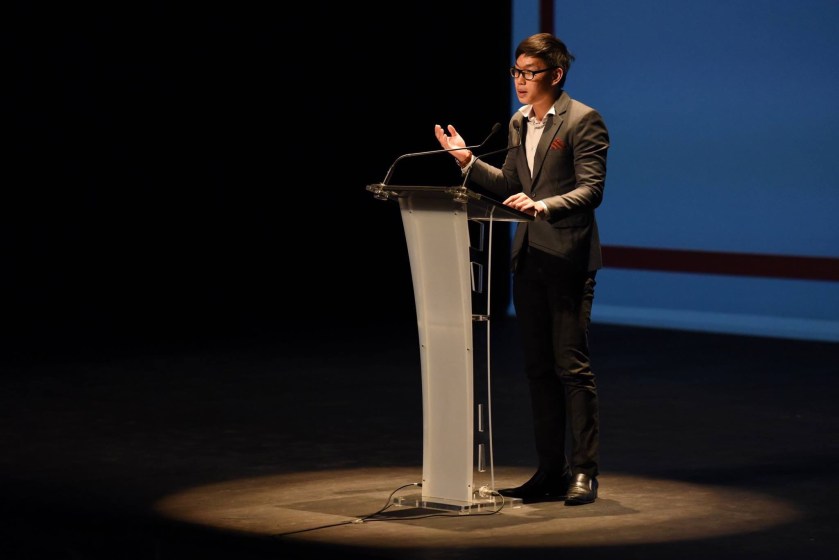
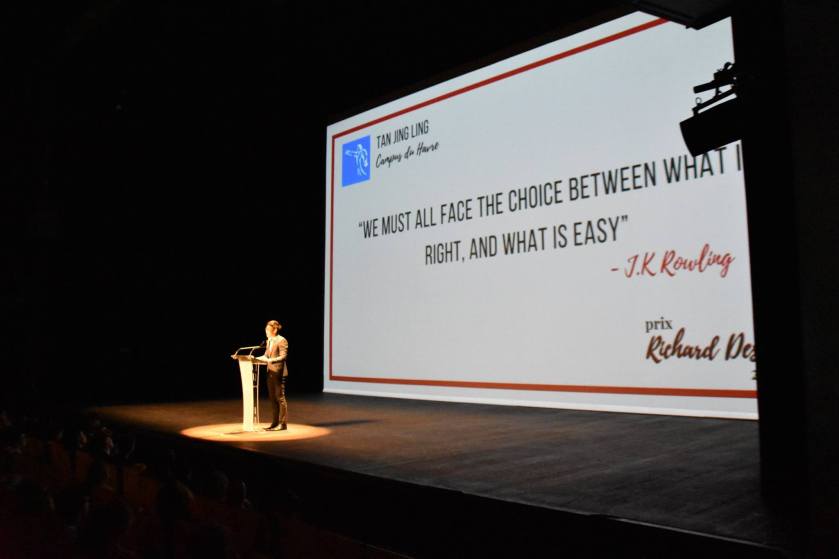
I was in the Theatre Auditorium de Poitiers, which sits 1000 people. It was the final round of the Prix Richard Descoings. I carried with my every word the reputation of Le Havre.

Every February, Sciences Po undergraduates gather together for the Prix Richard Descoings, an oratory competition to select the most eloquent English and French speaker from Sciences Po. I took part in the English category while Salomé Cassarino represented the French category.

Predictably, someone who made it past two rounds of a public speaking tournament would be perfectly comfortable on a stage and under the spotlight. I am not. The fear of speaking is perhaps the most understated fear in modern society.

This fear is silent: it is the unsaid words that built up in my lungs. It is the scrutinising eye contact of those looking, the prolonged silence before speaking, the deoxygenated air breathing. It was this fear that I carried from Le Havre to Poitiers – a fear that grew with the stakes.

In the waiting room on D-day, it was this fear that united the speakers from each campus – each clutching their script and pacing in quiet momentum. When asked, each would tell you that they are not nervous, and you would believe them. After all, they are representatives of eloquence. Yet, as the clock ticks and each speaker’s turn to speak approaches, you will see the little droplets of sweat forming at the fringe of their foreheads.

The fear of speaking is perfectly normal. Receiving the prompt: “we must all face the choice between what is right and what is easy,” a quote by J. K. Rowling in Harry Potter and the Goblet of Fire, I decided to speak about speaking itself. I decided that the steps that led me to Richard Descoings were all choices I made between what is right and what is easy. Here, I share that choice, that fear, and that speech:

[Start-of-speech]

“To speak, or not to speak, that is the question. When I open my mouth, and these words flow into your ears, in this particular order, every syllable, every movement of my lips, my tongue, every eye contact, every molecule in my body is making a choice.

You see, we are not just atoms. Words are not chemical reactions. Standing up here is not part of natural selection.

To speak is to put my life story up on the podium, where I can no longer control the reaction, the interpretation, the direction of where and how I want to hear – me. My story is my choice, but when I speak, I give this choice to you: to be silent, to clap, to laugh, to mock, to ridicule, to open your ears but not listen.

To speak is a choice. But, to speak is the 11-year-old me sitting in my class, with my teacher asking: “do you have any questions?”, and my thoughts formulating, my palms sweating, my arm not raising, my heart beat racing. I wanted to ask a simple question…but I could see the audience, the microphone that amplifies my imperfections, the spot-light of failures, the stage of my fear. All on me as I stood up and asked one…simple…question. And it was always this one…simple…question, that I rehearsed in my head, over and over again, and perfected in the exact same intonation that echoes but will never be heard. And the class is over. And I keep this question for tomorrow and tomorrow and tomorrow. Because speaking is a choice…but is it really for the ones who can’t be heard?

At 16 years old, I had to give my first class presentation. I knew I must face the choice between what is right and what is easy. At least now, questions could be whispered in tiny pockets of mid-air suspended confidence, before it deflates like a balloon, as my face reddens, when my teacher says: “wow, that is a stupid question.” How then am I supposed to hear nothing but the silence of my voice for 300 seconds? How am I supposed to hear myself when I can only hear you and your loud mental judgement as I stammer…as I stammer…as I stammer…as I stammer…as I stammer? How can you say speaking is a choice when I don’t have the choice to be heard?

At 21 years old, I made a choice between what is right and what is easy. I joined a competition and it is my first time speaking to more people than in a classroom. I listened to hours and hours of “I have a dream” and watched myself in the mirror, until fear was so used to being in my veins that when my mouth finally opened, fear flew out like a butterfly ready to escape from a cocoon. I am still the 11-year-old with my thoughts formulating, my palms sweating, my heart beat racing. I am still the 16-year-old with mid-air suspended confidence in a tiny pocket of 5 minutes, before it deflates like a balloon, again.

You see, when I open my mouth, and these words flow into your ears, in this particular order, from beginning to end, from end to beginning again, every syllable, every movement of my lips my tongue, every eye contact, every molecule in my body is making a choice that is anything but easy.

We must all face the choice between what is right and what is easy. And today, I choose, to speak.”

[End-of-speech]

To speak or not to speak? The answer is yours.

Edited by Philippe Bédos & Maya Shenoy

The Le Hood Chronicles: Oh Lord, Not the Board

I was free. The crisp, fresh air of Normandy nipped at my face and rushed along my thick down coat as I sped along the boardwalk of Le Havre. Locals tried not to stare as they saw such a big boy show such mastery of a skateboard so small, but I’d gotten used to the fame by now. It didn’t phase me anymore. Last time I’d been this far, I fell down by the hair salon I now visit twice a month to keep my hair just long enough to cover my eyes without blinding me completely. Now, I raced down that street without blinking once, confident as I rode over the very spot I fell on months ago. I was a tank moving over the rubble of my failure, crushing every piece of disappointment as I found my way back to my dignity. I gained more and more speed, my heart racing at the thought of falling with nothing but my $100 Canada Goose toque to protect my fragile head. Suddenly, I was whizzing past La Petit Rade. I’d never been this far before. I slowed down as kids skated by me on the new multicolored Pennyboards they had gotten for Christmas. That’s when I realized I wasn’t the only skater in this part of town. A boy of about 12 years of age raced by me, looking back to grin at the man twice his height lagging behind him. A deep sense of shame began to churn inside of me, but I wasn’t going to let it get me down. Not this January 4th. I continued along at my own pace, not faster than a jog, when, suddenly, it happened.

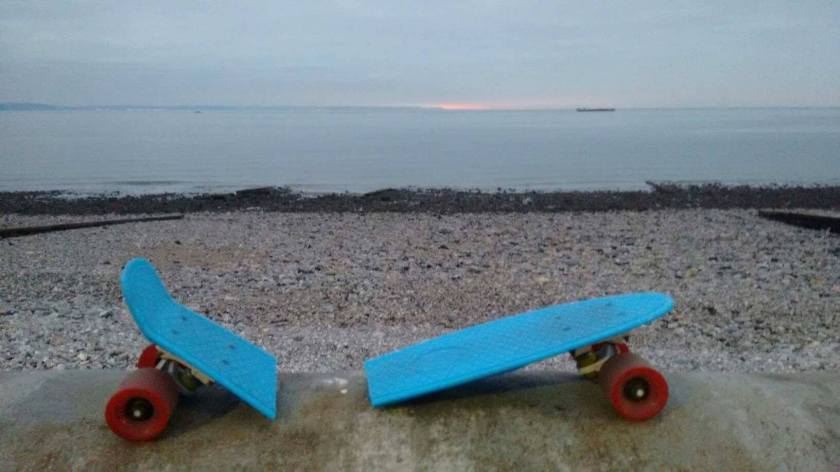
My back wheels got stuck in a crack but instead of the board stopping and throwing me to the ground again, it sacrificed itself and split in two!

It was a truly noble act which I may never be able to repay. Heartbroken, I picked up the two pieces of my board and set them next to me on the ledge looking out to sea as the sun set behind us. An elderly couple walked by and asked “mais qu’est que s’est passé” to which I replied “C’est triste, mais ça va”. But it wasn’t ça va. I grabbed my two pieces of plastic polymer and walked down the path that I had just gleefully skated down minutes before. People stared at me once again, but this time not in awe. As they watched the funeral procession of one, they looked at me with sorrowful eyes. Maybe they too were once skater bros like me and had lost their board to the fury of the natural world. Or maybe they saw the broken heart of the skater boy who lost his very identity in the simple snap of Chinese manufactured plastic. Either way, they wouldn’t understand. But when I got back home, I put the pieces of board on my table and smiled. Maybe the journey with my red-wheeled board was over, but my own journey as a skater boy wasn’t. So I sat down, got out my laptop, and ordered my first pair of checkered Vans. As soon as I confirmed my order, I felt the rush of rolling over concrete come back to me and I knew my life had found its path again. Once a skater boy, always a skater boy.

Leon is an enigma.

Gilets Jaunes: the fire that sparked a debate

Following the prolonged Gilets Jaunes protests, students of Sciences Po Campus du Havre weigh in on the legitimacy of the movement in a deeply divided debate.

With a burning fervour, the Gilets Jaunes protests scream not only along the streets of the Champ de Mars in Paris, but echo along the corridors of Sciences Po Campus du Havre, as students—French and international—exchange opinions on the subject between classes, sometimes amicably, sometimes assertively.

Initiated by student representatives, a debate was held on 4th December in the amphitheatre of Le Havre campus, following a weekend which saw the popularly backed protest spread its way down the streets of Le Havre in fire and fury.

The debate saw a full house of all nationalities of students, eager to put forth their thoughts on the hugely controversial issue that transpired right outside their residences, weighing in on the legitimacy and effectiveness of the movement.

In this article, Le Dragon Déchaîné summarises some of the key issues raised in the debate:


Proponents of the movement, vocally advanced by several French students, opinioned that the protests should not be evaluated solely on the basis of violence inflicted by protestors; rather, one should also consider the systemic violence inflicted on the protestors through systemic socio-economic alienation by president Emmanuel Macron’s “socially and verbally violent policies.” Implied here was that the damage caused by the protests—which is estimated to be €3-€4 million as of 1 December—was incomparable to the damage of systemic inequality.

On the other hand, opponents, largely led by international students, called out proponents with the logical fallacy of “whataboutism”: suggesting that the violence inflicted via unequal socio-economic policies in no way negates the violence inflicted during the protests. “Two wrongs don’t make a right,” said one student who counter-proposed that there are many feasible alternatives to violent protests, as seen in other democratic regimes like Germany.

To this end, proponents rebutted that it is the very violence of the protest that captured the attention of the media and of the government, pointing out how peaceful protests gain less attention in France. Perhaps then, prime minister Édouard Philippe’s concession—to suspend the fuel tax rise that sparked the protests—was a sign of the political might of the protest. However, most in the room were unanimous in condemning the violence of the protest.

Nonetheless, there is a long road ahead for both protestors and democratic discourse. Opponents emphasised on the glaring lack of representatives and leadership in the movement as well as the lack of clear, focused objectives. One student commented that there is no end in“protesting for the sake of protesting.”

As with the Gilets Jaunes, uncertainty hung in the air as the debate came to an end, but not to a close. On first principle, there was an irreconcilable difference between the rights-based proponents that focused on the right to violent protest in the face of injustice and an unresponsive government, in contrast to the opponents’ utilitarian argument that focused on the futility, lack of direction and extensive damage of the protests.


Despite the announcement to reverse the rise in fuel tax, protestors have vowed to maintain their movement. The flame lingers and the discursive scrutiny continues in what may be the most consequential lesson in politics yet.


This article does not necessarily represent the views of the editors or Sciences Po.


Impostor Syndrome

It was a bright, cold, August afternoon in Le Havre and the clocks were striking one. New Sciences Po students were rushing to their future campus. But as they started talking to their peers, many realized – that there must have been a grave error. Their admission must have been a complete misunderstanding. How could these talented students have been mixed up with them; ordinary people? In the midst of this collective existential crisis, a word emerged at the forefront of their minds: impostor.

This feeling of being an impostor is known as impostor syndrome, or impostorism. It is a psychological pattern in which individuals doubt their own capacity in the workplace, at university, and in relationships. Affected people attribute their success or accomplishments to luck and often believe that they have tricked people into thinking they are more intelligent than they really are, despite proof of their competences. The syndrome comes about within a cycle: an achievement related task is often apprehended by the individuals in one of two ways: either procrastination, or over-preparation so to link their potential success to a matter of luck or a result of hard work respectively. Individuals generally discount any positive assessment on their work, the feedback has virtually no effect on the person’s own perception of their capacity. The belief that achievements are due to hard work or luck shows that someone does not link their success to their personal abilities. This syndrome is not recognized as a mental illness but can seriously affect one’s life: feelings of fraudulence, stress, anxiety and depression increase with every cycle. This condition is more universal than we tend to think; some researchers estimate the percentage of people experiencing the syndrome once in their lives at around 70% and a third of millennials (especially females) suffer from it in the workplace.

Studies have also shown that feelings of impostor syndrome are particularly prevalent for people in a new environment. For instance, students settling into a new university can harbor such feelings. Our campus is a perfect example of how the syndrome affects students. Since my arrival, I have heard people comparing themselves to other students and not feeling as prepared, socially integrated, and deserving as their peers. People, and especially first-years, kept questioning the grounds on which they were admitted to SciencesPo.

This epidemic has often seemed widespread in conversations or discussions on Facebook. Like in many other universities, at Sciences Po a lot of students doubt their capability. Therefore, I felt the need to make a survey which I based on the Clance Impostor Phenomenon Test: to gauge how much people doubt themselves. This test establishes a scale on the prevalence of the symptoms like the fear of evaluation, of failure, of not being as good as others. 112 students , roughly a third of the campus, responded anonymously.

The results showed that 80% of the interrogated students are affected by the syndrome. Amongst these, 30% are intensely affected by it. This means that at least 30% of the panel suffer from anxiety, stress or even depression frequently and intensely. In addition, 50% have the same symptoms but less strongly and 16% moderately experience those symptoms. According to the results of the survey, only 4% of those who answered are not affected by the syndrome.

What should we deduce from those numbers? Are we a bunch of millennials too spoiled to handle stress? Studies tend to show that anxiety is an increasingly global phenomenon, making it the mal du siècle. But not for everyone. Students are the most affected: in America, students have the highest rate of impostor syndrome in the population. Moreover, the inauspicious beginning of the millennium – christened with the financial crisis, terrorist attacks, and the high level of unemployment – has created an anxiety-generating environment. This is not only very pervasive in Western countries, but also in Asia where the race for performance has done irreparable damage (suicide rates are the highest in Southeast Asia according to the WHO).

This global trend is clearly represented by the results of this survey. The origin of the syndrome is unclear although it is probably tied to the level of achievement. We should not allow ourselves to paint a bleak image of our potential and understand the cyclical nature of the syndrome itself. As it manifests itself in times of stress, it will most likely get better with time. We should reframe the start of the year in a new environment as the perfect setting to see this process. Increased interest in the classes and getting used to the requirements will temper the symptoms.

Rather than ignoring our anxieties and soldiering on, the first step to fighting the imposter syndrome is accepting its existence and understanding it properly. The psychologists who proposed the syndrome in 1978 also suggested a therapeutic exercise to their patients: attending group meetings. These meetings helped patients realize that they were not isolated in their experience; other people were suffering the same syndrome. We each have to realise how much we compare ourselves with others, catch ourselves doing it, and talk about it.

I have had the opportunity to talk to the Dean of the Collège Universitaire Mrs. Stéphanie Balme, to our campus director M. Fertey and Mrs. Catherine Droszewski, our new academic advisor. They were all concerned by those observations on different levels and have been looking into ways of reducing stress during our time here. In discussing solutions, we were confronted with some problems. Should students refuse to do a class presentation? This discussion of increased leniency also opens the door to a much broader subject: how could teachers incentivize students to do their work without the fear of deadlines?

Either way, knowing that we are in similar situations can help us to talk about it more easily and lower troubling thoughts that can become paralyzing. Spotting the symptoms and naming them is a first step to healing.

As the final exams approach, and this stressful time of the year deepens our anxiety, we must take advantage of our small tight-knit campus to acknowledge the ubiquity of the impostor syndrome and, finally to be honest with those feelings. I hope that our peers are aware: they are not alone in feeling fraudulent.

Edited by Le Dragon Déchaîné

Romantismes

Romantisme rime avec rupture. Charles Maurras va jusqu’à inclure ce mouvement dans sa trilogie honnie : Réforme, Révolution, Romantisme pour stigmatiser la décadence française qui, à ses yeux, suivit l’apogée du classicisme, avec le déclin du catholicisme et la fin de l’absolutisme capétien. Ce courant marche de fait au pas du Siècle des Révolutions, démocratiques et nationales, il les accompagne, exalte la liberté de l’individu, le lyrisme de la communauté historique, le choix du spirituel face au la spirituel face au matérialisme des Lumières. Le cœur contre la raison ? Ce serait trop simple. Les artistes romantiques affirment certains primats : celui des sentiments, de la nature, du mystère, du désir d’infini, du spleen sur l’ordonnancement d’un monde balisé et domestiqué. Peintres, poètes ou bien musiciens, ils sont de grands voyageurs, visiteurs d’un Orient fantasmé, de contrées septentrionales, de régions méridiennes, navigateurs sur fond de rêves ou de cauchemars infinis. La nuit, la folie, la violence et la mort les aimantent. Ils vivent l’amour comme on subit une malédiction, la foi comme on affronte un châtiment. Connaissant le monde, ils s’en détournent avec un certain dédain pour chercher une réalité sublimée, un ailleurs, une contrée solitaire dont leur âme sait les chemins. Ils meurent souvent jeunes, comme si cette Icarie réclamait pour y accéder le sésame d’une vie aussi incandescente que brève.

Les peintres de la génération romantique rompent avec les sujets académiques ou, s’ils y consentent, les métamorphosent et les plient à leur inspiration. L’Histoire revisitée devient épique voire vénéneuse chez Delacroix, dantesque et cruelle chez Goya. Elle est dramatisée et prend des allures universelles lorsque le peintre espagnol transcrit les horreurs de la guerre et les souffrances des hommes. Un colosse, géant cerné de brouillard peint par Goya entre 1808 et 1810, suscite une terreur intense chez des hommes à taille de fourmis. L’imaginaire goyesque dépasse ici de loin la simple dénonciation d’une brutale campagne militaire. Cette panique renvoie aux racines antiques, renoue avec la peur primale. Chez Delacroix, Sardanapale, indifférent, repose sur des cousins en contemplant le chaos et ce carnage qu’il a ordonné. La violence sourd de cette œuvre peinte par Delacroix en 1827. Le peintre de la Liberté guidant le peuple interroge l’Histoire, celle de la Grèce luttant pour son indépendance, celle de Rome croulant sous sa propre grandeur. Il s’en dégage un pessimisme profond quant au progrès dont serait capable le genre humain. Delacroix consigne tour à tour les avancées et les reculs de l’humanité, sollicite Scott et Shakespeare, tend vers le mythe et va jusqu’à en créer certains, telle cette Marianne sur une barricade. Comme Chassériau, il rentre d’Orient ébloui par l’indolence des femmes et le contraste entre ombre et lumière. Comme Géricault, il saisit la tension et l’énergie brutes, les résume dans ces chevaux frémissants, cavales des fantasias marocaines ou encore étalon de Mazeppa. Derrière l’œuvre picturale romantique se lit en filigrane un message qui dépasse le pittoresque ou l’anecdote. « C’est la grande armée, c’est le soldat, ou plutôt c’est l’homme ; c’est la misère humaine toute seule, sous un ciel brumeux, sur un sol de glace, sans guide, sans chef, sans distinction. C’est le désespoir dans le désert. » Ainsi s’exprime Alfred de Musset, au sujet d’Épisode de la campagne de Russie de Charlet, une œuvre présentée au Salon de 1836.

Le paysage se transforme également, devient un miroir qui révèle moins la nature que l’état d’esprit de l’artiste. Turner entremêle les volutes humides et les vagues pour donner à voir les éléments déchainés. L’angoisse étreint le cœur devant ses rafales de vent aux tons fondus. A force d’empâtements, les tourbillons soulevés par Turner au couteau trahissent à l’extrême la fragilité humaine. Pour sa part, Friedrich capture la mélancolie des soleils du nord, des brumes qui enveloppent les ruines d’abbayes et s’enrubannent autour d’arbres décharnés. Chacun de ses tableaux propose une énigme, un chiasme autour des âges de la vie ou une troublante allégorie de la condition humaine. Le poète allemand Novalis résumait en 1798 cet élan qui tend à voir au de-là de l’apparence : « Quand je donne aux choses communes un sens auguste, aux réalités habituelles un sens mystérieux, à ce qui est connu la dignité de l’inconnu, au fini un air, un reflet, un éclat d’infini : je les romantise » Cette démarche lui permet de retrouver le sens originel du monde qui demeure à jamais obscurci aux yeux des profanes. Le réalisme semble alors trivial et ne saurait rivaliser avec la fantasmagorie d’un Fuseli, d’un Blake ou l’idéal farouche, parfois morbide, qu’instille un Géricault à ses sujets. Lorsqu’il aborde les portraits d’aliénés, de 1818 à 1822, Géricault pousse à l’extrême une quête inaugurée avec l’observation de cadavres à la morgue pour son Radeau de la Méduse.

Alphonse de Lamartine composa une ode intitulée L’Homme, dédiée à Lord Byron, celui qui fut tout ensemble l’archange et le démon du romantisme anglais. Ce poème peut être lu comme un manifeste esthétique du romantisme, « Du nectar idéal sitôt qu’elle a goûté/ La nature répugne à la réalité / Dans le sein du possible en songe elle s’élance / Le réel est étroit, le possible est immense. » Spiritualiser le monde, voler le feu sacré aux Dieux, s’élever au-dessus du commun pour atteindre les cimes, ces ambitions reposent sur ce qu’énonçait déjà Swedenborg en affirmant que « le monde physique est purement le symbole du monde spirituel. » Le poète des Méditations utilise l’oxymore harmonie sauvage pour décrire le génie de Byron. Cette figure de style convient aussi aux convulsions puis à la sérénité d’un Liszt, aux flamboiements hallucinés de Delacroix, aux envolées lyriques de Pouchkine face à la mer. Mouvement européen, le Romantisme rassemble sous ses couleurs une génération fascinée par le sens et par les sens, par l’attractivité du néant, par la folie et la grâce, par le bien et le mal, les poisons et la mystique. La création est magnifiée, sublimée tandis que l’artiste hésite sur le fil, entre les tourments de Prométhée et les affres de Satan.

Un tableau réalisé par Friedrich en 1818 représente un voyageur, de dos, au sommet d’une montagne, surplombant une mer de nuages. Cette œuvre est devenue une icône du romantisme. De ce personnage, nous ne saurons rien, ni ses traits ni ses desseins. Il est suspendu pour l’éternité entre l’absolu et la finitude. Le ciel et l’abîme l’englobent, il devient le point focal du tableau qui concentre la grandeur tout autant que la solitude. Le voyage de la vie s’arrête au bord du gouffre. La ligne d’horizon et les crêtes ne sont qu’un lointain écho des montagnes bien réelles de l’Elbe, de même que la Mer de glace qui broie un navire dans Le naufrage est moins un rappel géographique qu’une poignante métaphore. Emu par cette toile, en 1834, David d’Angers évoquera à son propos la tragédie du paysage. Laissons donc Lamartine conclure : « Borné dans sa nature, infini dans ses vœux / L’homme est un dieu tombé qui se souvient des cieux. »

Sophie Rochefort-Guillouet is a professor at Sciences Po Paris Campus du Havre.