Echoes of 夏/ Été

by Elena Hayashi

Maybe it’s the cicadas

bustling in the air loudly, and proudly

presenting their voice, sparking curiosity.

Their melody—

not just a sign of the scorching summer sweat trickling down

my body—

but a reflection of the miscellaneous voices around me

that arise once the heat arrives.

Heat—Wind.

Cicadas—Seagulls.

Maybe it’s the seagulls

squawking by the docks loudly, and proudly

its cries carried by the restless wind.

Maybe it’s the cicadas, no—the seagulls

a new echo of curiosity,

adapting to the rhythm of this new life.

The Dual Nature of Reality

by Margherita Greco

We live in a world today that praises progress but trembles before crises. Heads of State invest in technological and scientific research but remain paralyzed when dealing with climate change, famine and genocide. Therefore, we should ask ourselves: “Is reality the story of human triumph or the story of our limits?”

This ambiguity in the perception of reality is not a new phenomenon. In the 19th century, two of the greatest philosophers of modern times offered two opposing  interpretations. On one hand, the German Georg Wilhelm Friedrich Hegel viewed reality as humanity’s steady progression toward freedom, civilization and ultimate triumph. On the other hand, Søren Kierkegaard underlined how reality was the place of despair, anxiety and impossibility, in which hollow men wander aimlessly in the shadow.

Even if these clashing interpretations were expressed two centuries ago, they remain more relevant than we could ever have imagined. Today, as opulent wealth and selfishness collide with hunger and poverty, we find ourselves living in both worlds at once. This dogmatic relationship with reality mirrors the uncertainty we live in today, caught between optimism about progress and despair at seemingly insurmountable crises. 

The Hegel’s optimism remains woven into modern narratives. His idea that history tends toward triumph has shaped both liberal democracy and Marxism and persists in today’s faith in human progress. This triumphalist spirit is reflected in higher forms of social unity, specifically in the technological realm as artificial intelligence, renewable energy sources and medical advancements are developed.

In the “Phenomenology of Spirit,” Hegel argues about “the fight for life and death,” which, in symbolic terms, should be interpreted as a conflict involving all humanity, in which those who have not been afraid to die win. In contrast, those who are afraid of dying  — those who have given up — succumb.

Through this conflict, men will obtain inner freedom and gain emancipation through work. This concept becomes apparent when applied to contemporary society: the desire to prevail over others is always more disruptive, reducing social relations to mere relations of necessity and power. 

But despite this hierarchy of strength, there is always a glimmer of positivity that is evident in the necessary interdependence of the strongest with the weakest, giving all the possibility to hold power. 

If Hegel interpreted reality as the place to advance towards the best, Kierkegaard, however, cuts against this triumphalism. For the Danish thinker, reality was not a matter of rational progress but a confrontation with despair. Anxiety, failure and faith were not detours on the road to victory: they were the essence of being human. Kierkegaard would likely be anguished by the growing climate crisis, global inequality and political polarization. How can we resolve these types of issues when we are only humans trying to make our lives a bit more bearable? Our limits, which we cannot overcome, ultimately render reality a place of impossibility, clashing completely with Hegel’s optimism and trust in progress.  

Living in our modern society requires us to be light-footed, jumping between optimism and despair with ease.  In our daily lives, we face the decision to feel like Hegelians, focused on development and innovation. However, we often find ourselves in a state of anxiety and paralysis, as Kierkegaard expounded, as we confront the digital world and the fragmentation of our identity, as well as wars and biodiversity loss.

To navigate this dilemma, we need to treasure both visions: cooperating and trusting the collective progress, while accepting certain limitations and having faith in the community to make our existence more tolerable. 

2025 is composed of two intertwined essences: progress and despair. We worry about climate change but, at the same time, fall into the blindest consumerism; we fight for individuality and freedom to express our thoughts, yet we criticize others online.

Perhaps, to live today is to accept this paradoxical nature of reality. Our world cannot afford blind trust in progress, nor can it survive steeped purely in despair. It is fundamental to realize optimism and doubt are companions, not opposites — both are necessary to navigate and improve this fractured world. 

We should collectively stand in the gap between Hegel’s and Kierkegaard’s theories, recognizing that reality has a dual nature that demands both faith and carelessness. 

By embracing this duality, it is possible to act wisely: advancing with hope, yet being aware of our boundaries. Only by assimilating this equilibrium can we dream of a future where human progress goes hand-in-hand with human vulnerability, in which we act consciously about our limits for the greater good.

Jacques-Louis DAVID : When Eyes and Strokes Speak Better Than Words

by Nahia Onchalo-Meynard

Image Credit: Nahia Onchalo-Meynard

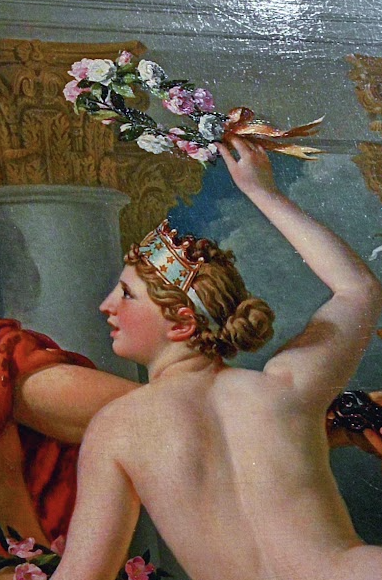
“One shouldn’t just look at the model, but should read it like a book.” This quote by the famous French painter Jacques-Louis David couldn’t be more opportune when it comes to characterize his own work. Indeed, a freshly set exposition at the Louvre, retracing his whole career as an artist and activist, is unveiling its captivating perspective on life and an undeniable talent, alongside a historical time-travel all the way to Antiquity where he drew his inspiration. However traditional, mainstream and excessively spoken of him and his work might appear, this exhibition did but prove this all wrong. The acknowledgment of him being a key figure in the French Revolution and a pre-romantic painter, as well as the popularity of very few of his compositions solely led to a well-known but unknown artist. Looking beyond the patriotic spirit that the Revolution and Napoleon stirred up in him, one can actually fully grasp the timeless aspect of his paintings. One discovers a touching sensitivity that resurfaces through the overwhelming gaze of Psyche and the teasing smirk of a cherub, or a die-hard humanity, be it in the dramatic astonishing fights between Romans and Sabins or the most discreet behaviors in the many portrayals he made. The latter brings a refreshing, lightening mood to the collection full of meaning. It does so by embellishing the most common day of one’s life, and picturing real, unfiltered and imperfect faces and realities, bringing not only a strangely comforting atmosphere to whoever looks at it, but also a deep realization of the very existence of these people, that once treaded upon the same ground.  Not only does he depict the “model,” but he indeed constantly strives for a deep understanding of it, well-conveyed to the observer, almost as a dialogue between people, eras, cultures and languages.This exchange, as one might call it, is in fact a leap backwards, a sneak peak into fascinating and foundational eras of history. Portraying myths and legends, representing real major events (or non-events), one does not only passively stare at the canvas, but actually learns alongside them. The observer knows from this point forward Brutus’ sons’ tragic fate, Romulus’ wife’s crucial role in the pacification of the Roman Empire, Socrates’ temper — and even reflects about dreaded dilemmas, such as the choice between the nation’s well-being or a close one’s life. These paintings appear indeed as heavily meaningful ornaments. Beauty is undoubtedly what comes to mind when contemplating most of the works. Nevertheless, it is merely a glimpse of what they contain. The eyes are pleased, but the soul is triggered, the heart flinching and the mind frozen. When picturing humanity with sensitivity, it also means picturing all of it: love, peace, courage, but also grief, terror, evil. It would be an understatement to say that it is hard not to shed a tear while looking at the portrait of a  13-year-old boy, dead because he enrolled in the revolutionary army to free people that never intended to do such for him. Its devastating impact on the spectator is enhanced by its unfinished state, highlighting a hardly sufferable violence, unrepresented,  maybe for the better. The death of Marat is not more comfortable to be around; made in three similar versions, they circle the visitor when he enters the dark room, conveying oppression, dread, horror and anxiety, underlining the price paid for peace.  So then, this exhibition did not allow only to readdress an influential yet unsung artist’s work, but also to dive back into an era, into feelings, into thoughts that one will probably judge as still relevant at any point of his life, be it academically, socially or personally. Even if the Crown jewels or the Joconde are worth your attention too, make the most of your passing at the Louvre to discover these gems and get a snippet of one unique mind in the revolutionary storm!

Ti’Péi, Gran Lamour

by Lu-Ann Pade

La nuit dernière tu m’es apparue en rêve.

Tenant dans tes mains l’étendard de la trêve,

Tu as signé l’armistice de cette guerre,

Triste reflet d’un combat solitaire. 

Comme une mère, tu m’as serrée dans tes bras,

Tel un linceul, marque de cette lutte qui s’effrite

Et qui meurt en même temps que mon embarras,

Marquant la fin de cet ère en laquelle tu étais proscrite.

D’où viens-je, qui suis-je?

Autant de questions ayant l’odeur du châtiment, 

Dressées sur un autel qui exige

De renoncer à son assentiment.

Alors laisse moi te vénérer.

Hurler en tous les mondes,

Plus acharnée, plus furibonde,

Que tu es celle qui porte mon passé, notre présent et leur futur.

Que le soleil qui se lève sur tes flancs,

Est celui qui m’a vu naître un matin.

Que ces peuples de l’Orient,

Que tu a accueillis sont les miens.

Fille du feu, des plaines et de la mer,

Fille de cette terre érigée d’un cratère,

Bénie par toutes les religions,

Péi de toutes mes passions.

This poem reflects on how I used to be ashamed of where I come from, how I used to discard it and paint my identity as having none. 

It is also about how I gave up on this act. 

Machado, “Champion of Peace”?

by Nil Topcular

Maria Corina Machado is the laureate of the 2025 Nobel Peace Prize, awarded to her for her fight for democracy in her native Venezuela. The ceremony will take place on Dec. 10 in Oslo, but Machado is currently in hiding and has only made two public appearances since July 2024, making it uncertain whether she will be able to receive her prize in person.

Machado is the leader of the Unitary Platform, an alliance formed by multiple Venezuelan political parties that oppose the rule of Venezuela’s current president Nicolas Maduro. She has been living in hiding due to the threats that she has received by the government. The threats started after her accusation that the 2024 presidential elections were fraudulent. Following this election, the government-controlled National Electoral Council declared Maduro’s third term, despite evidence provided by national and international organizations that the elections were undemocratic.

According to an ELLE article, Machado was exposed to the socioeconomic inequalities during her studies at Andrés Bello Catholic University. when she also volunteered in the low income neighbourhood of La Paredas, in Venezuela’s capital Caracas. She decided to pursue politics after college, seeing her country becoming unstable under the previous president Hugo Chavez’s rule. She ran for congress in 2010, and became one of the 65 opposition members in the National Assembly. 

Machado won the Peace Prize for her work promoting democracy in Venezuela. Following her win, she dedicated her award to the U.S. President Donald Trump, a figure who for many represents discrimination and repression. Trump has made many racist and misogynist remarks, has multiple sexual assault allegations, and his term is currently marked by strict anti-immigration policies. In an interview with Bloomberg, she voiced support for U.S. military intervention in Venezuela, and has expressed that it is necessary for a democratic transition in Venezuela. As the committee’s announcement salutes her fight for a peaceful transition to democracy, Machado has called upon military intervention. Here lies another contradiction: She fights against the oppressive regime in her country, but calls for the help of another regime which for many is oppressive. 

Machado has expressed her support for Israel in the ongoing conflict. She called Netanyahu to congratulate “the decisions he took during the war”. More than 67 000 Palestinians were killed in Gaza by Israeli forces.  “Today, all of the U.S. who defend Western values ​​stand with the State of Israel, a genuine ally of freedom,” as she tweeted in 2021. 

Machado is not the only controversial Peace Prize awardee. Previous laureates of the prize have also been criticised for their actions that are not always reflective of the award’s’ values. Barack Obama, for example, was heavily criticized because of his involvement in the war in Iraq and Afghanistan. The U.S. was at war throughout all eight years of Obama’s presidency. Machado’s win, like Obama’s, led to individuals and the media questioning the legitimacy and the meaning of such a “peace prize” – if working for, or even supporting peace is not a prerequisite, what does the prize mean?

Despite her controversies, Machado’s win was not entirely contested – many also celebrated her compensation. Particularly, as a recognition of women in the political sphere, and of opposition to authoritarianism. As of 2025, only 6% of current Nobel holders are women. Machado’s win was therefore congratulated by many women’s organizations, and media outlets targeted towards women. Machado is also the sixth Latin American and the first Venezuelan to be awarded the peace prize.

Furthermore, Machado has support in Venezuela. The New York Times conducted three polls that showed she is the most popular politician in the country, with more people accepting her leadership than not. According to Amnesty International, Venezuela has been in a deep political crisis for 10 years. Opposition is repressed, as seen in Machado’s case. There are also 853 political prisoners in Venezuela as of July 2025. Human Rights Watch states that there are arbitrary arrests, torture and even murder of political dissidents. In such a political climate, she is the main figure of resistance.

Nevertheless, her being awarded the 2025 Nobel Peace Prize has led to a debate: Should Machado be compensated for her efforts, even though she voices views that are contradictory to the name of the prize itself? She is a figure of resistance and freedom in her country, but supports regimes that are similarly oppressive to the one she is against. 

In the art world, there is also a long-standing debate about separating the art from the artist. Can we appreciate the work of an artist, even if we do not agree with their views or acts? Similarly, the question surrounding Machado comes down to whether we can separate her stance in Venezuela from her international views.