by Carmen Leong
Source: Tyler Jaewon Kim
The campus is waiting when I arrive that morning on my bike, daylight streaming through its glass walls into the quiet hallway. It’s a rare sight to see at ten A.M., but today is a special day — the Rentrée Solenelle, official welcoming ceremony for the incoming and returning students. Soon, they will arrive in batches from the different directions of the nearby dormitories, some dressed in colourful traditional clothing and others in suits and formal dresses. The familiar buzz of conversation will fill the air as they settle into the Grand Amphi to listen to guest speakers and performances; but for now, I enter the doors, go up the lift and head to the office at the very end of the hallway to meet one of the speakers before her speech.
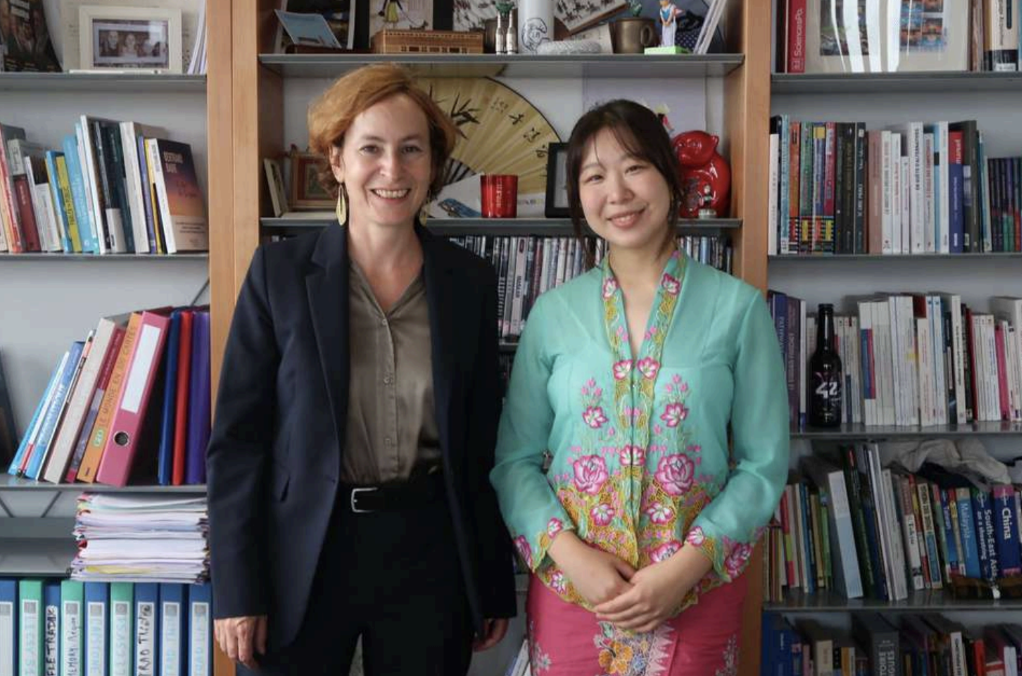
Professor Hauchecorne is there already, settling himself down after a staff briefing. I’m slightly on edge, not having done a proper interview in a few months. But then my interviewee walks in, and she pats her hair down, rearranging her well-tailored suit. Jeanne Lazarus greets me with a smile, and I feel at ease immediately. We shake hands and I lead her to her seat so that we can begin the interview.
It is not her first time in Le Havre, of course. Since becoming Dean two years ago, Madame Lazarus has come here twice a year as part of her duties to coordinate the campuses and organise the curriculum. It is common to hear complaints in Le Havre directed particularly at the bleak weather and even bleaker architecture, so I am pleasantly surprised when she compliments the modern look of our campus, and its position overlooking the sea.
“Also, I’m quite interested in the topic of the campus because I used to learn Chinese when I was in high school,” she adds. “And I did an internship in Taiwan for six months when I was twenty. So I used to speak Chinese, but unfortunately, I didn’t pursue it, and I wouldn’t dare to speak [it] now; but I’m still very attached to that region, to Asian Studies.”
In addition to her role as a leading administrator, Madame Lazarus has also been a sociology professor in Sciences Po for thirteen years; seven years of which she was in charge of the Introduction to Sociology course at the Nancy campus. Over the course of her career, she became the director of the Department of Sociology at Sciences Po and simultaneously an elected member — then president — of the conseil de l’Institut.
“And after all that, at one point, I thought that I really wanted to be more involved in the administration of Sciences Po, because I was involved in many ways, but more — I would say, on the side — as someone who could give some ideas or comments, but I really wanted to be in charge more. So that’s why I applied to become the Dean of the undergraduate college.”
So, why Sciences Po? I ask her. What makes our education stand out in the French and global landscape?
Madame Lazarus smiles and takes a breath. She must get this question a lot, I think.
“First, what is distinctive is the plural disciplinarity of Sciences Po — the fact that you don’t
choose too early to specialise on one topic. And that is a very strong choice, for the students as well, because it means that — compared to students who go to the university to study economics or law — you won’t have the same density in one topic. But what we think is that you will have, instead, an openness that will allow you to do whatever you want after having these first three years of general education.
“The second thing is the international view of Sciences Po,” she continues. “Sciences Po is one of the first French universities to [open itself up] to international students and international programs. The fact is that, in the bibliography of the courses you have here, you will read research from everywhere in the world. Also, of course, we have the third year abroad that opens students to other educational systems. We really cherish this international part of Sciences Po.
“And the third distinctive thing in Sciences Po is the fact that it is open to public life. Of course, with the parcous civique, but also with the fact that we have conferences open to the public, that our students are involved in many, many associations, initiatives… We want students to be, firstly, very good [in their] academics, but also to use their skills for the community — for others, at whatever level. It can be at a very local level, in associations; and also at national level, maybe.”
At this point, Madame Lazarus takes a pause, trying to find the words to convey her thoughts.
“I know we used to say that we are here [to teach] the students to become leaders. But I don’t really like that word, because I think that if you say that to people, then you will tell them that [being a leader] is for themselves, like you will be someone different from others. And I prefer to think that the students are going to be part of communities — maybe they will distinguish themselves, maybe they will lead some projects — but the idea that you are a leader…”
“Seperates them from the community?” I offer.
“Yes, and you have to, I think, be a little slower. To just think, first, that you will bring things to others,” she agrees. “You can also have a very good life not being a leader, but [just] being a part of something. It’s not only being a leader that is interesting.”
It is interesting to hear this from her when most top universities explicitly state otherwise — I recall writing numerous applications just over a year ago, trying my best to portray myself as a budding leader to gain better chances of admission. But Madame Lazarus has been involved in student life at Sciences Po to know enough about students and their ability to succeed beyond leadership. In fact, in 2001, she graduated as a Master’s student at the Paris campus. Back then, she tells me, the ‘internationalisation’ of Sciences Po had only just begun. Only the Paris campus existed, researchers numbered less than 50, and they had only just introduced the Conventions Éducation Prioritaire (CEP) programme.
“It’s much more aligned with the world now, I would say,” she concludes. I ask her if there’s any advice she may have for the incoming first-years.
“Well,” she begins, “really take what we as professors and administrators give you — which is a lot of knowledge, a lot of good research that is brought into the classroom; I think that it’s very important for the students to work on top of it, to make that knowledge their own.
“We know the abilities you have, so trust us, and work as much as you can to reach what we await from you. Sciences Po is more and more renowned in the world, and I think it opens many possibilities for us, of partnership and also research.
“We were asking ourselves before, are we a university, a school, an institute? We are sure today that we are a university, and we still attract students from everywhere. And that is very special in France, especially at the bachelor level, because it means that students at seventeen, eighteen years old, decided to cross the world to come here.
“We are in a very uncertain world today, so we need to reinvent ourselves. We have very good basics, and we can build on that, but we also need to think about what we have in front of us, which is a very difficult world to understand. But we have the resources for that. We have the students.”
Author’s Note: I would like to thank Madame Lazarus for taking the time to speak with me during the interview, and to congratulate her on the thoughtful speech she gave later on that day in the Grand Amphi.

 Le Dragon Déchaîné