by Nahia Onchalo-Meynard
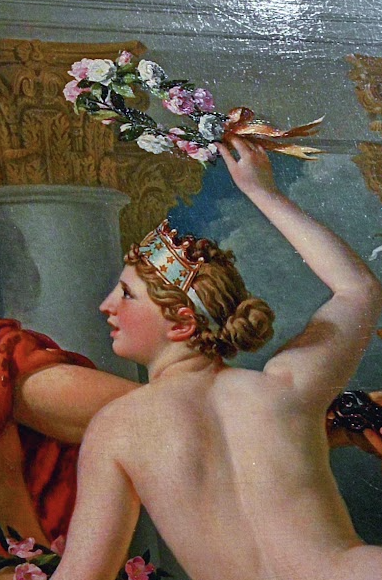
Image Credit: Nahia Onchalo-Meynard
“One shouldn’t just look at the model, but should read it like a book.” This quote by the famous French painter Jacques-Louis David couldn’t be more opportune when it comes to characterize his own work. Indeed, a freshly set exposition at the Louvre, retracing his whole career as an artist and activist, is unveiling its captivating perspective on life and an undeniable talent, alongside a historical time-travel all the way to Antiquity where he drew his inspiration. However traditional, mainstream and excessively spoken of him and his work might appear, this exhibition did but prove this all wrong. The acknowledgment of him being a key figure in the French Revolution and a pre-romantic painter, as well as the popularity of very few of his compositions solely led to a well-known but unknown artist. Looking beyond the patriotic spirit that the Revolution and Napoleon stirred up in him, one can actually fully grasp the timeless aspect of his paintings. One discovers a touching sensitivity that resurfaces through the overwhelming gaze of Psyche and the teasing smirk of a cherub, or a die-hard humanity, be it in the dramatic astonishing fights between Romans and Sabins or the most discreet behaviors in the many portrayals he made. The latter brings a refreshing, lightening mood to the collection full of meaning. It does so by embellishing the most common day of one’s life, and picturing real, unfiltered and imperfect faces and realities, bringing not only a strangely comforting atmosphere to whoever looks at it, but also a deep realization of the very existence of these people, that once treaded upon the same ground. Not only does he depict the “model,” but he indeed constantly strives for a deep understanding of it, well-conveyed to the observer, almost as a dialogue between people, eras, cultures and languages.This exchange, as one might call it, is in fact a leap backwards, a sneak peak into fascinating and foundational eras of history. Portraying myths and legends, representing real major events (or non-events), one does not only passively stare at the canvas, but actually learns alongside them. The observer knows from this point forward Brutus’ sons’ tragic fate, Romulus’ wife’s crucial role in the pacification of the Roman Empire, Socrates’ temper — and even reflects about dreaded dilemmas, such as the choice between the nation’s well-being or a close one’s life. These paintings appear indeed as heavily meaningful ornaments. Beauty is undoubtedly what comes to mind when contemplating most of the works. Nevertheless, it is merely a glimpse of what they contain. The eyes are pleased, but the soul is triggered, the heart flinching and the mind frozen. When picturing humanity with sensitivity, it also means picturing all of it: love, peace, courage, but also grief, terror, evil. It would be an understatement to say that it is hard not to shed a tear while looking at the portrait of a 13-year-old boy, dead because he enrolled in the revolutionary army to free people that never intended to do such for him. Its devastating impact on the spectator is enhanced by its unfinished state, highlighting a hardly sufferable violence, unrepresented, maybe for the better. The death of Marat is not more comfortable to be around; made in three similar versions, they circle the visitor when he enters the dark room, conveying oppression, dread, horror and anxiety, underlining the price paid for peace. So then, this exhibition did not allow only to readdress an influential yet unsung artist’s work, but also to dive back into an era, into feelings, into thoughts that one will probably judge as still relevant at any point of his life, be it academically, socially or personally. Even if the Crown jewels or the Joconde are worth your attention too, make the most of your passing at the Louvre to discover these gems and get a snippet of one unique mind in the revolutionary storm!

 Le Dragon Déchaîné