
by Hannah Schepers
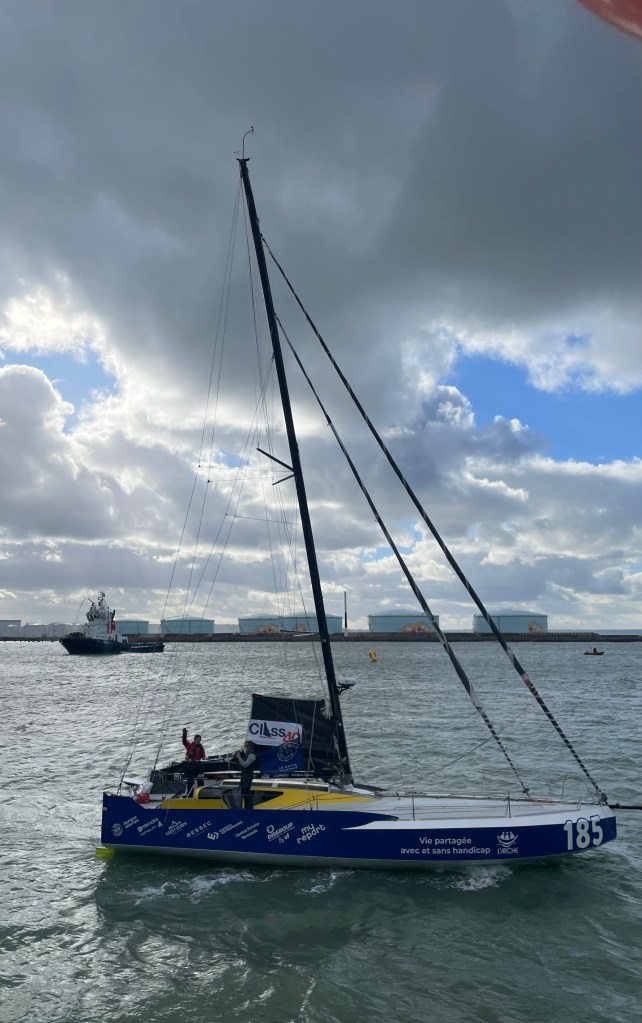
Image Credit: Hannah Schepers
Under stormy blue skies and cheered on by the public, the sailors participating in the Transat Café L‘Or have left the port of Le Havre on Sunday, Oct. 26. The boats will head across the Atlantic Ocean, towards the goal of this year‘s regatta in Martinique.
The city of Le Havre has hosted this race for the 17th time this year. The regatta was created in 1993 and retraces the route of trading ships transporting coffee from South America to Le Havre, the biggest port to import coffee in France. The sailors compete in teams of two to be the first to reach their goal in South or Central America, which is newly picked for every race.
With the race village set up right in front of campus, it has been quite hard for Sciences Po students to miss this event. During 10 days before the departure, the public was able to participate in several activities, learn about the regatta and admire the boats resting in the Bassin Paul Vatine.
Embarking on a journey of solidarity
Among the many competitors is the team of skipper Sophie Faguet (38) and navigator Nicholas Jossier (49) who are participating in the regatta for the second and third time, respectively. This year, they are sailing in cooperation with the social organisations L‘Arche en France and Ellye.
For this article, I had the opportunity to accompany Faguet and Jossier when entering the Bassin Paul Vatine on their boat, together with a group of residents of the newly founded community of L’Arche au Havre.
With a rumbling motor the boat leaves the port of Le Havre, for the short distance the sail will stay rolled up in its cover. We are not far out at sea but we are still met with a strong wind. I can only imagine how strong it will be on the open Atlantic.
While organising ropes on deck, Faguet tells me about her history in sailing.
She grew up in Normandy, close to the sea, and started sailing when she was still in primary school. What she likes most about this sport is the connection to nature and the feeling of true freedom: “You can go wherever you want.” Looking out on the open water lit up by the setting sun, I think I grasp the idea.
She participated in various sailing competitions for over ten years, becoming a full-time professional in 2019. Her next goal is to participate in the transatlantic regatta Route du Rhum in 2026.
When asked about challenges she faced, Faguet mentions the search for financial support from sponsors. In this race she and her teammate Nicholas Jossier are sailing in cooperation with Ellye, a non-profit organisation that is engaged in educating people on cancer affecting the lymphatic system; as well as L‘Arche en France, an organisation that works with people with a mental disability, to create more visibility and solidarity for these topics.
On the way to the Bassin Paul Vatine, she discusses the programme of the next days before the departure with the residents of L‘Arche au Havre. This cooperation started in 2024 when L‘Arche au Havre was still in development and Faguet participated in the Tour Voile, a regatta around the coasts of France, from the English Channel to the Mediterranean. In October this year L’Arche has celebrated its official inauguration, only a few weeks before the Transat Café L‘Or. The community consists of people with and without a mental disability who live together in a shared house, supporting each other in their daily lives.
We have nearly reached our destination when we pass in front of the Sciences Po Campus and enter the basin through the open bridge. Students leaving campus now will have to make a detour.
“[The hardest part is] making the right meteorological decisions for taking the fastest route,” Faguet explains. The sailing boats in the regatta are dependent on wind and taking the wrong route can cost their team precious time.
Especially this year, with storm Benjamin hitting France right in the week before the departure, the weather is not to be underestimated. The strong winds have overturned three trimarans in the English Channel that had already left on Saturday night, a few hours before the official departure. All of the sailors have been rescued, but they will not be able to continue the race.
Nonetheless, both Faguet and Jossier are optimistic: “[…] I am sailing with someone I trust completely,” Jossier states in an interview with Le Figaro Nautisme. “Our strength will come from our ability to remain united and stand by our choices,” Faguet underlines in the same interview.
The boat with the number 185 comes to a halt at the very end of the basin and our small group leaves the deck.
In the next days, Sophie Faguet and Nicholas Jossier will make their last preparations before leaving Le Havre to cross the Atlantic Ocean.

 Le Dragon Déchaîné