
By Carmen Leong
Just over a year ago, nearly two million people gathered in the central Freedom Square of Jakarta, waving enormous flags in a spectacle of red and white, but also green and black. They were rallying to express solidarity with Palestine, in light of the war on Gaza that had devastated the state and slaughtered thousands. It was one of the most significant protests for Palestinian resistance in Southeast Asia, said regional law and politics scholar Daniel Peterson. Our campus had had the privilege of inviting him to give a lecture on Indonesia and the Palestinian cause at lunchtime on 28 January, in which he outlined the principles and narratives driving Indonesia’s support of this vastly distant state.
Indonesian support for Palestine stems from its own history of anti-colonial resistance and humanitarian principles – the latter of which is stated explicitly in its Pancasila state philosophy. But the massive scale of mobilisation for Palestine in the country can perhaps best be attributed to the sentiment of Islamic solidarity resonating among its people for their brothers and sisters across an ocean. The significance of this relationship can be traced back to the 1955 Bandung Conference; it not only secured Indonesia’s political presence on the international stage, but also marked the country’s diplomatic and moral pledge to Palestine. Although some dissent exists – for instance, a 2017 BBC World Service poll recorded that 9% of Indonesian survey respondents view Israel positively – most Indonesians take a pro-Palestinian stance, motivating the Indonesian government to do the same. For instance, Indonesia has refused to entertain Israel during international sporting events, most recently with Indonesia being stripped of its hosting duty for the FIFA Under-20 World Cup due to concerns over whether the Israeli team could compete there without disruption. Even so, some critics have argued that Indonesia can do more to ally itself with the Palestinian struggle; even if geographical distance and limited military power restricts its ability to intervene directly in the conflict, Indonesia can welcome Palestinian refugees. At this point, Peterson paused and directed the question at our audience: do we think Indonesia will welcome Palestinian refugees?

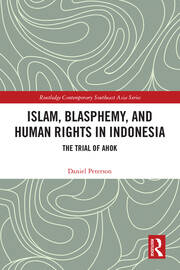
Image Credits: Melbourne Law School, Routledge Contemporary Southeast Asia Series
As LDD’s newspaper correspondent, I was lucky enough to catch him for an interview later that day, during which I asked his opinion on the very same question. His answer: it’s highly unlikely. There is firstly the argument that accepting Palestinian refugees is counterintuitive to the greater struggle; when refuting reports of Trump’s plan to relocate Palestinians in Gaza to Indonesia, the Indonesian Ministry of Foreign Affairs asserted that “any attempts to displace or remove Gaza’s residents is entirely unacceptable”, since “such efforts to depopulate Gaza would only serve to perpetuate the illegal Israeli occupation of Palestinian territory and align with broader strategies aimed at expelling Palestinians from Gaza.” Secondly, Indonesia has not had the best track record for taking in refugees, with Rohingya from Myanmar facing hostile pushback from local communities when arriving on Indonesian shores in recent years, due to fears of competition over scarce resources and an increase in crime and inter-ethnic conflicts.
Evidently, the Indonesian government must carefully take into account its domestic situation prior to undertaking any intervention in the Israel-Palestinian conflict. This could explain its continued reluctance to use the word “genocide” to describe Israel’s actions against Palestine – a point that Peterson brought up in response to a student’s question during the Q&A segment of his lecture. Given Indonesia’s own violent history, such as the 1965-66 massacres of members of the Indonesian Communist Party (although the anti-Chinese sentiment behind this event has been refuted by some scholars as a myth), it may not be politically expedient to directly accuse Israel of “genocide”, since the definition of the word also varies and genocidal intentions are difficult to establish. That said, the Minister of Foreign Affairs has arguably asserted the same sentiment, by stating that “Israel’s ultimate goal [is] to wipe Palestine from the world map.”
In light of Indonesia’s steadfast, justice-oriented stance against Israel in the ongoing dispute, some may question why it has not adopted a similar position against China, especially considering the allegations against the latter of being complicit in the persecution of ethnic Uyghur minorities in Xinjiang. To this, Peterson points to Indonesia’s significant economic dependence on China. Just recently in November 2024, Indonesia signed $10 billion in deals with China; it is also the highest recipient of Official Development Assistance (ODA) and loans from China among Southeast Asian countries. In contrast to Israel, with whom Indonesia has minimal economic ties, China holds far greater influence over Indonesia’s economy, requiring the country to carefully balance its stance on human rights with the need to cultivate favorable relations for economic and development purposes.
Daniel Peterson’s lecture provided me – and, I’m sure, many other students – with a deeper understanding of how cross-border movements shape international relations. I now have a greater appreciation for how governments must carefully consider their own internal tensions and domestic situation before formulating foreign diplomatic strategies, particularly in the case of Indonesia’s approach to the Israel-Palestinian conflict. Our team at LDD would like to express our gratitude to Dr. Peterson for taking the time to participate in the interview, and we hope that this article offers valuable insights to those students who were unable to attend the lecture.

 Le Dragon Déchaîné