
by Beau Sansoni
All images credited to the author.
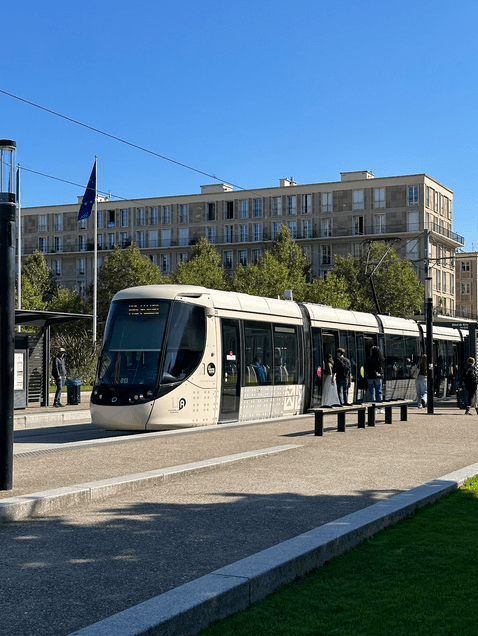
↑ Above: Standard Havrais Alstom Citadis 302
Le Havre was once a city criss-crossed by the tracks of railcars. All corners of the city would be reachable via these movable steel boxes, whether it be from the downtown to the upper city, or the docks into the suburbs. These trams would, with the beginning of the age of the automobile, begin to decline and die out as buses and cars dominated the streets. This had followed a worldwide trend, at a time of cheap gas, where countries could replace their ageing tram fleets with buses, or offload the costs to consumers through encouraging car ownership.
Le Havre, as many cities had, aimed to revive its tram network in the early 2000s. The clear aim of the network, which can be seen by analysing the route, was to bring the suburbs and city centre closer together. While it is not as extensive, each tram car is much larger than their early 20th century counterparts, allowing for decent capacity despite the smaller network.
The current network in Lines A & B extends to the upper city, past the chalk hills in the north of Le Havre. However it did not connect eastward, towards the suburbs and the older mediaeval towns past them. They were connected to Le Havre, though, not by bus or tram, but by a short train line which runs a singular carriage or two carriages along the line at a time. This line was known as the LER, or Lezarde Express Regionale, and it connected Le Havre to the ancient port at Harfleur, and the old abbey city at Montivilliers. It also connected you to a station at Graville in the suburbs, to l’Hopital Jacques Monod, and also, a few times a day, to Rolleville.
However, as of the 1st of September 2024, the line has been permanently closed, and replaced by a fleet of buses (specifically 11, 11 Express, and 21) which will ferry passengers to the old stations. The reason for its closure is for work on the third tram line for Le Havre: Tram Line C. Not only will it cover the old stations at Graville, Harfleur, l’Hopital Jacques Monod, and Montivilliers (but not Rolleville), but also new stations along the way and in the south-eastern Quartier de l’Eure.
The eastern and south-eastern sections connect at the centre through the Gare du Havre, merging with Lines A & B which were already running on the same stretch of track. For the future student of Sciences Po, this tramway will connect them to the rest of the city, and further to the Quartier de l’Eure through a station at Les Docks, on the same road as the nearby Twenty Campus. I’d argue it’d help students reach the University of Le Havre’s Crous canteen, however in the three years until it finishes construction, I would be surprised if there was not a local canteen for the campuses in this area.

Above: The LER operating at Harfleur
Regardless, the current plans are for a public inquiry, which may be occurring now, followed by construction works from 2025 to 2027, which will be when the city attempts to begin operations on the new line. The new line will open 17 new stations from Vallée Béreult, just east of the Quartier de l’Eure, towards les Docks and the Gare du Havre, before unmerging at the University and heading east past la Stade Océane and terminating at Montivilliers. The city claims this would amount to 14 kilometres of new railway track, which would service around 9,000 university students. These new stations would be paired with new amenities such as a net addition of 300 planted trees, alongside new bike (and car for some) parking at each station. They further claim that the carbon footprint of the project will be 80 times less than of someone taking their own car.
As someone who is interested in urbanism, I believe that this project will be beneficial to those who live in the areas to which this railway will go. It will help the city reduce its carbon footprint.
and expand the amount of areas that can be traversed without using a car. It will reduce journey times (supposedly 10 minutes from Gare to Vallée Béreult, and 25 minutes from Gare to Cité des Abbesses) across the city, and will allow for ease of transit for those unable to drive or those who are disabled. While not an expert, I do worry about the amount of traffic being ferried from three different tram lines using the same stretch of track from Université and Gare, and that it may lead to more delays. However, with improvements in signalling, I’m fairly confident in the smooth running of the system.
This article is dedicated to the times in which I took the LER into Harfleur and Montiviliers. While useful, it was at certain points of the day an underutilised line, and the aged stations showed the need for its modernization. It had been running since 2001 on the same route its predecessors had taken in the 20th century. This new line, which has been long in the planning, will serve not only this old route of the LER, but also future Sciences Po students and those in the suburbs in both the south and east. I would highly recommend a visit to the Le Havre Seine Métropole website in order to see a map of the incoming Line C route, along with renders of the new stations and further details on the plan.

 Le Dragon Déchaîné