by Fyodor Dmitrenko
Andrej Isakovic/AFP via Getty Images, Politico.eu
On my recent visit to Serbia in July of 2024, on the way from the airport to the centre of Belgrade alongside the stark Genex tower, I witnessed an interesting display. The highway to the centre was lined with small Serbian tricolour flags but also a stranger sight – that of a line of equally numerous blue flags with yellow stars.
While seeing EU flags in Paris or Bucharest wouldn’t be that strange, their presence in Belgrade mere blocks from the location of the Yugoslav Ministry of Defence Building damaged in the NATO bombings of 1999 seemed bizarre, especially considering many Serbs still feel lukewarm at best towards EU member states like Germany, France, and Italy who participated in the air campaign against them – a sentiment illustrated clearly by the fact that EU accession is still seen more negatively in Serbia than in their Western Balkan neighbours according to IRI, with 44% of poll respondents stating they would vote in favour of joining, compared to 89% in Kosovo and 92% in Albania more than 2 decades after the event. So, what was going on?
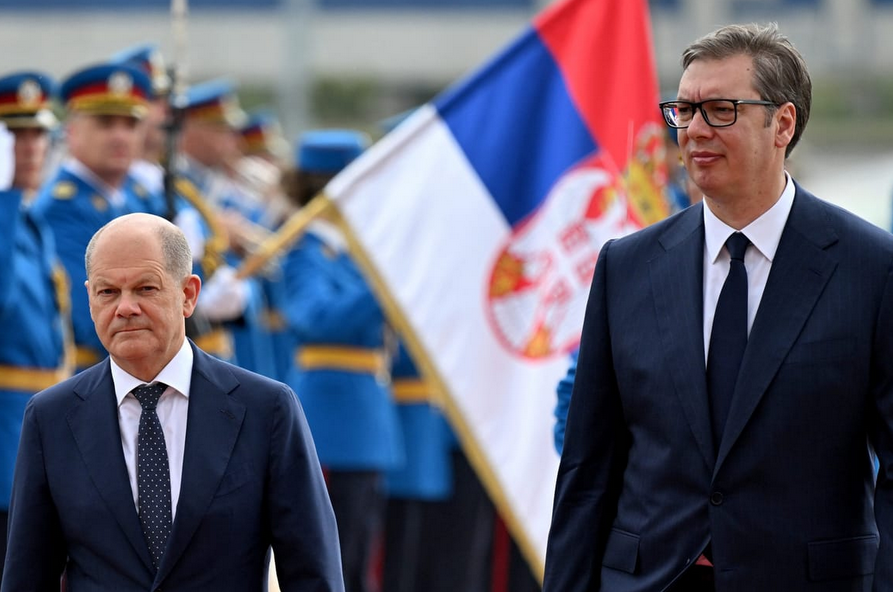
Unbeknownst to me, the flags had been put up for an interesting ‘trade summit’ on July 19th between German chancellor Olaf Scholz and Serbian President Aleksandar Vučić which led to the re-opening of the Jadar valley lithium mine project in Western Serbia by British-Australian mining and refining firm Rio Tinto. According to Reuters, this project could fulfill up to 90% of Europe’s current lithium needs, a material used in the manufacturing of lithium-ion batteries and thus critical to the Union’s aim of achieving net zero emissions by 2050. This also falls in line with other major EU objectives such as the current endeavour at securing more secure raw material procurement from partners – due to mistrust of Chinese suppliers and volatile supply chains owed to waning European influence in African nations like Niger – and playing catch-up to China and the US in high tech industries such as the manufacturing of electric vehicles.
I found the reopening of the mine project especially interesting given that less than 2 years ago, Serbia had shut down the project after mass protests over environmental concerns. The complete U-turn in policy has unsurprisingly raised eyebrows yet also revealed an increasing trend in Serbian politics – a desire to mend ties with the EU.
Despite the aforementioned mistrust towards the EU from the Serbian population (one further supported by a similar 2024 poll by Balkan Barometer), Vučić seems increasingly interested in developing ties, in large part due to the economic payoffs that these could yield.
The most prominent manifestations of this interest are Serbia’s repeated attempts to join the Union itself, with its first formal request being submitted on the 22nd of December 2009. The EU granted Serbia official candidate status in 2012 following recommendations from both the European Commission and Council to do so. A further step towards closer integration has come in the form of the recently ratified Stabilisation and Association Agreement (SAA) establishing a framework to bring the country into closer political and economic relations with the bloc.
The main drivers for this shift in policy appear to be the economic incentives offered by both membership of and outside forms of economic cooperation with the EU. For example, the EU has invested heavily in Serbia as part of official multilateral aid initiatives like the Instrument for Pre-Accession Assistance II (IPA II) – a financial policy tool used to support countries aspiring to join the union, with 1.5 billion Euros in grants being made available to the country between 2012 and 2022 according to the Delegation of the EU to Serbia, and significant private sector support for Serbia’s economy with the EU being Serbia’s largest trade partner with $4bn (13.2%) worth of its exports going to Germany alone in 2022 according to OECD data. Furthermore, without Serbia’s being a member of the Union, travel for Serbian nationals in the EU was made visa free from December 2009, with Serbia returning the favour shortly thereafter, making cross border exchanges significantly easier and thereby supporting labour migration and creating a system of remittances that have supported EU soft power in Serbia.
Another example of more symbolic political engagement with the EU has been Serbia’s toeing of the EU foreign policy line vis-à-vis the Russian war in Ukraine, a feat notable given Serbia’s initial support of the Russian annexation of Crimea in 2014. Serbia furthermore voted to suspend Russian membership of the UN human rights council in April 2022, a move which shows a general trend of Serbia’s distancing itself from Russia in favour of closer ties with the EU.
And yet cosying up to the EU doesn’t mean Serbia has abandoned ties with its traditional partners – if anything it has intensified them. This is especially true for relations with the People’s Republic of China (PRC). The root of the recent relationship stems from the 1990s when China supported SFR Yugoslavia which would later become Serbia against the NATO bombing campaign because, as Peking University and University of California San Diego graduate Dr. Suizheng Zhao points out, it saw the NATO-backed secession of Kosovo as a dangerous precedent that could inspire armed separatism in the provinces of Tibet and Xinjiang as well. The stance of China was further intensified by the destruction of the PRC embassy in Belgrade which killed 3 Chinese nationals, and injured a further 20 others.
Since then the two have cemented their relationship through political efforts including the affirmation of a strategic partnership in 2009, which was subsequently upgraded to a ‘comprehensive strategic partnership’ in 2016. This relationship and its origins were showcased recently by Chairman Xi’s visit to Belgrade in May of 2024 to commemorate the anniversary of the aforementioned NATO bombings that he said China will “never forget.”
More importantly however, China has invested heavily into economic cooperation in an official capacity with over US$10.3 billion in bilateral aid being provided between 2009 and 2021 within the China-CEEC (Central and Eastern European Countries) program alone – a whopping 70% of all spending within that initiative, and Serbia being the first country to sign a free Trade Agreement with China in October 2023, with 90% of products traded between the two parties being exempted from tariffs, 60% of which would be exempted as soon as the agreement came into effect on July 1st 2024.
In a more unofficial, private sector capacity, Chinese firms have also invested an estimated 5.6 billion euros into the country’s economy in the last decade according to an article by Forbes Serbia published in May 2024. The latter point is especially important given that according to the same report over 1,500 companies currently operating in Serbia are majority owned by Chinese stakeholders, with Chinese entrepreneurs being involved in numerous operations including mining (‘Zijin mining’ in Bor), heavy industry (‘Hesteel’ steel making plant in Smederevo) and automotive parts (Minth factories in Šabac and Loznica).
This is all excludes the significant foreign direct investment in Serbian infrastructure including but not limited to sections of the A2 Miloš Veliki Highway linking Belgrade with the south of the country built by publicly owned Chinese construction giants like Shandong Hi-Speed Group and China Communications Construction Company (CCCC). Cumulatively these investments (both public and private) make China the single largest investor in Serbia according to China briefing, rendering it unsurprising that the two are such cordial partners.
Interestingly, however, Serbia has not yet cut ties with its longtime ally Russia despite statements supporting Ukraine in 2023. While bilateral relations are less manifest in recent years than those with China and the EU (at least in economic terms), the two nations still share relatively cordial relations.
Perhaps the most significant reason for this enduring bond stems from a long history of shared interests and support, with the Russian empire being a firm supporter of Slavic and Orthodox nationalist movements in the Balkans against the Ottoman empire as early as the formation of Serbia and other Balkan nations under the 1878 treaty of Berlin.
This support would be expanded in 1914 with Russia entering WW1 in defence of Serbia against Austrian aggression, a fact that Serbs have not forgotten with Czar Nicolas being revered in Serbia as a canonised saint. Monuments distilling the centrality of Russo-Serbian relations in Serbia’s national imagination are plentiful, especially in Belgrade, in which there lie the Church of Saint Sava and a bronze statue of the Czar unveiled in November 2014, less than 100 m away from Novi Dvor, the seat of the Serbian President) in the centre of Belgrade.
While there was a partial break in relations between the two during the cold war due to SFR Yugoslavia wishing to exert greater independence from its larger communist ally following major disagreements between Tito and Stalin in 1948, relations would improve following de-Stalinisation yet remain tepid as Yugoslavia pursued a policy of non-alignment in the cold war, staying out of Soviet organisations like the Warsaw Pact and maintaining relations with Soviet rivals like the USA.
Despite this, the modern Russo-Serbian relationship would be restored and cemented due to the collective hardship endured by the simultaneous collapse of both states in the 1990s, and the NATO bombing campaign against Serbia which Russian President Boris Yeltsin called “open aggression,” according to an article by the BBC. This contributed to the development of strong bilateral relations – a trend that Vučić has worked hard to maintain despite his increasing EU alignment.
However the current relationship between Serbia and Russia rests not only on historical, but also economic and military considerations. Russia still comprises an approximate 3.95% of Serbian exports and 7.18% of imports in 2022, with crude petroleum being Serbia’s primary import from Russia, aiding in the diversification of Serbian energy sources and thus reducing its reliance on coal and hydropower. Moreover, the Serbian Armed forces use primarily former Yugoslav and Soviet military equipment and still purchase numerous weapon systems from Russian manufacturers due to their perceived reliability and similarity to weapons already in service. In this vein, Russia has also gifted Serbia several vehicles including 30 modernised T72 tank variants, 30 upgraded BRDM-2 reconnaissance vehicles and 6 MIG 29 fighter jets to facilitate military cooperation, further underscoring Russia’s vested interest in maintaining strong bilateral relations with Serbia through their combined military ties.
Given all of this information, why the idiosyncrasy? More specifically, why is Serbia trying to have a foot in all camps, a strategy which seems at odds with its strategic interests? The simplest explanation to this seems to be that Vučić is increasingly trying to leverage Serbia’s historical connections and geographical position at the centre of the Western Balkans to make Serbia a ‘middle power’ – a sort of geopolitical conduit and client state between the EU, Russian, and Chinese blocs while asserting Serbia’s independence and deriving certain benefits, such as diversified sources of investment.
Whether this will continue to work in the future is debatable, given the increasing polarisation of the world order into geostrategic blocs like those of the EU and China and its allies, each with their own (possibly competing) supranational structures. One day Serbia may be forced to choose a side, but for now it seems set to continue the balancing act, walking a tightrope between the national interests of Russia, China, and the EU. After all, why should a nation limit itself to one partner, when it can have its cake and eat it too?

 Le Dragon Déchaîné