By Rita Zeefal and Syontoni Hattori-Chatterjee
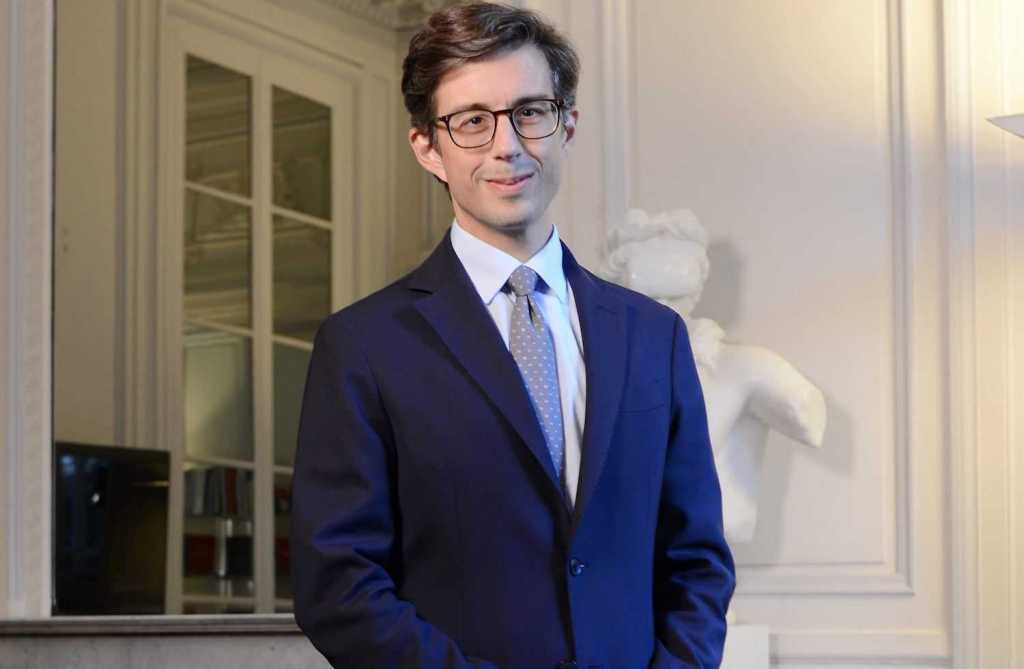
Image credit: Sciences Po
On Friday the 11th of October, journalists Rita Zeefal and Syontoni Hattori-Chatterjee from Le Dragon Déchaîne were lucky enough to have a few words with the new director of Sciences Po Paris, Luis Vassy, during his visit to the Le Havre campus. In the conversation transcribed below, Mr. Vassy shares insights from his diplomatic career and delves deeper into the foundational principles of his project for the school.
RZ: You have stated that your three years as French Ambassador to the Netherlands taught you of the importance of integrating democratic approaches to budgetary planning. And you stated that you would like to introduce this approach to the budgetary planning on campuses like ours too. Are there any other matters relating to the functioning of Sciences Po in which you would like to give students more decisional power?
LV: I found, during my time as ambassador, that the Netherlands was an incredibly participatory society. I think statistics show that they have among the highest proportion of young people who volunteer. There is also a culture of open dialogue, negotiation, and consensus. Even little children are trained from very early on to negotiate their way through life. There is also the whole Polder system that I admire a lot. And indeed, we all try to build on the experiences we’ve been able to have throughout life, and it’s true that my 3 years in the Netherlands as ambassador have opened me to this way of organising a community and a society and I think there are lessons, indeed, for the community like the one we represent. We have a chance to encourage the practices of taking responsibility and forging a culture of consensus and compromise.
So, among the ideas that I brought up in my programme, are those related to seeing if we could create these spaces where discussion and responsibility-taking could be developed. And I hope there are other ways of doing it, but I really strongly believe in that balance between responsibility and the health of a community.
SHC: Yeah. And sort of leading off of that as well, regarding your program and the manifesto that you talked about, and different types of more participatory mechanisms that take into account the diversity of our Sciences Po network and institutions, especially the regional campuses. We’re on one of them right now, of course. If you were to sum up briefly your 3 main priorities as director related to the regional campuses, what would they be?
LV: Well, as you know, there is work going on on the structure of the Bachelor. As I said in the program, I think the priority has to be to make sure that the competencies we develop for the students are completely in tune with the needs of tomorrow’s society – or even today’s society. I really think that there are fields where we can move forward and maybe even be leaders, for example, the kind of competencies students will need in a world that will be strongly dominated by AI. So as I said in another context, and it’s in the project, for example, I understand that from a cognitive standpoint, the capacities of synthesis and writing are very useful. At the same time, I believe that they are personal cognitive assets, but they won’t be professional assets so much in a world where AI will overtake, easily, some of the synthesis and writing part. But there are other maybe deeper, stronger competencies that we can look into.
And that’s why I propose to look into the scientific method in social sciences which will allow students to develop cognitive competencies that will be useful for them. I think it has to do with the ability to distinguish between true and false in a world where AI can actually create a grey zone or difficulties there. Students need to have the ability to go to original sources, the ability to develop hypotheses and challenge them, the ability to doubt, simply, and the ability to experiment and to find solutions to problems that are very diverse.
And the other aspect for the Bachelor’s, that all the candidates came to the same conclusion on, is the necessity to strengthen the common curriculum and the basic disciplines that are taught here in Sciences Po. Why?
Because I believe indeed that in a world, again, where so much knowledge is available digitally, there will be a huge advantage for one that is able to go pretty deep into issues so as to understand the bridges and links we can make between different disciplines when we look at a specific problem. And that means not remaining at the surface of things. It means going very, very deep into each discipline. Then, I also say I’m not a researcher. I’m not a pedagogue, so I will, of course, work on these issues with the whole community and see which kind of conclusions we can derive from this, let’s say, overall analysis.
But I also think there are lots of extremely interesting things to be done here. For example, there is the question of the identity of the campuses. I want to look into other ways of specialisation.
Regarding the geographical specialisation, I believe this development has enriched the Sciences Po community greatly, but the campuses also correspond to a state of the world at the beginning of 2000 where globalisation was a happy thing. And so you will conquer Asia in Le Havre, or you will conquer North America in Reims. There was a very optimistic vibe about the development of the regional minor campuses, which I think we can and should cherish.
But there are also new challenges that we can look into early. What I say here is not definitive – it’s an intuition rather than a definitive decision. But we should also look at having campuses that could specialise on things like climate change, the ecological transition, maybe on digital issues, maybe on international security issues. There may be other ways of looking into the specialisation.
This will be a very open discussion, but since I’m honest in general, I just wanted to share my intuition, let’s say, in these, in these first steps here.
RZ: Do you intend to institute reforms as sweeping as those of Richard Descoings? You mentioned that in the early 2000s globalisation was at the forefront of everyone’s minds. Now we’re 20 odd years on and questions like climate action and the regionalisation of the world are at the forefront of our minds. Do you think that you could react institutionally to these global issues in the way that Descoings did during his time?
LV: I don’t like the word “react” but yes, I think we need to adapt ourselves as we have done constantly over the past 30 to 40 years. Sciences Po is an institution that has always been dedicated to understanding the world as it is. It’s the motto.
The world of the end of the 1800s was not the same as the world of 1945 which is not the world of 1989 to the beginning of the nineties. And it’s not the same world as today. So as I said many times before, it’s true that we are coming out. We have already come out of a world of functional democracy and happy globalisation.
Clearly, the world in which you will have to thrive will be a different one with different challenges. And yes, I think we are at this point of the cycle where we need to readapt the curricula and the intellectual intent of the institution to these realities. That’s what I proposed in the program that got me elected. So I guess there is some support for doing that, and I hope to be able to now operationalise that into concrete decisions.
When I was a student here there was a course that was called Les Grandes Lignes de Partage du Monde Contemporain. It was really just a course on globalisation. One of the fascinating things I find is that it was created in 1989 before Richard Descoings by Lancelot. This means that this institution has always been able to sense very early on the coming evolutions of our time.
And I think that’s the spirit we want to continue – one that always has its eye on the future.
SHC: And finally for us on our end, especially in terms of reacting to the world, and students’ role in that. In light of current events and your first message to the Sciences Po community about them, you expressed your desire to safeguard students’ freedom of expression, within a context of respect for diverse opinions. Obviously, this is also a value very strongly shared by our student community. And so could you further define your vision of freedom of expression at Sciences Po? What’s its scope? What are its potential limits?
LV: I think the scope must be as broad as possible, and the limit is the one set by laws and our international regulations that do not have so much to do with the content of what you express rather than the way you express your opinions. And I think it’s always extremely important for everyone to be mindful of the fact that we are not isolated cells, in the world, that the way we express ourselves individually or collectively also has an impact on others. And so I want to make sure this is a concern that is raised, you have to reach out to students that feel that their opinions cannot really be expressed freely. So what I hope is to make sure that we have a consensus, because it won’t come from the director alone or from the administration, that we have a consensus within the community.
Our endeavour is to make sure that everyone feels safe to express opinions, freely. We live in a very polarised society, in a very brutal world. And so if there is one place where all this should be handled in a civil democratic, pluralistic, open way, it is Sciences Po.
Of course, there will be different opinions. There will be strong emotions. There will be difficulties at times. But if we are not able to do it here, I’m really worried about the state of our society. And I think we have a role, as a role model for the rest of society, to show that disagreements, even deep disagreements, can be handled in a civil manner within a democratic context.
We have this chance – to live here, in France, in a democratic society. Not everyone has that chance. So, let’s keep that in mind and try to have these values of openness, pluralism, ability to deal with disagreements live through us in the way we handle even political activism or, or expression of opinions. So that’s my, that’s my call for everyone..
I was really glad to be here in Le Havre today. It’s the first campus I have visited. I intend to spend one day each week on a different campus, so I can continue touring the whole Sciences Po.
Next week, I will be in another campus of Sciences Po. And so I will continue moving around and be in touch with the realities of the ground and make sure that we are just one community despite this geographical diversity we need to embrace, which is also a chance,and an opportunity that we need also, to make sure that we feel we belong to the same community, and I will be very attentive to it. And in the course of the day, we discussed, of course, very practical issues surrounding that theme, and then we tried to make sure that there is this sense of fellowship within the community.

 Le Dragon Déchaîné